Across the Universe, Across Campus
On Thursday March 8 an Eden Hall audience received a crash course in modern astronomy. Rice University professor of astronomy and astrophysics Reginald J. Dufour gave his presentation, “A Journey Through Space and Time,” on our most current knowledge of the cosmos.
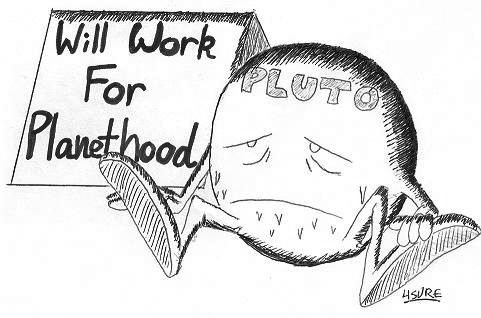
He started off with an encapsulated history of astronomy, starting with Copernicus’ discovery that the universe did not revolve around the Earth; Isaac Newton’s explanations for that, the physics of which helped inform the Industrial Revolution; and twentieth century discoveries that have expanded our notion of what the universe is. During a brief jaunt through our solar system, someone asked, “What about Pluto?” to which he replied that Europe and Czechoslovakia in particular had been lobbying for the old dog’s emasculation for awhile. It’s easy to see why: Czechoslovakia is no longer a country (it split into Slovakia and the Czech Republic in 1993); therefore, Pluto is no longer a planet. It’s only fair.
Dufour also said that one of the things he likes about Oregon (he’s going to retire here) is that the sky is “pitch black” and allows one to easily observe the stars. The audience got a good laugh from this.
There then followed some basic definitions of astronomical terms, from “sun” (“a large, glowing ball of gas that generates heat and light through nuclear fusion”) to “universe” (“the sum total of all matter and energy; everything in between galaxies”). The final section was devoted to evidence of the Big Bang, such as the residual background radiation found in space and the constant hydrogen/helium/deuterium ratio.
Is the universe going to keep on growing, or will it recollapse in on itself and start another Big Bang chain reaction? Don’t hold your breath. The universe will continue its expansion, Dufour said, and in a hundred billion years or so its energy will be utterly spent; no more blue stars, just some burned out shells and black holes. “Those of you who think you’ll be reborn in some future universe, you’re out of luck.” Sleep tight.
The lecture was organized by SOCC track coach and Astronomy enthusiast Dan Neal. “I wish it had been more basic because I wanted the general public to get as much out of it as I could,” he said. Because it was only about an hour in length, the presentation covered only what is known, not how, and as such the headier concepts may have been hard for a layperson to grasp. But regardless, “the information is good and he is always a great speaker.”
Neal wants to do a talk on the basics of astronomy next term, as well as have a night sky viewing session with some of the college’s telescopes. He said, “The college has some fantastic scopes.”