An End to Persian Aspersion
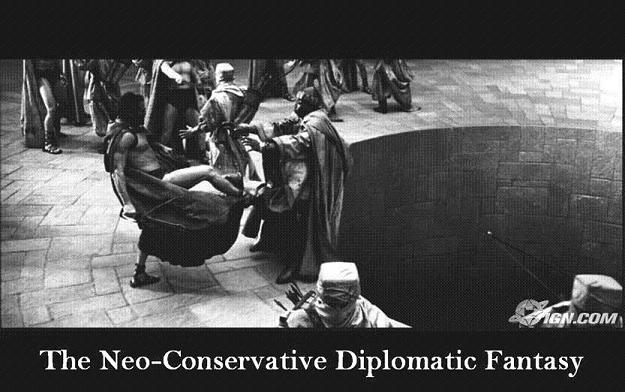
Yet the news lines were abuzz earlier this month with word that American diplomats were soon going to talk with representatives from these two rogue states. I thought Republicans voted for Bush in 2004 because they didn’t want a flip-flopper? Maybe Mitt Romney has a chance after all…
The situation with Iran was looking much analogous to the buildup to the Iraq war four years ago; instead of WMDs (Weapons of Mass Destruction, natch) that could go to international terrorists, the Bogeyman government was supposedly supplying IEDs (Improvised Explosive Devices) being used by Shia militias in Iraq. If you were only going by the letters in the acronyms and the countries’ names, you could be forgiven for thinking them one and the same.
But there are obstacles to starting a ‘glorious’ war against the Persians: the intelligence on Iraq’s WMDs was grossly wrong, for one thing. None of the “thousands of tons” of nerve gas and other weapons cited in the buildup to war have been found. The Bush administration has also conceded that their 2002 accusations of North Korea’s attempts to enrich their uranium were, essentially, dead wrong (the bomb they exploded late last year used plutonium) and have already haggled over aide and inspections with them. These intelligence failures constitute a large credibility gap when it comes to Iran’s stirring up trouble in Iraq, as well as, more importantly, its nuclear ambitions.
Our moral superiority since then has evaporated too; while film audiences are expected to be appalled by Persian brutality and applaud when the 300 Spartans desecrate the bodies of their enemies, viewers of our current theater of conflict have been mortified by the violence wielded not only by Sunni suicide bombers and Shia militiamen, but by the U.S.: extraordinary rendition and state-sanctioned torture just don’t sit well with most folk.
The administration has also had to cope with a number of different scandals, in the past month alone, such as the firing of eight attorneys who wouldn’t prosecute Democrat lawmakers before last November’s elections, public outrage over the treatment of returning soldiers at the Army’s Walter Reed medical facility, and Dick Cheney’s chief of staff I. Lewis Libby being found guilty for lying to the grand jury about whom he learned the now blown identity of a CIA operative from. Democrats in Congress, meanwhile, have introduced a plan to begin moving troops out of Iraq. The movie analogy , as seen by the Republicans, would be the queen being coercively shagged by the Senator in league with the Persians.
Iraq offers Bush just the slightest reprieve, as the 21,000 troop “surge” is having some success. According to the Iraqi Body Count, the number of weekly deaths has declined from 750 a week in early February to 450 a month later. There is also word that a number of tribes in the Sunni-dominated Anbar Province have turned against al-Qaeda and are beginning to resist. In the meantime Iraq has been rocked not just by continued (suicide) bombing, but by the public accusations of a Sunni woman who claims Shia policemen raped her. And while we ramp up troop levels, the British are starting to pull out; Prince Harry is to be deployed in May or June, so the obvious solution for them is to get out as soon as possible.
Good and bad news aside, though, it will take several months to know if the surge is really working, and its long-term success or failure will become most manifest when it ends; at some point the soldiers are going to have to leave, and by then Muqtada al Sadr and his thugs (many of whom we are training in the Iraqi police and military) will be tanned, rested, and ready not only to deal with Sunni insurgents, but to continue their campaign of ethnic cleansing in Baghdad and beyond, without U.S. forces to restrain them. Iran, where Sadr is said to be laying low, and Syria have considerable leverage on the various factions at work and at war in Iraq, and hopefully President Bush has realized that stability will only come with their cooperation.
But we’re not talking about confrontation and suicidal stands at Thermopylae, right? It’s all about diplomacy! So were the 2003 Iraq inspections, and we all know how that ended. A war with Iran right now would be the worst thing Bush could do, not only because with our military resources stretched so thin it’s literally impossible, but also because it would only strengthen Mahmoud Ahmadinejad’s power base. The Iranian president, in spite of his grand pronouncements that Israel should be wiped off the map and that his country has discovered an herbal cure for AIDS (or maybe because of them), faces growing unpopularity at home that likely contributed to his political allies’ losses in the December elections for Tehran’s city council and Assembly of Experts. Attacking Iran, a nation three times as large and populated as Iraq, would only strengthen his hand; if 9/11 taught us anything, it’s that foreign attacks will unite a people under even the most unpopular leader (and no, Bush is not as bad as Ahmadinejad, but you know).
Of course, the Iranian regime may well be playing us and the international community for suckers, baiting us with promises of cooperation in order to stall action that may be taken against them while they tinker with nuclear power and, presumably, an atomic bomb. Israel, with the intention of remaining on the global map for the foreseeable future, is probably not going to play along much longer; strikes on Iranian facilities, ala Iraq’s Osirak in 1981, are quite possible, if not inevitable. Iran casts a long shadow over the Middle East, however, and Hamas and Hezbollah can be counted on to make life very difficult for both the Israelis and our soldiers in Iraq if they were to be bombed. ‘What else is new,’ right? ...Maybe. But Bush’s “Bring ‘em on” comment was an open invitation for insurgents to kill our soldiers that was taken up with a literally religious zeal; do we really want to tread that bloody, corpse-strewn path again? The Islamists can surge just as much as we can, after all, and probably at a quicker pace too.
Unfortunately, the bold new diplomatic step has only thus far proven to be a baby’s. The much-touted meeting between diplomats, held in Iraq on March 1 with ambassadors from several other countries present, bore little fruit, just a “bland joint statement at the end of the conference” after a day of both sides leveling accusations at one another. But it is a start. And finally, it must be said: the Spartans did their share in the war against Persia, but they wouldn’t have been able to do it without Athens and its “philosophers and boy lovers,” of which today’s wannabe Spartans have a few of their own.