When Justice Just Isn't
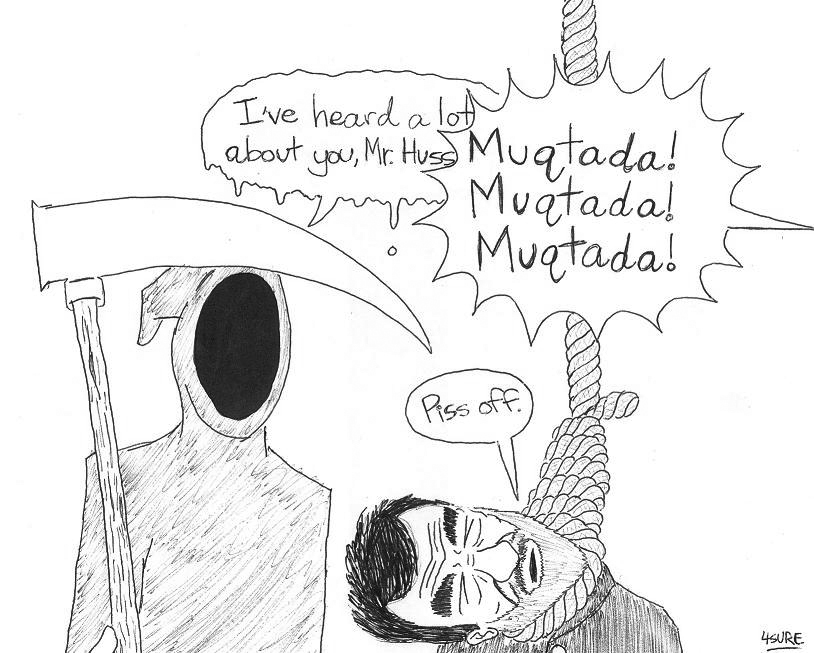
There are plenty of things that happened during SWOCC’s month-long Christmas hiatus, as well as things happening right now, for me to write about. Bush’s new plan to send a paltry (get serious or get out of the way, George) 20,000 troops to Iraq is one of them. But in following my muse I keep returning to Saddam Hussein; his corpse is nearly a month cold by now, but his trial and grotesque execution are worth re-examining, not only for their immediate repercussions but also for their underscoring the unfortunate truth that humanity’s worst needs better treatment.
The trial that resulted in Saddam’s death sentence was inherently tainted; how could it not be? In a country that had been systematically terrorized for two decades, how could anyone be expected to deal with such a case even-handedly? Obviously most of the world had made up its mind as to Saddam’s guilt, but that’s true of any high-profile case; look at Michael Jackson. A United Nations-sanctioned trial at the International Court of Justice at The Hague would have at the very least allowed for judgment by parties that had no personal stake in the case, something that cannot be said with a straight face regarding Iraq.
A U.N. court would also have been far removed from the violent sectarianism that has been endemic in Iraq since the bombing of a holy Shiite mosque in March last year. Saddam’s defense team repeatedly complained that they lacked protection, and the facts bore it out: three members of his defense team were assassinated by Shiite radicals. Supporters will say that he received a fairer trial than he ever gave anybody, but they would be advised to reconsider their rationale; is “better than Saddam!” really much of a selling point?
After a protracted trial, Saddam was sentenced to death for executing 148 Shiites after an assassination attempt. This is heinous, no doubt; but Saddam Hussein started a bloody eight-year war with Iran, waged a genocidal campaign against the Kurdish minority within Iraq, invaded Kuwait, and after losing the fight with U.S. forces manipulated the U.N’s Oil for Food program to pocket millions while his people starved. Executing him for the 148 people in place of the hundreds of thousands killed in the Iraq-Iran war and the Anfal (Arabic for ‘the spoils’ of war) campaign against the Kurds before having fully investigated the rest of his offenses is missing the bigger picture. That the court dropped the genocide charges after his death makes sense from a legal standpoint, but is a monumental slight to the Kurds. Saddam was in the midst of being tried for Anfal when the death sentence came. According to Iraqi law, an execution cannot occur on (religious) holidays, a rule bypassed by way of a loophole to the chagrin of U.S. officials and Iraqi Sunnis. Saddam was hanged on December 30, the first day (for Sunnis, of course; Shiites start the next day) of Muslim holiday Eid ul-Adha, which celebrates Abraham’s willingness to sacrifice his son Ishmael for God; do I smell symbolism?