Geneva Absolute
Ask anyone (be it a Republican, Democrat, Green, Libertarian, or Socialist) if he wants the U.S. to prevail in this so-called “War on Terror” and 99% of the time he’ll say yes. Most people don’t want to have more planes smashing into buildings, and most don’t want to live under a theocracy of any sort. The vast majority of people believe in the unalienable rights of life, liberty, and the pursuit of happiness spelled out in the Declaration of Independence. We’re all after the same thing.
So why all the bickering and infighting? Means of implementation. Whether it’s hippies or war hawks, ideologues like to frame an argument in order to proclaim themselves the final authorities on the subject, and to demonize any opposition to their point of view. So if John Kerry votes against an $87 billion supplement to the war in Iraq, then he’s voting against our troops.
Well, no. Kerry may have been wishy-washy, but he’s not ‘against the troops.’ For God’s sake, he fought in Vietnam. No, what he voted against was more blank check spending on a war that was not properly thought through when it was started and has been the cause of billions of dollars now unaccounted for.
Leftist types can be just as self-righteous, especially when it comes to the word ‘peace.’ Peace is a lofty goal, but not a means around which to base a foreign policy. Not fighting a war doesn’t automatically make someone diplomatic; he may just be complacent. Non-violence and disengagement may have been a good idea for Vietnam, but for the U.S. to stay out of World War II on the grounds that “war is bad” would have crossed the line of naïveté into the realm of stupidity. There are occasions when a nation is causing trouble and needs to be bitch-slapped back into place; Iraq just happens to not be one of them (at least not this time around). In past times of war our government has never been one for taking advice. It has gone to great lengths in order to more easily get its way, with the Sedition Act of 1918 during World War I and the McCarthyism of the Cold War 1950s. The Bush administration and its proponents, post-9/11, have stayed true to tradition and will dismiss any criticism on the grounds that it undermines the war effort.
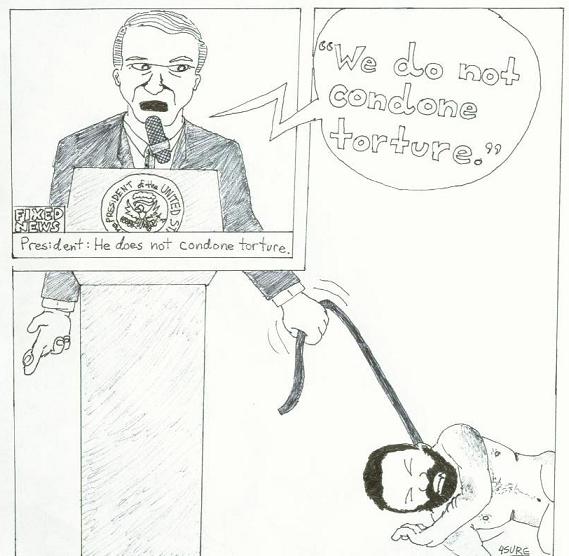 The most recent example of this is in regards to a provision in a bill soon to be voted on in the House of Representatives. The bill contains language which specifically forbids the use of cruel and degrading treatment by the CIA on terrorist suspects, particularly in the prison facility in Guantanamo Bay, Cuba; and in the use of extraordinary rendition, wherein a person suspected of having terrorist ties is detained and then flown in secret to another country (usually known for torture and extreme methods of extracting information) for interrogation, all without ever being charged for a crime. This is outlawed by the Geneva Convention, but because the suspects are not labeled prisoners of war but rather “enemy combatants,” (which are not covered by the Geneva Convention) the U.S. has conveniently gotten around the red tape that would result from POW status.
This should be one of those ‘Well, duh!’ scenarios where it doesn’t need to be stated that torture is reprehensible, but the White House insists they will veto the bill if it is passed, claiming the provision would impede their ability to wage the War on Terrorism. While they aren’t killing the messenger, they are still taking the position that their judgment is inherently the best. It’s not like this is some partisan Democrat legislature either; the bill sailed through the Republican-controlled Senate, being overwhelmingly approved in a 90-9 vote. The vote on the bill has been delayed, with some saying it is to momentarily spare the White House from another embarrassing public defeat, in the wake of Harriet Miers’ resignation and I. Lewis Libby’s indictment. Their stubbornness is made all the more shocking when one considers who drafted the provision: Republican senator John McCain of Arizona. For those of you didn’t know, McCain is a veteran who spent five-and-a-half years as a POW during the Vietnam war. He knows what he’s talking about when he says torture is wrong.
And it is. Advocates of Guantanamo Bay and extraordinary rendition say such measures are needed in order to gather information and prevent another 9/11, and they don’t follow the Geneva Convention anyway, so why should they be protected by it? The problem with the intelligence gathering rationale is that it does not work. Confessions can be extracted by torture, but they’re usually not true; detainees will say whatever their interrogators want to hear in order to stop their suffering, whether or not it’s the truth. Good information is gotten by forging a bond of trust with the detainee and offering incentives for cooperation. Several of those interrogated are released months later without being charged because they never had anything to do with terrorism to begin with.
One can make the argument that terrorists don’t deserve protection by international law, but it’s not a very ethical argument. We lose the moral high ground when we say ‘we shouldn’t care about international law because they don’t.’ Aren’t we supposed to be holding ourselves to a higher standard? The United States has always prided itself on leading the rest of the world by example, and acts of indefinite detention and torture set a dangerous precedent. If the greatest nation on Earth can get away with abusing its prisoners, whose place is it to say a brutal dictator can’t do the same? This has already started to happen; in 2002 Hassan Bility, the editor of one of Liberia’s most independent newspapers, was abducted by the Liberian government. According to the Human Rights Watch, “Copying both the U.S. administration's vocabulary and its disregard for the rule of law, the Liberian government announced that Bility was part of a terrorist cell and therefore an ‘unlawful combatant,’ refusing to produce him in court.”
Defense Secretary Donald Rumsfeld has complained that media coverage of the Abu Ghraib incident and other torture scandals is biased. He wonders why there aren’t any newspaper editorials about the beheadings which have gone on in Iraq. There aren’t (m)any editorials because we take it for granted that the terrorists are evil and no tactic, regardless of matter how dirty or morally reprehensible it is, is beneath them. We certainly hear it enough from our leaders. What we don’t hear is honest self-criticism from our government, which calls the Geneva Conventions ‘quaint’ and then feigns surprise when they find out prisoners are being abused and/or tortured. It’s up to the Iraqis to speak out against the brutal tactics being used by the insurgency (I cannot imagine very many of them supporting the bombing of children who are receiving candy from a soldier), and it’s up to us as responsible citizens to hold our leadership’s asses to the fire and see to it that there is some accountability when things like Abu Ghraib or Bagram happen.
I do not subscribe to the notion that “Killing for peace is like fucking for chastity,” nor do I believe “You’re either with us or you’re with the terrorists.” Both sides are just claiming moral superiority and trying to stifle debate because they don’t want to entertain the possibility that they may be *gasp!* wrong about something. Absolutism impedes meaningful discussion, and while discussion might not allow things to get done right away, at least it improves the chance of things getting done right.