Amphetamine of the Masses
Religion can make people do funny things, like killing
abortion doctors in the name of life or blowing themselves up to achieve
martyrdom. These things are funny, darkly so, because of their inherent
contradictions. Other things are made humorous by their apparent frivolity,
like when religious folk freak out about some negative media depiction. Humor
and tragedy are two sides of the same ironic coin, however, and so it is that
while on some base level it’s amusing to see the Islamic backlash against a
dozen cartoons, it’s also sad; both that some people took the time to go out of
their way to piss off a large segment of the world’s population, and that these
people are receiving death threats because of it.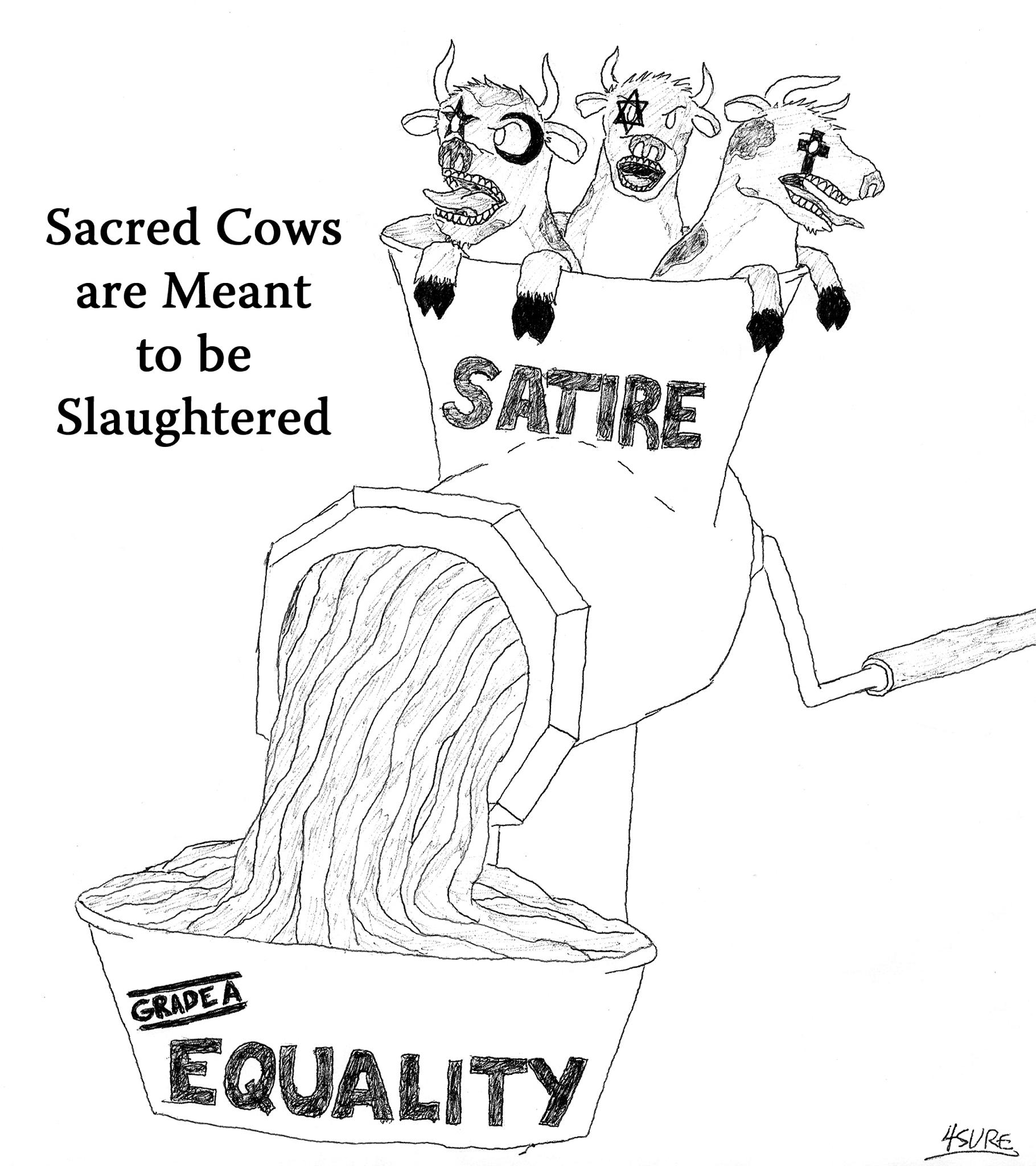
I’m speaking
of the September 2005 publication of twelve cartoons by the Danish right-wing
news daily, Jyllands-Posten. In
order to test the waters of self-censorship the newspaper commissioned twelve
artists to draw caricatures of the founder of Islam, the Prophet Muhammad. Any
sort of depiction of the Prophet, positive or negative, is forbidden by the
Quran as idolatry; while the caricatures would thus be offensive on their own,
they are made all the more so by the poor taste many were done in: the most
notorious of them has the Prophet wearing a lit bomb as a turban.
The rage sparked by these cartoons,
while initially small and localized, has since the end of January spread like
wildfire, thanks to both a Muslim group that brought the pictures to the
And just to prove that we can
be stupid and reactionary, an American conservative group is printing T-Shirts
with the turban-bomb caricature on them, in a ridiculous act of defiance with
the usual “or else they win” justification. The violent protests and spiteful marketing
of the shirts is just making things worse by reinforcing both sides’ negative
stereotypes of each other.
To be sure, there’s more to this
than a religious minority that’s too touchy. Many are seeing this as a reaction
not only to the twelve pictures, but also to a greater anti-Muslim sentiment
that pervades
Even more noteworthy is the fact
that a few years ago this same paper refused to publish cartoons of Jesus that
had been submitted to them because they felt their readers would be offended
and they wanted to avoid a controversy. So while they will turn down Jesus
caricature offers, they will not only publish cartoons of Muhammad, but actually
go out of their way and ask forty artists to do them.
Yet there is something naggingly
hypocritical about the Arab side of controversy as well. Are the pictures
offensive? Yes. Are they racist? To a degree; the turban-bomb picture likens
Muhammad, the founder of Islam, to today’s Islamic fundamentalists, suggesting
that all Muslims are terrorists, which they’re not. However, it’s hard to take
seriously the complaints of discrimination from people (like the Palestinians)
whose raison d’ et is to drive the Israelis into the sea. Anti-Semitic
cartoons are a fixture of Arab media, and it’s only escalated since this
incident began; an Iranian newspaper is now hosting a contest to find the
twelve best Holocaust funnies. What better way to demonstrate your moral
superiority than to set your standards of decency even lower?
Do these mixed signals excuse the
actions of the Danish paper? No, they don’t. As previously mentioned, the
editors knew that they were going to be disturbing a wasp’s nest and even
intended to do so. But therein lies the question: why do we consider the Muslim
world to be a wasp’s nest? Why is it a given that if Islam or its founder is
portrayed unflatteringly, regardless of whether it is an accurate portrayal,
there will inevitably be a violent backlash from its followers?
Christianity has had similarly childish moments in recent history: both “The Life of Brian,” “The Last Temptation of Christ,” and even “Dogma” ignited firestorms of controversy for their perceived blasphemy, which ultimately did little more than raise their profiles; the pilot episode for “South Park” featured a battle between Jesus and Santa Claus; proving himself to be an equal-opportunity offender, Bill Maher, in his book When You Ride Alone, You Ride With Bin Laden, prefaced his essay on the clash of Christian and Muslim civilizations with a painting that featured Jesus and Mohammad (sic) in a boxing match and read, “The Real Celebrity Deathmatch: Religion Can Be Dangerous.” The list goes on and on.
In spite of this, however, Christians have no qualms whatsoever with the iconography of their religion’s founder, as long as they are the ones selling it. Depictions of Christ have metamorphosed from Catholic décor into a veritable industry, with merchandise ranging from the curiously earnest (the crucifix) to the astonishingly kitschy (Jesus Inspirational Sport Statues. I kid you not.).
Even when the indignation has boiled over into violence, as was the case with “Last Temptation,” (with a handful of theater raids and a Molotov Cocktail fire) it’s been on a relatively small scale, and otherwise Christians have been reasonably good sports (so to speak) about having their Messiah lampooned. Not so with, say, the fatwa (religious bounty) put out on Salman Rushdie after he wrote The Satanic Verses, or the murder of Theo Van Gogh, a Dutch filmmaker killed in 2004 for his provocative short film Submission, about what he perceived as Islam’s sexist attitude towards women. Such incidents, along with the present caricature furor, serve only to discourage artists from criticizing Islam, whether or not the criticism is justified.
The whole
issue is a symptom of the larger problem of Muslim reluctance to modernize. I
don’t know a whole lot about history, but here’s what I do know: Islam appeared
on the scene about 600 years after Christianity began. Christianity began
taking up less of an all-important role in peoples’ lives starting with the
Protestant Reformation in the 16th century, and European life and
governance became much more secularized during the Enlightenment. Today
religion plays a much smaller part of public policy than it used to (Alabaman
judges notwithstanding). Since Islam never went through such a re-evaluation
(if it is to be judged on the same time frame, its reform is about a hundred years
overdue), it is still the rule of law in virtually any Middle Eastern country
you can find. These governments are assuredly part of the reaction to the
cartoons; the biggest incidents have been in police states, where the public is
very much oppressed, and the government has now funneled public resentment away
from them and towards the cartoon issue. How else do you explain an embassy
being burned down in a dictatorship like
Bottom line: if someone doesn’t believe the Prophet should be reproduced in picture form, then he shouldn’t; it’s tradition, it’s his business, whatever. But when he says that other people cannot do so because it offends his sensibilities, he is forcing his beliefs on others, and I see little distinction between that and Christians complaining about gay marriage being forced on them, as if they were actually being coerced into doing it. At the same time, the Danish press needs to learn there are better ways to go about criticizing Islam than by depicting its founder with a halo replaced by a lopsided crescent made to look like devil horns serves no purpose; such an affront, while insensitive and just plain stupid, does not merit the offender having his head chopped off. A clash of civilizations, if that’s what we must refer to this as, suggests that both sides be civil, after all.