"All-Knowing Being Changes His Mind. Film at Eleven."
Case in point: the recent discovery and translation of The Gospel of Judas, a text dating from the second century and once circulated amongst the Gnostics, one of the competing sects of Christianity in its early years. The emerging Catholic Church dubbed this and other such Gospels, such as that of “doubting” Thomas and Mary Magdalene, to be heretical. It depicts Judas Iscariot engaging in private conversations with Jesus Christ and being told that, by selling Jesus out to the Romans and helping to accelerate the freeing of Christ’s soul from his body, he will become greater than any of the other disciples.
Mayhap in the afterlife things panned out that way, but here in our terrestrial reality he has been, with the exception of those crazy Gnostics, universally vilified. Italian (Catholic) poet Dante Alighieri, in his seminal Divine Comedy, consigned him to the lowest circle of Hell for treachery against masters and benefactors, where his body is to be flayed and his head chewed by the center of Satan’s three heads for all eternity. His name has thus become synonymous with deceit. Hey Judas, they’ll take it bad.
This ‘Judas problem’ (which could apply to Lucifer, Cain, or any other of the Biblical villains, particularly the traitors) has always bugged me, and it seems it has perplexed many philosophical thinkers throughout history. Jesus’ crucifixion is the centerpiece of all Christianity, and without Judas’ ‘betrayal,’ it would never have been possible. So did Judas really go to Hell for what he did? After all, God is omnipotent, and nothing happens without His prior approval, so how can anyone, especially someone so key to the crucifixion, have something like that held against him, if God gave the say-so first?
This new ‘revelation,’ in my eyes, could do a lot to clear things up… but it won’t. People won’t let it. To many, suggesting that their savior orchestrated his own capital punishment to set the stage for his resurrection is that rapper on The Sopranos hiring Bobby to shoot him in the thigh to boost his record sales. The point is, Christ has never been known as being manipulative, and most would like to keep it that way: black and white, plain and simple.
Humanizing Judas was kept out of official scripture. Other concepts were arbitrarily introduced and sometimes discarded. Purgatory was invented as a way of making money off the laity with indulgences, and good old Dante devoted a whole third of the Comedy to it. In the Inferno, the first circle of Hell is Limbo, wherein unbaptized children and virtuous Pagans go for not having an opportunity to know God. Canto IV is easily the cheeriest section of the Inferno, but Pope Benedict XVI of the Catholic Church has spoken recently of abolishing Limbo entirely. Why? It’s just not an attractive doctrine, especially to potential converts – Catholicism is spreading like the plague in Africa and Latin America, where infant mortality rates are particularly high – and who wants to deal with that, especially when competing with Islam and Mormonism, the two fastest-growing religions in the world?
Both of these faiths have a gung-ho mentality about the infallibility of their holy books, The Qur’an and The Book of Mormon, bordering on paranoia. As I wrote a few months back, Salman Rushdie was forced to deal with a fierce Muslim reaction to his book The Satanic Verses; not for the book itself (it’s fantastic) but for the episode in Islamic history from which the title and an extended sequence in the book are drawn from.
During Islam’s formative years, Muhammad faced stiff resistance to his new religion in Mecca, which was still a polytheistic community. The story goes that in order to make peace he received word from the angel Gabriel that the three pagan goddesses al-Lat, al-Uzza, and Munat were legitimate deities; he then recanted, claiming that Satan had deceived him and given him the verses, which were later amended. The suggestion that the Prophet could be tricked and humbled (read: human) is anathematic to many a Muslim, hence the outcry against Rushdie.
The Church of Jesus Christ of Latter-Day Saints has its own built-in system of augmentation: the Prophet of the church is designated to receive instruction from God, which has usually been whatever course of action is politically expedient. Most of this happened with its founder, Joseph Smith, but he left his mark, no doubt. LDS theology started off simply being a narrative of Jesus preaching to an American offshoot of an Israeli tribe, and then through ‘revelation,’ the church restructured Heaven to have three tiers (Telestial, Terrestrial, Celestial); legitimized and later condemned polygamy; and lifted the ban on black males from joining the priesthood. The path to Paradise is difficult indeed to tread, when the roadmap is undergoing such frequent revision.
In the various denominations of Christianity, which don’t have the centralized organization as the Catholics and Mormons, the attitude towards various social issues has frequently changed with the times, usually in a more liberal direction. The enslavement of the African people was justified for centuries with the Biblical story of Noah’s son Ham being cursed to father a race of servants (starting with his son Canaan), after seeing his father drunk and naked. After the Civil War and (especially after the Civil Rights Movement), that idea was pushed far away from mainstream Christian thinking. This liberalization is true for other social issues such as homosexuality, and even abortion, to which the more conservative groups would say, “They’re not real Christians.” *sigh*
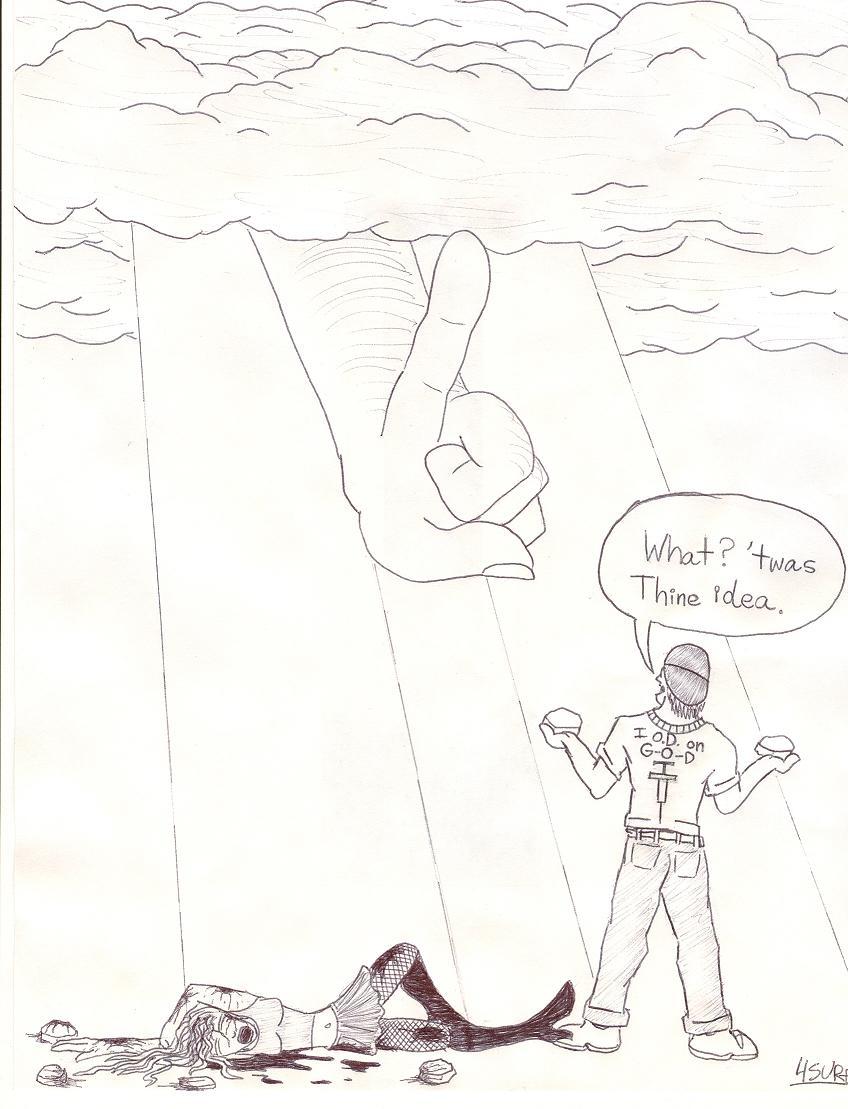 The very idea of the coming of Christ is a flip-flop of unfathomable magnitude. Here we had an Old Testament, about a fiery, vengeful God that lays down an endless number of sins and what offerings to give to make up for it. What good is there in laying down this multitude of rules when they only have a shelf life of a few thousand years? The whole spat between Cain and Abel over their sacrifices could have been neatly avoided if The Man had just told them, “Hey, you don’t need to burn up your hardest-won crops and livestock for Me; I’ve got Someone coming down in a couple millennia, He’ll take care of this whole sin and sacrifice business.” All of a sudden there was The Lamb of God in place of an actual lamb, and endless atonement and capital punishment went out the window. Get it right the first time, Thou damn it!
There’s nothing wrong with someone re-evaluating his beliefs, especially in light of recent discoveries and developments. In fact, to not do so would be stupid in the truest sense. But to say a religion, a church, whose official stance on “the issues” has changed to adapt to modern times, is the absolute authority on matters of faith, which by their very nature cannot be proven, is ridiculous. There’s no doubt as to the authenticity of the Gospel of Judas manuscript; experts have dated it to be from between 220 and 340 A.D. But people will naturally shrug it off as some silly cult artifact and probably take the early church’s word for it, because they were just so knowledgeable 2000 years ago; who are we to question?