|
NET PAKISTANI
Kid Zone
Cosmetic
Surgery News
Dental Cartoons
FIRST
DENTAL VISIT
BABY
BOTTLE
BAD
BREATH
FLOSSING
TIPS
ORAL HYGIENE FOR
CHILDREN
PREGNANCY GINGIVITIS
SMOKING AND
ORAL HEALTH
SPECIAL BRUSHING
AND FLOSSING AIDS
THUMB SUCKING
TOOTH
SENSITIVITY
TOOTH
GRINDING
TEMPROMANDIBULAR
JOINT /MUSCLE DYSFUNCTION
INTERESTING FACTS ABOUT
TOOTH PASTE
TRIGEMINAL
NEURALGIA
DENTAL
EMERGENCIES
MINI
DENTAL IMPLANTS
Millions of Pakistanis could benefit from
orthodontics to prevent oral health problems as well as enhance
their appearance and self-esteem.
Find out more about Orthodontic.
|

Orthodontic And You
Orthodontics and You
This web page is designed to
help you - the parent, or the patient, to have a better
understanding of orthopedic and orthodontic therapy. It covers
such items as diagnostics, treatment time, and cost, and provides
many helpful suggestions.
|
|
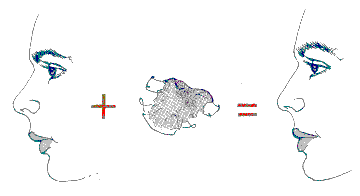
Orthopedics
To the lay person the name
maxillo-facial orthopedics can be very confusing. In simple
terms it means changing the size, shape, and relationship of the
bones of the face and jaws. In most cases this correction can
be accomplished with functional removable orthopedic appliances as
opposed to surgery.
Lost or
destroyed appliances will result in an additional laboratory
charge.
Orthodontics
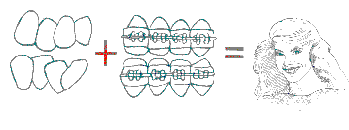
Most of us understand that the
term orthodontics means the movement and correct alignment of the
teeth. This change in tooth position is usually best
accomplished with fixed or permanent braces.
Unfortunately,
removable orthopedic appliances can make remarkable corrections in
the patient's bony problems, but they do not align the teeth
well. Conversely, fixed conventional braces can align the
teeth quite nicely, but they have difficulty correcting bony
problems. It is for these reasons that your dentist may use a
combination of both of these techniques to properly solve a
problem.
New invisible
porcelain braces are available to make the orthodontic portion of
the treatment less obvious. There is, however, an additional
cost for this type of orthodontic appliance.
|
|
Diagnosis
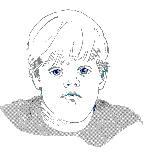
The first step in treating your child is to fully
understand the nature of the problem. In order to arrive at a
proper diagnosis the dentist will take a series of records.
These include study casts of your child's teeth, photographs of the
face, x-rays of the teeth and jaws, and a single x-ray of the skull
called a cephalometric radiograph. |
 |
|
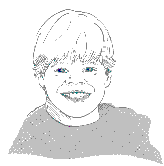 |
Once the doctor has all of this information,
he or she can diagnose the exact cause of your child's problem.
It is important for you, the parent, to understand that the
improper alignment of dental units is usually more complex than just
"crooked teeth." The dentist must not only straighten the
teeth, but must also establish balance and harmony within the jaws,
face and the temporomandibular joint.
|
Treatment
The exact type of treatment
that will be required to correct your child's problem will obviously
depend upon the information that was gained from the
diagnosis. However, we can divide therapy into four
categories. They are functional orthopedic therapy, extraction
therapy, surgical therapy, and fixed appliance therapy. In
order to eliminate confusion, let's briefly define these four
concepts of treatment.
Functional Orthopedic Therapy: When a removable
orthopedic appliance is used to correct jaws that are growing
improperly. A different form of appliance may be required to
treat different growth problems.
Extraction Therapy:
When the removal
of permanent teeth is required in order to correct an orthodontic
problem. This technique is used very selectively as it is
usually in the patient's best interest to maintain all of the
permanent teeth if possible.
Surgical Therapy: Just as the name implies, this procedure is reserved
for those patients whose bony imbalance has progressed to the point
that only surgical intervention can correct the
problem.
Fixed
Appliance Therapy: This is the conventional appliance technique using
fixed braces. The appliance is attached to each individual
tooth for precise positioning of the teeth. It should be noted
that quite frequently two or more of these techniques are combined
in order to achieve the desired results. Your dentist will
explain to you the type of treatment that can best correct the
patient's problem.
|
Who is Responsible?
The treatment of your child is
a cooperative effort. It is very important that everyone
involved understands his or her responsibilities in order for the
treatment to be successful. Also the overall cost of the
therapy is directly related to the child's
compliance.
|
- The Dentist
- The role of the dentist is to recognize the patient's problem
and to select and apply the appropriate therapy.
- The Patient
- It is the patient's job to faithfully wear the appliance and to
follow the instructions of the doctor.
- The Parent
- It is the responsibility of the parent to see that the child is
wearing the appliance and following the appropriate instructions
of the doctor.
|
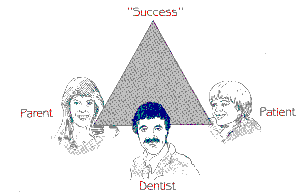
| This relationship is called the "triangle of
success." When everyone does their job correctly, the results
will be astounding. |
|
|
Let's Get Under Way!
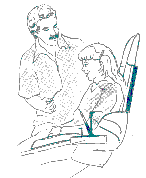 |
Now that we have a basic understanding of the
problem and the treatment, let's get down to the "nuts and bolts" of
every day therapy. Most cases require between two and three
years of active treatment to correct. This means that
discipline is important. All appointments must be kept.
If you fail to keep appointments, then the treatment will be
longer and more expensive for the patient. No one is a
winner. If appointments and instructions are honored then the
treatment goal is obtained quicker, easier, and cheaper.
Everyone benefits. Don't forget the triangle for
success!!!!! |
|
Removable Orthopedic Appliances
We have already stressed the
need for cooperation. Beyond this there are some pointers that
can be very helpful.
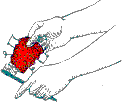
Cleaning: Both the appliance and the teeth
must be cleaned regularly. Any of the commercial denture
cleaners work quite well when used on a daily basis to clean the
appliances. However, some patients will build up a white
coating on the appliance that is difficult to remove by
soaking. "Lava" soap and an old toothbrush will easily remove
this deposit. Be Careful!! Do not bend any of the wires
while brushing the appliance. |
 |

|
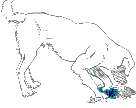
Lost Appliances: Most removable appliances are
lost as a result of the patient removing them for eating. An
appliance box with the name and address of the patient is furnished
by the doctor. If, however, the appliance are not placed into
the box, they can easily be lost. The patient or parent should
never wrap the appliance in a tissue or napkin. If this occurs
they are easily discarded as trash and lost forever.
Appliances are no different than eye glasses. They must be
properly cared for!!! A second major cause of loss is the
household dog. Dogs love the smell and taste of an appliance
after it has been in a patient's mouth. They will chew on it
or even bury it much like they would a bone. Keep the
appliance and the box well out of reach of the family pet!!!
If an appliance is lost or destroyed the doctor must pass the
expense of replacement on to the patient or parent. Appliance
therapy is not extremely expensive if patients and parents are
responsible. |
Fixed Appliances
The most important fact to
remember about fixed appliance therapy is hygiene. If the
patient does not keep the appliances clean, either decay or a change
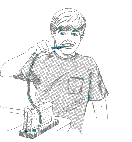
in tooth color will result around the braces. The patient must
brush after every meal being careful to clean around each individual
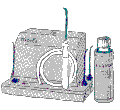
tooth. In addition, an irrigation cleaning with fluoride
should be performed after breakfast and just prior to bed. The
standard plaque controlling fluoride mouth wash can be added to the
water reservoir or used after irrigation. If these rules are
observed, no damage will occur to the teeth or gums as a result to
orthodontic therapy. A second major factor in appliance care
is diet. Orthodontic appliances are very delicate instruments
and can be easily damaged by improper diet. |
Sticky foods
such as gum and candy must be avoided. In addition, hard items
such as ice, nuts, or chips can break the appliance away form the
tooth. Common sense dictates that careful attention to eating
habits can speed treatment and reduce the cost of orthodontic
therapy. If elastics are required as part of the therapy, they
should be worn exactly as requested by the dentist. All rubber
bands should be exchanged for new ones every twelve hours. If
the rubber band supply becomes low, please contact the dental office
for an additional supply. |
|
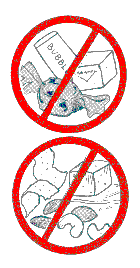
Watch Your Diet!
|
- Avoid
Sticky Foods
Candy
Gum
- Avoid Hard
Foods
Ice
Nuts
Chips |
|
Retainers
There are a number of different kinds of
retainers. The doctor will select the particular type of
retainer that is best suited for each patient. No matter what
type of retainer that is used, it is extremely important that it be
worn according to the doctor's recommendations. Everyone has
too much invested to let a few careless months spoil the
results. Don't Forget that triangle for
success!!! |
|
Common Questions
As with anything that is new
and unfamiliar, many questions always arise. The following are
the most common. If you do not find an answer to your question
be sure to ask the dentist. The more that you understand about
the treatment, the better it will progress.
- Q
What causes the problem in the first place?
- A No
one knows the exact cause of every orthodontic problem. Some
causes are very evident, such as thumb sucking. Most are
much more complex . However, the old cliche' that the
patient inherited daddy's teeth and mother's jaw is simply not
correct.
- Q Why
do my child's teeth look so large?
- A The
teeth do not change in size once they are formed. In a
normal relationship the face and jaws grow fast enough to
accommodate the erupting permanent teeth. It is when this
balance becomes disrupted that orthodontic problems start to
occur.
- Q Are
teeth ever actually too large for the patient's
mouth?
- A
Yes. However, this is not a common occurrence.
Incidentally the teeth can also be too small for the patient's
face and jaws as well.
- Q Is
early treatment always best?
- A Not
necessarily. If the patient's problem is growth related then
it certainly is wise to begin therapy early. The majority
of problems fall into this category. However, if the problem
is simply "crooked teeth", the dentist may advise you to delay
treatment until all of the permanent teeth have developed into the
mouth.
- Q Can
my child be treated with only removable
appliances?
- A Not
usually. Sometimes all of the permanent teeth will
correctly align themselves following orthopedic therapy.
Everyone should be prepared to complete the second phase of
treatment which is orthodontic therapy with fixed
braces.
- Q
What will the treatment cost?
- A In
most situations the doctor can provide you with a reasonable
estimate of the expenses involved. If you have any questions
regarding the fee by all means ask the doctor.
- Q
Will my insurance cover the cost of braces?
- A As
with all insurance the amount of coverage will vary from policy to
policy. Most policies have a maximum age limit as well as a
maximum "life time" total. The average insurance policy will
usually pay about 40% of the total amount with the patient being
responsible for the remainder. Be sure and consult the
information booklet that came with your insurance policy for
specific details.
- Q Do
children "talk funny" with appliances in their
mouth?
- A
Only for a short period of time. The speech pattern will
quickly adapt to the appliance when they are worn full
time.
- Q
When can my child take the appliances out?
- A
Only when eating and brushing. There are certain exceptions
such as singing in a choir, but these should be discussed with the
dentist. There are also certain malocclusions that it's best
to eat in the appliances.
|
|

It's the goal
of everyone concerned to create beautiful smiles, beautiful
faces,and teeth that will last a lifetime. The time and
expense that is required to attain this goal is a nominal investment
compared to a lifetime of rewards.
|
|
| |
