 |
|
|
 |
 |
 |
| The Seokguram Grotto was constructed in the 8th century and forgotten about due to the suppression of Budhism . It was rediscovered in 1909. It contains the seated Buddha looking toward the East Sea (Sea of Japan). At the time, the Japanese occupied Korea. If they had had their way, the Buddha would be in Japan. However, locals were extremely uncooperative and the plan was abondoned (Way to go, Korea). The grotto was carved out of the mountain. Walking inside is really quite amazing. The Buddha is huge. Seated in the alcoves are his helpers and devils are carved in the walls. Of course the whole display is protected by a glass shield. Taking pictures is against the rules. The only complaint we had was the number of people inside the viewing area. It really is difficult to feel the majesty of the secluded grotto with the serene statue while surrounded by a mass of people. |
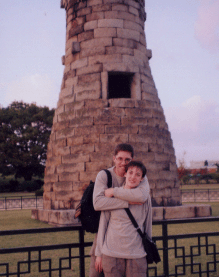
| The Cheomseongdae astronomical observatory was constructed between AD 632-46 by order of Queen Sondok. It looks simple, but don't be fooled. The 12 stones at the base represent the months of the year. The 30 layers from top to bottom represent the days of the month. There are 366 stones used in its construction-days of the year. From a two-seater plank at the top, the ancient Koreans studied the position of the stars. Quite the project! |
| Walking around the park by the observatory reveals a beautiful little forest. It's supposed to have revealed the birth of an important king and is therefore enchanted. Also, we saw many burial tombs. Immense mounds in the field which would make lovely little sledding hills in Canada. They're huge! When we walked past the park we ended up in some back alleys and saw a lovely set of traditional buildings. They happened to be the local Buddhist academy - which has existed for several hundred years in the same location. |
| Gyeongju October 14 octobre 2001 (Kyungju) |
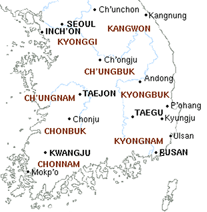
| Les feuilles commencent a peine a changer de couleur. On s'est rendu Gyeongju a environ 2 heures au nord de Busan. Cette region est riche en artefacts datant de la dynastie Silla qui a regne sur la Coree au VIIe siecle. Du haut du mont Tohamsan (environ 700 metres) on a pas pu apercevoir la mer (a cause d'une bande de nuage causee pas la pollution) mais on a pu avoir un avant-gout des couleurs d'automne , les collines toutes autour etaient encore vertes mais legerement teintees de rouille, jaune et rouge. Ca va etre beau dans quelques semaines. |
| Nicely preserved Korean historical sites are hard to find as the country has been ravaged by many wars and invasions. In the VIIth century Gyeongu was the capital of the Silla kingdom which unified the three kingdoms that had previously fought for the control of the peninsulla. The capital was moved when the following dynasty took over and as a result Gyeongu was left untouched for centuries. The site is rich in artifacts as well as original standing stone structures all of which are numbered national treasures. Most of the artifacts are housed in the museum but the stone stuctures are still in their original spot and can be visited. |
| Grotte Seokguram Grotto, mont Tohamsan |
| Cheomseongdae - astronomical observatory/ observatoire |
| visit/visitez |
| The tombs and the harvest / les tombes et les recoltes |
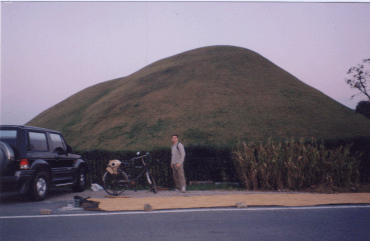 |
| On distingue mal Dennis a cause de la faible lumiere mais j'aime la curieuse composition de cette photo: a gauche un "Jeep" moderne et une vielle bicyclette, derriere Dennis un monticule funeraire et a ses pieds, une recolte de ble qui seche au soleil. |
| He oui, quand on demande a un gentil touriste de nous immortaliser devant un site historique on ne peut pas lui en vouloir d'avoir si bien coupe la tete du chef d'oeuvre qui a survecu quelques 13 siecles. |
| top: a 1930 shot of the whole tower bottom: modern view left: yours truly and part of tower |
 |
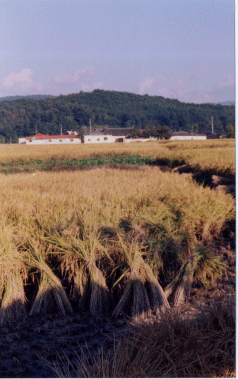 |
| Champ de riz devant le musee Rice field by the musem |