| Cannibalism part one |
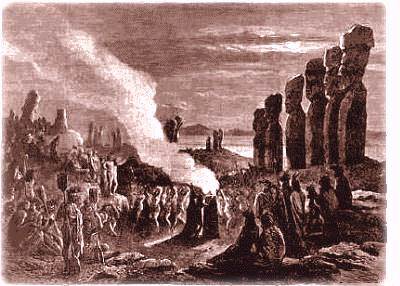
| " Every Easter Islander knows that his ancestors were kai-tangata, 'man-eaters'. Some make jokes about it, others take offense at any allusion to this custom which has become in their eyes barbarous and shameful. According to Father Roussel, cannibalism did not disappear until after the introduction of Christianity. Shortly before this, the natives are said to have eaten a number of men, including two Peruvian traders. Cannibal feasts were held in secluded spots, and women and children were rarely admitted. The natives told Father Zumbohm that the fingers and toes were the choicest morsels. The captives destined to be eaten were shut up in huts in front of the sanctuaries. There they were kept until the moment when they were sacrificed to the gods. The Easter Islanders' cannibalism was not exclusively a religious rite or the expression of an urge for revenge: it was also induced by a simple liking for human flesh that could impel a man to kill for no other reason than his desire for fresh meat. (Man was the only large mammal whose flesh was available) Women and children were the principal victims of these inveterate cannibals. The reprisals that followed such crimes were all the more violent because an act of cannibalism committed against the member of a family was a terrible insult to the whole family. As among the ancient Maoris, those who had taken part in the meal were entitled to show their teeth to the relatives of the victim and say, 'Your flesh has stuck between my teeth'. Such remarks were capable of rousing those to whom they were addressed to a murderous rage not very different from the Maly amok." |
| So. You like to eat human flesh. You salivate when someone burns their hand on a hot stove. You drool when they show medical operations on TV. You'd like nothing better than to invite Mr. and Mrs. Jones next door around for dinner. You're a cannibal. Well. Have I got bad news for you. The art of cannibalism is currently undergoing one of its darkest times ever. It is considered immoral - downright rude in fact - as a culinary choice. Even that utopia of cannibalism, New Guinea, has opted for more "civilised" dining habits. How, I hear you ask, do I cope in this modern world? The Calcutta body market is thriving. A kidney here, an arm there. Airmail the product over, and it should be in a nice tender state once it gets here. Modern drugs are great! You can drug someone senseless, and cut bits off them. (It is better to start from the inside, I've found, as you can remove an appendix, liver, even intestine, and they won't guess what has really happened.) Old people. They may be a bit chewy, but you can usually pick one up without too much trouble. Hang around a dangerous intersection. When an accident occurs, nip in and steal a loose limb. Virtual Reality Cannibalism. You'd be amazed at how real it can be. Just mind you don't take off the headset and find a few fingers missing. Finally for the cheapskate, you can spice up any beef dish with "Artificial Human Flavouring". Some consider it not 'natural'. Well it's not. Of course it's not, it's called "Artificial Human Flavouring". |
| So You're a Cannibal |
| Cannibalism, eating of human flesh by human beings. The term cannibalism is derived from Canibales, the Spanish name for the reputedly man-eating Carib Native Americans who lived in the West Indies when Christopher Columbus arrived. The practice of cannibalism has been reported in many parts of the world. Some indications point to its practice as early as Neolithic times. The Greek historian Herodotus and other ancient writers described various cannibalistic peoples. In medieval times Venetian traveler Marco Polo reported that tribes from Tibet to Sumatra practiced cannibalism. It was practiced among many Native North Americans, especially the tribes of the western coast of the Gulf of Mexico. Until recent times cannibalism was believed to prevail in central and western Africa, Australia, New Zealand, Melanesia, Sumatra, New Guinea, Polynesia, and remote parts of South America. Several motives have been proposed for the practice of cannibalism. In some cultures, it was believed that the person who ate the dead body of another would acquire the desired qualities of the person eaten, particularly of a brave enemy. In a few instances, cannibalism might have been dictated by no other motive than revenge. It was even believed that an enemy's spirit would be utterly destroyed if the body were eaten, thus leaving nothing in which the ghost could live. Cannibalism was sometimes part of a religious practice. The Binderwurs of central India ate their sick and aged in the belief that the act was pleasing to their goddess, Kali. In Mexico, thousands of human victims were sacrificed annually by the Aztecs to their deities. After the ceremony of sacrifice, the priests and the populace ate the bodies of the victims, believing that this would bring them closer to their gods. Among Western peoples cannibalism is rare, although starvation has sometimes driven humans to eat the flesh of other humans. One instance in America involved members of the ill-fated Donner party in the Sierra Nevada in California during the winter of 1846-1847. Another occurred in Chile in 1972, when 16 members of a Uruguayan soccer team survived for 70 days after their airliner crashed in the Andes Mountains. Alfred Packer convicted of being a cannibal in the 1800s. He was not hanged because the said massacre happened on the Indian territory so it was not under Colorado state law. |
| Encarta's Cannibal |
 |
 |
 |