| Cannibalism part 2 |
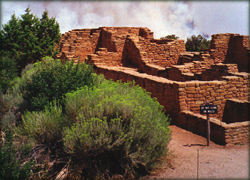
| Life in the southwestern corner of Colorado can be difficult in the best of times. Rainfall is scarce, making growth hard even for the scrubby sagebrush and tough pinon and juniper trees that dot the arid land. In summer the heat is oppressive on the flatlands, and only slightly more tolerable on top of the flat, high mesas that jut above the horizon. Winter is not much better. Chapin Mesa, one of the largest features in the area, dominates the landscape and the imagination. Tucked away within its hidden canyons are the famous cliff dwellings built long ago by the Anasazi Indians. Sheltered by enormous natural overhangs, each village is a dense cluster of brick-walled rooms stacked two or three stories high, fronted by sunny plazas. Tiny windows in some rooms yield glimpses of paintings on inside walls; subterranean gathering rooms -- called kivas -- feature benches and elaborate ventilation systems. Everything is constructed of redish-gold sandstone, which seems to glow in the unforgiving southwestern sun. Magnificent as these homes were, however, the Anasazi lived in them for fewer than a hundred years. For some unknown reason, they completely abandoned the area around A.D. 1300. Today, most of the cliff dwellings are preserved in Mesa Verde National Park, and every summer throngs of visitors ponder the mysterious departure of the Anasazi. Drought, warfare, and the harsh environment are all cited as possible explanations. But another, deeper mystery lies just a dozen or so miles west of Mesa Verde, in an area known as Cowboy Wash, a broad, flat floodplain in the shadow of Sleeping Ute Mountain. A century and a half before the abandonment of Mesa Verde, Cowboy Wash was home to another group of people, probably Anasazi as well. Recently archeologists covered several piles of human bones at the site. These bones, they say show clear evidence of cannibalism. What's more, they maintain that this find does not represent an isolated incident. In the last at least 30 nearby digs have yielded similar evidence of humans eating humans. Some archeologists speculate, naturally, that only people forced to desperate measures by starvation in this harsh environment would resort to cannibalism. The excavators of Cowboy ash, however, propose a new theory. The cannibalism that occurred there, they say, was an act of prehistoric terrorism. Traditionally the Anasazi have been portrayed as peaceful farmers who quietly tended their corn and bean crops. Archeological records indicate that they occupied the Four Corners area -- the juncture of present-day Colorado, Utah, Arizona, and New Mexico -- from the beginning of the first millennium to around 1300. During that time they developed complex societies, farming methods, and architectural styles, culminating in life among the cliff dwellings. But recent work hints that the Anasazi world was far more turbulent than suspected. The clues come from an archeological dig conducted by Soil Systems, Inc., a private consulting firm in Phoenix, Arizona. Under contract to the Ute Mountain Ute Tribe, SSI excavated several ruins in the Cowboy Wash area so the tribe could relocate any ancient human remains before the launch of a new irrigation project. The site where the bones were found, a dwelling known as 5mt10010, is believed to have been occupied between the years 1125 and 1150. It includes three pit structures, the roofed, semi-sunken rooms typical of Anasazi homes at that time, as well as other rooms and trash heaps known as middens. Some 15 to 20 people, divided into three households, probably lived there. The telltale bones were found scattered about the floors of two of the pit structures. In one, known as Feature 3, SSI archeologists found more than 1,100 bones and bone fragments, including shoulder blades, skulls, vertebrae, ribs, arm bones, hand and foot bones, and teeth. Nearly all were broken. Most were found in a heap at the bottom of an air shaft. In the other pit structure, Feature 13, the bones were found scattered on the floor and in side chambers. "This was in no way: a burial," says Patricia Lambert, a bioarcheologist from Utah State University in Logan who was hired to analyze the bones. "There was no reverence for these remains." Lambert's job was to try to reconstruct complete skeletons from the fractured pieces and decipher the clues left behind. "It was a big puzzle," she says. "The elements were all mixed together and broken." Many bones, particularly large leg bones, were missing. Eventually Lambert established that at least five people had been disposed of at Feature 3 -- three adult males, one adult female, and an 11-year-old child. Two children were found in the other pit structure, one a 7 year-old, the other 14. Evidence of trauma was not hard to find. Most of the bones were broken, and many looked scraped and scorched. The marks looked like those left on the bones of large game animals after butchering. According to many archeologists, the presence of such marks, on human bones is a clear indication of cannibalism. Someone who is planning to eat a human body part, the theory goes, would naturally prepare it in the same manner as he would an elk or a deer. And that is exactly what Lambert found. "I found cut marks at muscle attachment sites, such as where the femur is attached to the hipbone," she says. "It's pretty clear they were disarticulating the body, cutting tendons and soft tissues that connect various parts." The cut marks occur when cutting tools slip and strike bone instead of tissue, she explains, and they cannot be mistaken for the gnawing marks an animal might leave. The relatively pristine condition of the bones is vet another clue; If the flesh had been left to rot away rather than being deliberately removed, says Lambert, the bones would be discolored and pitted instead of white, smooth, and dense. And some bones look as through they were broken open so the nutritious marrow could be extracted. They bear the complex fractures that occur in living bone -- not the simple, smooth fractures of decaying bone. Moreover, they show flake scars, the marks that are left when a hammering tool chips bone. Perhaps most disturbing was the evidence of burning and cooking -- even a mere summation of it, 850 years after the fact, is enough to make one queasy: some bones appear to have been browned by heat exposure when they were still covered with flesh, and the skulls of both children in Feature 13 were obviously burned. "The burning clearly happened while the head was intact," says Lambert. "The back of the cranial vault was down around the coals, and the flames licked up and browned the side and blackened the back. Sometime later the head was taken apart -- we found the pieces in two separate piles. They were putting the head on the fire. They were not incinerating it, but they did put it on there long enough to have cooked the brains. "I can't say that they were eating these people, but they were certainly processing them in a way that suggests they were," says Lambert. The victims and alleged perpetrators also left behind a few other clues. In one pit structure, archeologists found a set of tools, including two axes, that might have been used to butcher the bodies. "Sort of like leaving a calling card"' muses archeologist Brian Billman, project director for SSI. Not only were cooking pots, ladies, and lids left behind, but so were tools, beads, and some jewelry. Leaving behind such valuables suggests that the sites were suddenly abandoned, says Billman, and sediment deposits on top of the bones and pots provide clues that the homes remained vacant. Furthermore, three other sites in the immediate area yielded the same type of remains, from the same time period: human bones irreverently scattered about deserted homes. The evidence, Billman concludes, all points to an outbreak of cannibalism designed to terrorize and intimidate a group of people, most likely some foreigners who posed competition for scarce food resources. "It was a time of severe drought, as well as social and political upheaval," he says. "People were moving into new areas and mixing up alliances." Billman believes that people from about 60 miles south moved into Cowboy Wash and replaced the local community, as evidenced by several pots found there bearing the style of a more southern culture. But the immigrants' arrival apparently did not sit well with the local Anasazi. |
 |
 |
| Another Article about Cannibalism |
 |