|

|
 |
| ~A Medical Description~ |
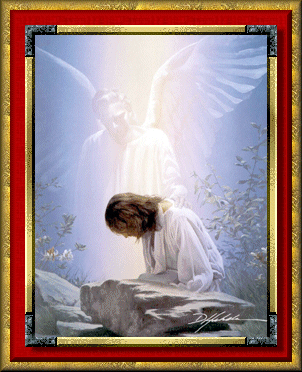
| The physical trauma of Christ begins in Gethsemane with one of the initial aspects of His suffering...the bloody sweat. It is interesting that the physician of the group, St. Luke, is the only one to mention this. He says, "And being in agony, He prayed the longer, And his sweat became as drops of blood, trickling down upon the ground." Though very rare, the phenomenon of hemathidrosis, or bloody sweat, is well documented. Under great emotional stress, tiny capillaries in the sweat glands can break, thus mixing blood with sweat. This process alone could have produced marked weakness and possible shock. |
| After the arrest in the middle of the night, Jesus was brought before the Sanhedrin and Caiaphas, the High Priest. A soldier struck Jesus across the face to remaining silent when questioned by Caiaphas. The palace guards then blindfolded Him and mockingly taunted Him to identify them as they each passed by, spat on Him and struck Him in the face. |
| In the early morning, Jesus, battered and bruised, dehydrated and exhausted from a sleepless night, is taken across Jerusalem to the Praetorium of the Fortress Antonia. It was there, in response to the cries of the mob, that Pilate ordered Barabbas released and condemned Jesus to scourging and crucifixion. |
| Preparations for the scourging are carried out. The prisoner is stripped of His clothing and His hands tied to a post above His head. The Roman legionnaire steps forward with the flagrum in his hand. This is a short whip consisting of several heavy leather thongs with two small balls of lead attached to the ends of each. The heavy whip is brought down with full force again and again across Jesus' shoulders, back and legs. |
| At first the heavy thongs cut through the skin only. Then, as the blows continue, they cut deeper into subcutaneous tissues, producing first an oozing of blood from the capillaries and veins of the skin, and finally spurting arterial bleeding from vessels in the underlying muscles. The small balls of lead first produce large, deep bruised which are broken open by subsequent blows. Finally the skin of the back is hanging in long ribbons and the entire area is an unrecognizable mass of torn and bleeding tissue. When it is determined the the prisoner is near death, the beating is stopped. |
| The half-fainting Jesus is then untied and allowed to slump to the stone pavement, wet with His own blood. The Roman soldiers see a great joke in the provincial Jew claiming to be a king. They throw a robe across His shoulders and place a stick in His hand for a scepter. A small bundle of flexible branches covered with long thorns is pressed into His scalp. Again there is copious bleeding (the scalp being one of the most vascular areas in the body). After mocking Him and striking Him across the face, the soldiers take the stick from His hand and strike Him across the head, driving the thorns deeper into His scalp. Finally, they tire of their sadistic sport and the robe is torn from His back. This had already become adherent to the clots of blood and serum in the wounds, and it's removal, just as in the careless removal of a surgical bandage, cause excruciating pain... almost as though He were again being whipped and the wounds again begin to bleed. |
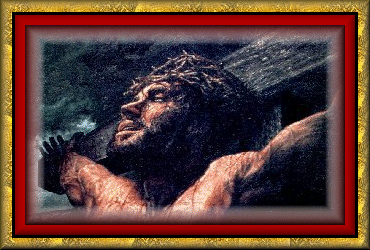
| The heavy beam of the cross is then tied across His shoulders and the procession of the condemned Christ, two thieves and the execution detail, begin its slow journey. The weight of the heavy wooden beam, together with the shock produced by copious blood loss, is too much. He stumbles and falls. The rough wood of the beam gouges into the lacerated skin and muscles of the shoulders. He tries to rise but human muscles have been pushed beyond their endurance. |
| At Golgotha, the beam is placed on the ground and Jesus is quickly thrown backward with His shoulders against the wood. The legionnaire feels for the depression at the front of the wrist. He drives a heavy, square, wrought-iron nail through the wrist and deep in the wood. Quickly, he moves to the other side and repeats the action, being careful not to pull the arms too tightly but to allow some flexion and movement. The left foot is pressed backward against the right foot and with both feet extended, toes down, a nail is driven through the arch of each. The beam is then lifted in place. At the top of the post the titulus reading "Jesus of Nazareth, King of the Jews" is nailed in place. |
| As He hangs there, He pushes Himself upward to avoid the stretching torment and places His full weight on the nail through His feet. Again there is the searing agony of the nail through His feet. Again there is the searing agony of the nail tearing through the nerves between the metatarsal bones through the feet. As the arms fatigue, great waves of cramps sweep over the muscles, knotting them in deep, relentless, throbbing pain. With these cramps comes the inability to push Himself upward. Hanging by His arms, the pectoral muscles are unable to act. Air can be drawn into the lungs but cannot be exhaled. Jesus fights to raise Himself in order to get even one short breath. Finally, carbon dioxide builds up in the lungs and in the blood stream and the cramps partially subside. Spasmodically, He is able to push Himself upward to exhale and bring in the life-giving oxygen. |
| Hours of this limitless pain, cycles of twisting, joint-rending cramps, intermittent partial asphyxiation, searing pain as tissue is torn from His lacerated back as He moves up and down against the rough timber. Then another agony begins. A deep crushing pain deep in the chest as the pericardium slowly fills with serum and begins to compress the heart. The compressed heart is struggling to pump heavy, thick, sluggish blood into the tissues. The tortured lungs are making a frantic effort to gasp in small gulps of air. The markedly dehydrated tissues send their flood of stimuli to the brain. Jesus gasps, "I thirst". |
| He can feel the chill of death creeping through His tissues. With on lst surge of strength, He once again presses His torn feet against the nail, straightens His legs, takes a deeper breath, and utters His seventh and last cry, "Father, into thy hands I commit my spirit." |
| Apparently, to make doubly sure of death, the legionnaire drove his lance through the fifth interspace between the ribs, upward through the pericardium and into the heart. Immediately there came out blood and water. We therefore have rather conclusive postmortem evidence that Our Lord died not the usual crucifixion death by suffocation, but of heart failure due to shock and constriction of the heart by fluid in the pericardium. |
 |
 |
| The Crucifixion |
| Condensed from "The Crucifixion of Jesus" by C. Truman Davis, M.S. March 1965 |
| Take a moment and think about what Jesus did. This is not some fantasy or fairy tale; this is real!! These events really happened to Jesus, the King of all Kings. How can so many reject so great a love. Mankind can search forever and would never find a love such as this. Our own capacity to love is nothing compared to the love Jesus exhibited for us. Our mind cannot comprehend a love this great, but our heart-if we will open it to Him-can feel it. How sad it must be for Jesus to see the children He loves so, reject His sacrifice and be eternally damned. To know He suffered these great agonies, and to have so few accept the precious gift He freely offers, must cause Him such pain. Make no mistake, Jesus calls all to repentence. Listen to your heart and you will hear the call. It is up to you. Will you be one who will say "Lord forgive me," or will you be one of those who goes along with the crowd while saying "Crucify Him, Crucify Him." ~~The choice is yours~~ |
| Visit My Other Pages |
 |
| Did you like this site? If so, then cast your vote at Cross Daily Awesome Christian Sites by clicking on the link below. Thanks, Dee Dee |
|
|
|
|
|
|
 |

|
 |
|
|
|
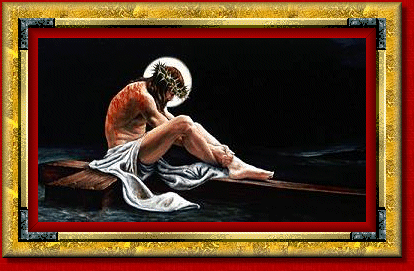
| We sometimes forget that Jesus was a flesh and blood man who felt pain the same as we do. His pain was not only physical but emotional as well. As St. Luke describes how our Lord sweat great drops of blood, One has to wonder how great the emotional stress must have been to cause this type of reaction. Jesus did more than die on the cross: He SUFFERED!! How often do we really think about the pain Jesus endured before He was nailed to the cross. Many still have no idea what scourging was. Most assume it was like being beaten with a whip. It was many times worse than that. Scourging alone was enough to kill a person, often causing one to bleed to death; but Jesus wasn't yet ready to die. He lived through it, only to be mocked and tormented more. He endured these cruelties even though He held ALL the power of Heaven and earth in His hands. When contemplating how Jesus bled and died, we have a tendency to think only of the blood He shed on Golgotha's Hill, but He shed much more than that. After such pain and suffering, one wonders how He could have gone on. But He did go on; all the way to Calvary. Taking upon Himself- He who was without sin- the sin of the world. After reading this account of the crucifixion, there should be no doubt in your mind that there has never been, nor will there ever be, evidence of a greater love than that which Jesus displayed by suffering such monumental agonies. Christ was literally mutilated for mankind's transgressions; He accepted our sentence and He did so willingly. Salvation wasn't for sale and yet he paid for it anyhow. Messiah means "Chosen One". Yes, He was chosen, and thank God the Father that He accepted. |
|
|
|
 |
 |
|
 |
|
|
|
|
|
 |
 |
 |