






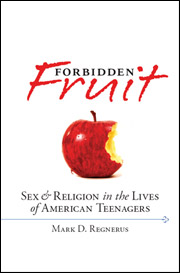
 As is evident from contemporary debates about sex education, Americans remain deeply ambivalent about teenage sexuality. While many presume that such reticence is rooted in religion, how exactly religion contributes to the formation of teenagers' sexual values and behaviors has been poorly understood before now. Does religion really motivate the sexual choices of a significant segment of adolescent society? Are abstinence pledges effective? Is there evidence for a "technical virginity" phenomenon among religious teenagers? What does it mean to be "emotionally ready" for sex? Who expresses regrets about their sexual activity and why?
Tackling these and other questions, Forbidden Fruit tells the definitive story of the sexual values and practices of American teenagers, paying particular attention to how participating in organized religion shapes sexual decision-making. Merging analyses of three national surveys of teenagers with stories from interviews with over 250 of them across America, Forbidden Fruit covers a wide range of topics, including sentiment about waiting to have sex until marriage, motivation to pursue sexual relationships, proclivity for same-sex attraction and behaviors, teenagers' experience of virginity loss, and the frequency of several heterosexual practices. Forbidden Fruit reveals the complexity of teenagers' sexual decision-making, documenting that religion affects their sexual attitudes, but that it does not often motivate their decisions to act. Instead, religion often accompanies other "secular" reasons for delaying sex, like concern for safeguarding one's educational future. Forbidden Fruit describes this largely religion—less "middle class sexual morality" in detail, and concludes with a new typology for documenting how religion shapes human action among adolescents and adults. More broadly, however, Forbidden Fruit puts to rest inane fears about rampant teenage sexuality, concluding that most teenage sex is "traditional," while pointing out new evidence for disturbing trends both in particular sexual practices and how teenagers learn about human sexuality. Read from Chapter Four of this book. "Motivating Sexual Decisions" from Forbidden Fruit: SEX & RELIGION IN THE LIVES OF AMERICAN TEENAGERS, by Mark D. Regnerus. (c) 2007 by Oxford University Press, Inc., and employed here with permission of the Publisher. Chapter OverviewIntroductionIn the introduction I lay out the issue—adolescent sexual behavior—and describe my interest in understanding religious influence on sexual decision-making. I highlight the basic features of the different data sources, and conclude with a short overview of how teenagers think about religion and just how involved they are in it. Chapter 1. Fashioning New Stories from Old Wisdom The first chapter discusses "old" religious teachings and "contemporary" religious perspectives and resources about human sexuality and sexual behavior, and concludes with an overview of the book's key findings, illuminated through personal accounts and perspectives of six adolescents. Chapter 2. Can Religion Cause Behavior? Chapter 2 reviews and evaluates the various ways in which scholars of religion and adolescent behavior have come to understand how the one affects the other. Social scientific debate about the real influence of religion on human behavior remains intense. Social science is not like basic chemistry or physics principles, since people—teens and adults alike—have options and make choices. This chapter provides the reader with a sense of how social scientists come to figure out whether religion actually makes a difference in human behavior, drawing upon examples from the study of adolescent sexuality. Chapter 3. Learning Sexuality In this chapter I focus on how teenagers learn about sex and birth control. Sex education debates, I argue, are quickly becoming outdated by the digital and democratized communications age in which we live. I discuss parental strategies for the sexual socialization and education of their adolescents, and focus on distinctions between moral education and information exchange about sexual acts and contraception. We learn that religion matters for determining the nature of what parents say about sex and contraception, and to whom they talk with about sex, and how often, and with what ease. Not all teenagers turn out heterosexual; I conclude the chapter with a brief look at current statistics about same-sex attraction, behavior, and self-identity during adolescence, and common attitudes about homosexuality among American teens. Chapter 4. Motivating Sexual Decisions The fourth chapter concerns the development of adolescent sexual ethics and norms, including their attitudes about and motivations to avoid or engage in sex. I document what types of adolescents are likely to take abstinence pledges, how well they work, the sexual and familial idealism they portray, and the popularity of emotional readiness as a (vague) barometer of sexual "preparedness." I conclude with a discussion of the sexual boundaries of religious youth and contemporary perspectives about masturbation. Chapter 5. Sexual Experience The longest chapter "consummates" the study by focusing on actual sexual behavior: adolescents' experience virginity loss, age at first sex, the context of adolescent sex, attitudes about birth control and actual contraceptive use, and patterns of sexual behavior after losing virginity—including just how many teens stop after starting and their average number of sexual partners. I spend most of the time exploring religious differences in patterns of sexual behavior, and consider alternative models of religious influence on sex (such as "does sexual behavior diminish religiosity"). I also address negative sexual experiences and the nature of adolescents' regrets about sex. I conclude with explanations of a key anomaly about evangelical Protestant sexual morality—their restrictive sexual attitudes but middle-of-the-pack rates of actual sexual activity. Chapter 6. Imitation Sex and the New Middle-Class Morality The sixth chapter discusses alternative forms of sexual behavior, like oral sex, anal sex, and the use of pornography. I spend time addressing the question of which teens equate oral sex with sex, and which do not. An interesting pattern of "imitation sex" preferences emerges, suggesting that many modestly religious youth actually delay sexual intercourse and pursue the path of "technical virginity," not because of a uniquely religious sexual morality but because of the perceived threat of intercourse to their future prospects for material success. Chapter 7. A Typology of Religious Influence Chapter 7 gives attention to the motivations that lie behind adolescent religious discourse about sexual decision-making. Are devout youth really distinguishing themselves in the sphere of sex because of their faith, or is religion a pragmatic and strategic tool to help them reach the goals they want—namely, to avoid pregnancy and to retain virginity until closer to (or at) marriage? Or does it work in an altogether different way than this? I introduce a typology of religious influence which should help us make sense of the ways in which religion affects adolescents' sexual behavior. I discuss six distinct types of religious influence, drawing upon examples from adolescents' own accounts: intentional, instrumental, invisible, inconsistent, irrelevant, and irreligiosity. While there is considerable evidence that religion influences adolescent sexual outcomes, religion does not often motivate sexual decision-making. Conclusions and Unscientific Postscript I bring the book to a close with 12 key conclusions from the data, followed by an unscientific postscript—a set of my own reflections about adolescent sexual behavior, the strong connection between morality (visions of the good life) and sex, and about the social scientific study of adolescent sexuality. |
