The
Quest for Thylacoleo:
Shark Calling #1
22/3/2002
: It's been over a year but we're back on the water! What we've
done is to hook up the Vocaliser animal caller to an underwater
sound projector. Home made, of course: Quest finances won't run to anything
else. Don't laugh - we figured out about acoustic impedance matching and
all that.
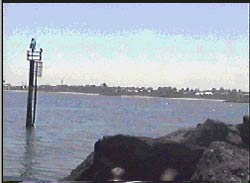
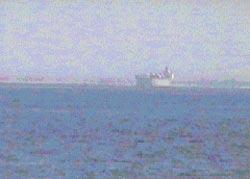 We
take it to the end of a breakwater . It's a big one which goes out about
a kilometre from shore. The bay is quiet, the only boats around are cargo
ships at anchor miles away. The sea is calm - that's important cuz we don't
want too much background noise from waves. The day is sunny and bright
- not ideal for our purposes. Sharks arre said to prefer dull, overcast
days before they'll come near the surface. Early morning is supposed to
be a better time as well.
We
take it to the end of a breakwater . It's a big one which goes out about
a kilometre from shore. The bay is quiet, the only boats around are cargo
ships at anchor miles away. The sea is calm - that's important cuz we don't
want too much background noise from waves. The day is sunny and bright
- not ideal for our purposes. Sharks arre said to prefer dull, overcast
days before they'll come near the surface. Early morning is supposed to
be a better time as well.
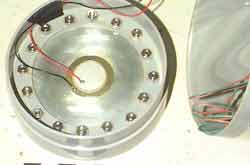
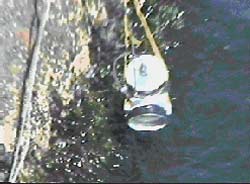
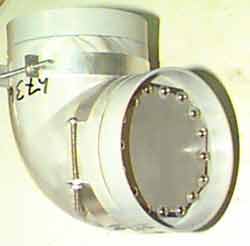 It
doesn't look much - just a PVC elbow joint with end caps which have been
cut to take I/O cables at one end and the acoustic surface at the other.
The sound projector is a 0.5mm thick aluminum plate which has a piezo crystal
acoustic transducer bonded to its inner surface. Polycarbonate plastic
has better acoustic matching properties in water but we couldn't find any
in the local hardware shop. There are aluminum brackets on the outside
to which a support rope can be attached. It's important that the signal
cable does not take any strain. Because it's hollow a ballast weight must
be attached to the clamps.
It
doesn't look much - just a PVC elbow joint with end caps which have been
cut to take I/O cables at one end and the acoustic surface at the other.
The sound projector is a 0.5mm thick aluminum plate which has a piezo crystal
acoustic transducer bonded to its inner surface. Polycarbonate plastic
has better acoustic matching properties in water but we couldn't find any
in the local hardware shop. There are aluminum brackets on the outside
to which a support rope can be attached. It's important that the signal
cable does not take any strain. Because it's hollow a ballast weight must
be attached to the clamps.
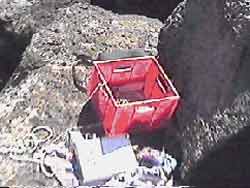
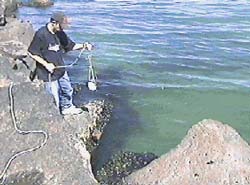 We
set up the control box & battery supply on the rocks and run the cable
down to the water. Then we just plonk the transducer in, switch on and
wait to see what happens. There are problems. You can't stop the the thing
from twisting so you have no way of controlling which way the acoustic
surface is facing. Most of the time it's facing the rocks which won't help
fish to hear it.
We
set up the control box & battery supply on the rocks and run the cable
down to the water. Then we just plonk the transducer in, switch on and
wait to see what happens. There are problems. You can't stop the the thing
from twisting so you have no way of controlling which way the acoustic
surface is facing. Most of the time it's facing the rocks which won't help
fish to hear it.
 What
we need to do is trail it from a boat in deep water. But because the object
is to attract active, predatory fish like sharks there's NO WAY we're gonna
try this from the good ship Thylacoleo. Sailing dinghies are way
too small and unstable to do an experiment like this safely. Absolutely,
positively the last thing you'd want is to finish up in the
water with Mr. Shark.
What
we need to do is trail it from a boat in deep water. But because the object
is to attract active, predatory fish like sharks there's NO WAY we're gonna
try this from the good ship Thylacoleo. Sailing dinghies are way
too small and unstable to do an experiment like this safely. Absolutely,
positively the last thing you'd want is to finish up in the
water with Mr. Shark.
RESULTS?
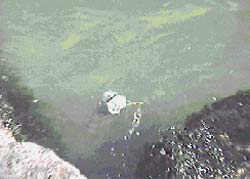 So
what happened? We let it run for about half an hour. It had an effect on
small fish - a lot of them seemed to gather in the water near the transducer.
You can't really see them in the JPEG with all the reflections. But of
larger fish there was no sign. Does that mean the experiment flunked?
No, not really. At this stage we have no idea what sorts of sounds a shark
would find interesting, so that aspect will take a lot of experimenting.
The Vocaliser can be programmed with all sorts of audio files however.
Besides which we don't actually know if even one shark was anywhere
near this spot. The transducer is a first attempt : its BW will not be
optimal, the power output is probably inadequate and we can't control its
attitude in the water. There's obviously a long way to go with this technology
so we'd have to say the results are inconclusive right now.
So
what happened? We let it run for about half an hour. It had an effect on
small fish - a lot of them seemed to gather in the water near the transducer.
You can't really see them in the JPEG with all the reflections. But of
larger fish there was no sign. Does that mean the experiment flunked?
No, not really. At this stage we have no idea what sorts of sounds a shark
would find interesting, so that aspect will take a lot of experimenting.
The Vocaliser can be programmed with all sorts of audio files however.
Besides which we don't actually know if even one shark was anywhere
near this spot. The transducer is a first attempt : its BW will not be
optimal, the power output is probably inadequate and we can't control its
attitude in the water. There's obviously a long way to go with this technology
so we'd have to say the results are inconclusive right now.
NOTE
#1 : I was reminded by J.B. that at the low freqs we're using the
small acoustic plate will be effectively omni-directional anyway. Thanks
JB!
EXPT
#1 : Measure the freq. response of the xtal acoustic element. Should
have down this first. Also some notes on the Lloyd Mirror effect.
EXPT
#2 : Assessing the feasibility of a magnetorestrictive element as an
acoustic transducer.
REFERENCES
Applied Underwater Acoustics
by D.G. Tucker & B.K. Gazey, Pergamon Press 1977.
How to Build & Use
Low-Cost Hydrophones by Frank Watlington, TAB Books 1979.
Copyright
© 2002 to Debbie Hynes. All rights reserved. The Quest for Thylacoleo
: http://www.thylacoleo.com