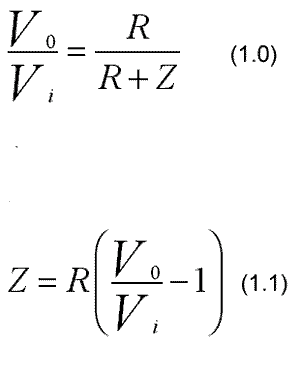
METHOD:
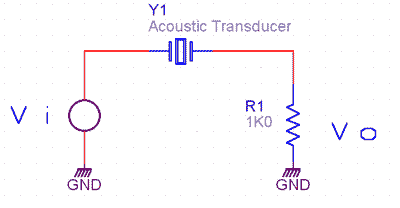
A cct was bread boarded
as shown in the LHS figure with a 1K resistor in series on GND side.
The input signal, Vi, was supplied by an "Advance" AF signal generator.
Sine waves were used for all measurements. the AF signals Vi & Vo were
measured with an HP model 400H VTVM.
|
|
NOTE : The xtal is mounted on its metal acoustic plate in its enclosure. Measurement was done in air and not water.
RESULTS
| Frequency, input & output voltages | |||||
|---|---|---|---|---|---|
| freq, Hz | Vo, volts | Vi, volts | Vo+Vi | Vo/Vi | R*(Vi/Vo-1), ohms |
| 50 | 0.150 | 16.200 | 16.350 | 0.009 | 107000.0 |
| 80 | 0.230 | 16.000 | 16.230 | 0.014 | 68565.2 |
| 100 | 0.270 | 15.800 | 16.070 | 0.017 | 57518.5 |
| 150 | 0.380 | 15.300 | 15.680 | 0.025 | 39263.2 |
| 200 | 0.490 | 14.800 | 15.290 | 0.033 | 29204.1 |
| 300 | 0.670 | 13.700 | 14.370 | 0.049 | 19447.8 |
| 400 | 0.630 | 14.400 | 15.030 | 0.044 | 21857.1 |
| 800 | 0.880 | 11.500 | 12.380 | 0.077 | 12068.2 |
| 1000 | 0.920 | 8.500 | 9.420 | 0.108 | 8239.1 |
| 1500 | 1.040 | 6.500 | 7.540 | 0.160 | 5250.0 |
| 2000 | 1.050 | 5.300 | 6.350 | 0.198 | 4047.6 |
| 3000 | 1.100 | 3.700 | 4.800 | 0.297 | 2363.6 |
| 4000 | 1.100 | 2.800 | 3.900 | 0.393 | 1545.5 |
| 8000 | 1.100 | 2.100 | 3.200 | 0.524 | 909.1 |
| 16000 | 1.100 | 1.650 | 2.750 | 0.667 | 500.0 |
| 32000 | 1.100 | 1.500 | 2.600 | 0.733 | 363.6 |
| 50000 | 1.100 | 1.490 | 2.590 | 0.738 | 354.5 |
 |
DISCUSSION
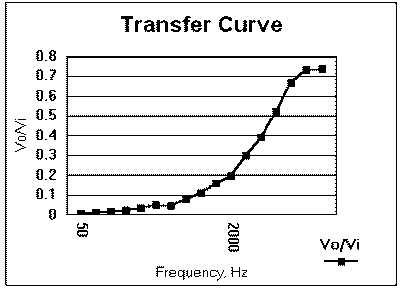
The crystal element behaves
as a high pass filter, something which we knew already. Looks like its
3 dB frequency is around 2500 - 3000 Hz. This is way too high for our purposes
: we want to construct a hydrophone/underwater sound projector which
will comfortably pass signals down to around 100 Hz. The vocalizations
of land animals of which we have some experience have BWs of around 10
Hz to about 8 kHz. We don't know what to expect from marine animals of
course.
We constructed a crystal
based acoustic transducer because it was cheap and easy to do. But it's
becoming clear that its overall response is not what we need. Possibly
the next experiment should be to utilize a pot core inductor bonded to
an aluminum plate as the active acoustic element?
ADDENDUM #1.1
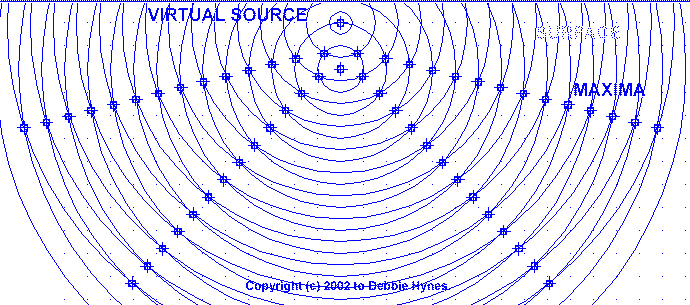
:The Lloyd Mirror Effect (30/3/2002)
This is one we never thought
of till it was kindly pointed out by J.B. Many thanks again. Our reply
might go as follows
You'd get a reflection from the bottom which should propagate in shallow water by bouncing between surface and bottom. You'd get complex phase relationships though and no reflections at all where you had a soft muddy bottom that could absorb sound waves. So the poor ol'manatee, talked about in the references below, would still get run over by the barge in the mpeg.
 |