



|
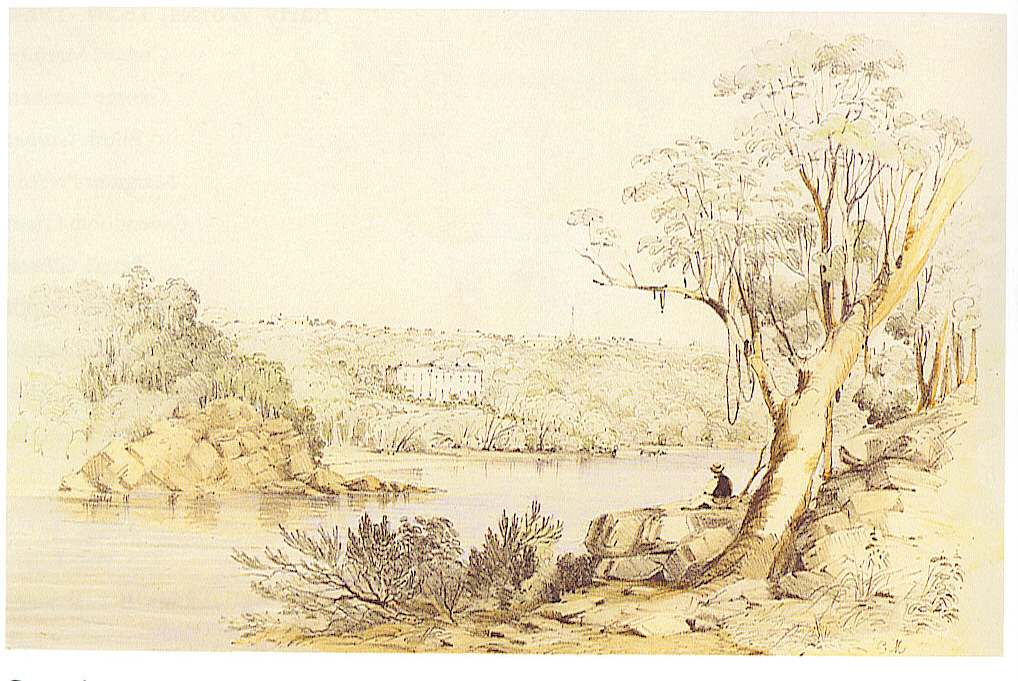
Artworks produced of the Australian land were mostly for scientific purposes, and created by botanists or sailors on their ships. Australia was not wholly new to the Western world; however its diverse flora and fauna intrigued visitors – and soon to be settlers – such that those in Europe would not believe the existence of a platypus created by a sailor on a voyage. Artwork produced were highly influenced by the European style of the “softening of Australian landscape to a European one” (Rainbird 1995:14) This Impressionist landscape painting which was romantic in its style of soft colours and lighting was not a true reflection of Australia’s harsh landscape that the new settlers actually encountered. Conrad Marten’s ‘Elizabeth Bay’ displays this Impressionist style that Europeans were shaped to depict. Melbourne and Sydney scenes encompass most artworks produced around this era, as these cities were the major settlements for Europeans who had migrated to the land of opportunity. |
|
|
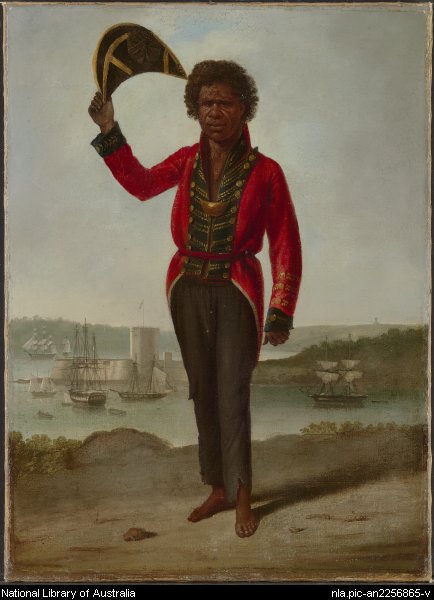
Australian art evolved from these borrowed styles of Impressionist techniques and European influences to its own unique style of visual art. For one, we cannot ignore the influence of the indigenous people of Australia – though in early times they were largely ignored and discriminated against by the white immigrants – whose artworks are completely distinctive from other cultural crafts. The aboriginal people have suffered the most intensive change in the shortest period of time – in only approximately 200 years they have nearly lost all sense of culture and identity. The history of Australia is not all white, so to say. As the white settlers took the most fertile of the lands to begin farming, aborigines were forced to leave – most after a massacre of violence – and have ever since been the minority of the Australian population. |
|
|
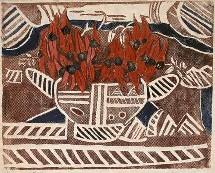
Aboriginal art apparent in history is mostly related to their spiritual beliefs of the Dreaming. By the ‘40s Aboriginal design was being incorporated into artworks through a modernist approach[1](Australia – 1900 AD to Present. (2007). [Internet]. The Metropolitan Museum of Art. New York. <http://www.metmuseum.org/toah/ht/11/oca/ht11oca.htm> [Accessed: 23/08/07]). Artists such as Margaret Olley and Preston are excellent examples of this occurrence. This placed aboriginal culture on a decorative level of value, and later this notion is investigated by Gordon Bennett. Women in the art scene of Australia around the mid-50s and before were marginalised as creating only ‘women’s art’: comprising of still lives and household scenes it is hypocritical of the men who also created such works. Margaret Preston is a typical example of this.
|
|
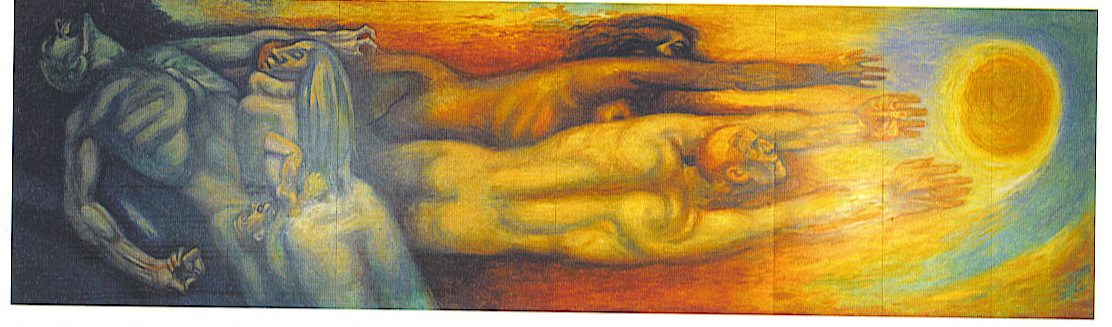
| The beginning and the end of World War II had a significant impact on the world of art. Post-war pieces and especially the issues that arose under Robert Menzies (Australian prime minister from 26 April 1939 – 28 August 1941, and 19 December 1949 – 26 January 1966) government ruling; the fear of communism spread from Menzies regime with the ‘reds under the beds’ slogan. What with the after-effects of both World Wars and Australia rising from the Great Depression in the late 20’s, revolution and realism were ever-present in works of this period. An excellent example is Noel Counihan’s mural which is now situated in Broken Hill City Art Gallery depicts a post-expressionist image of ‘humans emerging from the pain and suffering of war and poverty to find peace and happiness’ (Donald & Richardson 1995: 95). |
|
|
Post-war art leads onto the issues of postmodernism in art: this is the most colourful period of Australian-produced works because postmodernism as an art form is challenging to the perception of modernist works. Highly influenced by contemporary culture and mass media – consumerism, globalization, the feminist movement of the ’80s and rise of technology – Postmodernism’s growth as an art form is apparent in the now widely accepted movements of pop art, installations, multimedia shows and video art.
|
|
|
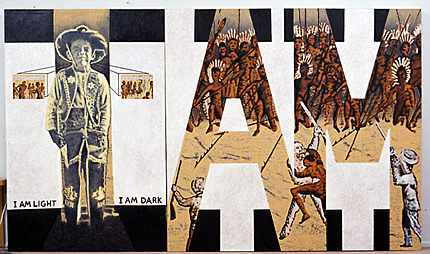
Here we view the work of Gordon Bennett: ‘Self Portrait (But I Always Wanted to be One of the Good Guys)’ displays the views of a part-Aborigine in a community where Aborigines are marginalised into either petrol-sniffing homeless people or a culture to be sympathetic towards. We see how Post-modern works are reflective of historical facts, opinions and even other artworks through the use of appropriation, satire, irony and pastiche. Though it may be more confronting and obvious than other art forms, Post-modern ideology appeals to our consumerist society as it is an art form that forms a bridge to reality. |
|
| All in all, Australia's history of visual art is very interesting in that Australia is a melting pot of cultures and styles. |
This is the written work of Kira Bauleka, Year 12 Modern History summative syllabus: Studies of Change .