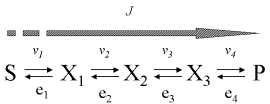
Step 2. Write down the balance relationships.
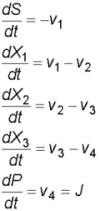
Step 3. Write down the kinetic relationships. e.g. Mass action kinetics
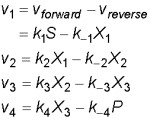
Step 4. Solve by analytical or numerical methods.
Classical approach for determining the reaction mechanism
1)Identify the primary stoichiometry of the overall reaction.
2)Compile a list of chemically plausible species.
3)Break down the overall reaction into likely elementary steps.
4)Assemble all relevant experimental data available.
5)Put all the thermodynamically plausible steps and the corresponding kinetics data together to form a trial mechanism.
6)Use numerical methods to simulate the experimental results.
7)Continue to refine and improve the mechanism, testing it against all new experimental results.
8)Changes in biomedical research
9)Traditional labour intensive! Hypothesis testing
10)High throughput measurements, -omic technologies, databases: data-driven modelling
11)Experimentation is now non-hypothesis driven
Pathway Databases:
• Metacyc: Reaction pathways for organisms other than E.coli .
• Ecocyc : Encyclopedia of E. coli Genes and Metabolism
• BRENDA: For enzymatic catalysis.
• DIP : For protein – protein interaction.
• Transfac: For protein – DNA interaction.
• EMP : Enzyme and Metabolic Pathway.
• WIT : Pathway construction.
• MGDB : Microbial Genome Database
• KEGG : Kyoto Encyclopedia of Genes and Genomes: Metabolic Pathways
• LIGAND : Chemical Database for Enzyme Reactions
• SPAD : Signaling Pathway Database
• BRITE : Biomolecular Reaction pathways for Information Transfer and
Expression.
Pathway Of Infection Of Mycobacterium tuberculosis
Mycobacterium tuberculosis infects human macrophages

Stimulates the production of interleukin 12
IFN gamma production stimulated .
Activation of CD4+ T cell mediated cytotoxicity