Click Here To Download
The Idler's Mobile Version

The Idler's Home Page and Table of Contents
The Idler's email list
To advertise in The Idler
Write a letter to the editor

(www.the-idler.com)
Volume II, Number 165





CHAPTERS: Memories of the Great and the Good
By Alistair Cooke
Chapter Ten: Harold Ross (1951)
One evening toward the end of 1923, there appeared this item, in the daily column of a popular New York journalist who often wrote a parody of Pepys's diary: "And to H. Ross's, and we talked about the low state periodical comick literature is sunk into."
It was true enough. But nobody in America apparently was doing anything about it. There was the old Life, and there was Judge, two family magazines whose stock-in-trade was deaf old ladies, comic valentines, he-she jokes, and a dreadful series of contributed saloon gags called Krazy Kracks. Sophisticated New Yorkers might wince at this stuff, but the instinct to wince was merely satisfying proof of their own urbanity.
Yet there was one man who winced for a living. He was coeditor of Judge, and as he corrected its laughing copy every wince was a stab at his pride, his taste, and his patriotism. He would reach in his drawer and finger the pages of Punch and Simplicissimus and sigh over the superiority of Europe. He quit his job and turned to improve American humor with the almost suicidal frenzy of a Strindberg hero. He was impossibly cast for this part. He wanted to found a sophisticated, ironic metropolitan weekly. He was a gawky outlander, a runaway from a small town high in the Rockies, an itinerant newspaperman who had bummed his way to San Francisco, a doughboy who had gone AWOL to run an American army magazine from Paris, a cantankerous, poker-crazy, all-swearing, all-drinking westerner Huck Finn in a slept-in business suit and cracked yellow shoes. He was, however the H. Ross of "F. P.'s" little item. He looked for a wealthy backer and found one in the socialite heir to a yeast fortune.
In February 1925 he put out a thin, unlikely-looking firstborn. It combined Punch's Charivari with Judge's two-line jokes. It had some comic strips barely dignified as "panels." There were a few local advertisements, some caricatures of actors, and art notes by "Froid." Its only note of superiority was a derisive promise that it would not be edited for "the Old Lady in Dubuque." Ross called it The New Yorker.
From that start, it lost two thousand dollars a week. It took three years and the outpouring of seven hundred thousand unrequited dollars to turn the red ink into black. Today, we are told, it may be bought by almost anybody with ten million dollars to spare.
In 1950, a book appeared to celebrate that twenty-fifth anniversary, a miracle of longevity nobody knowledgeable about journalism, least of all H. Ross, could have imagined in the early days of its penury and of H. Ross's groping all over town to find a writing style that would fit the model magazine he held in his imagination. He never did find it, which only proved something terrifying about Harold Ross that no contributors, early or late, ever guessed at when they first encountered the naive lunkhead. It was the totally unsuspected perfectionism of his mind and the unanswered question of where he got it from. He had quit high school and, with precious little education, wanted to be and became a newspaperman. He had read one whole book through and never pretended otherwise. What nobody anticipated before they turned in their copy was his probing, unsleeping, fussy, appallingly unforgiving intelligence. He kept on his desk what he called his two "bibles": Fowler's Modern English Usage and Mark Twain's devastating diagnosis of the flatulence and related prose disorders of Fenimore Cooper. But he by no means regarded Fowler as gospel -- he liked his precision and wit but when Fowler moved over the line from clarity to pedantry, Ross moved in on him as brutally as he did on any and every contributor, except two writers whose styles most nearly approximated to the impossible ideal: E. B. White and James Thurber.
Ross's literary ignorance made him no respecter of persons, however eminent. A writer who quoted Tennyson's "Nature red in tooth and claw" was immediately corrected. Ross's amendment read "Nature red in claw and tooth" with a note to the effect that a bloodthirsty animal would grab its prey by the claws before lifting it onto the teeth.
By the time the magazine's final proofs were passed on to the printer, Ross had read every line, much of the copy two or three times over. Before that longed-for Tuesday twilight, every contributor to the current issue had received, with his galley proofs, a typed page of numbered notes. They could run to ten or fifteen comments, varying from an abrupt single word ("Bushwah!") to a brief note of advice ("Could trim here" and "too detailed") to exasperated comments on the writer's dumbness ("Outside of what? And sheriff who? Who's he?") or verbosity ("For God's sake, there's no point in enumerating all these subsidiaries.")
Also unaccounted for was his exquisitely neurotic feel for syntax, a gift or a tyranny passed on to his deputy and nonfiction editor, William Shawn, who shared a similar sensitivity. (A book review I wrote in which I noted that the young and rebellious Churchill "almost completely ignored the school's syllabus" evoked a pained marginal comment: "The New Yorker does not recognize degrees of completeness." Touché!)
For Ross, there was no such thing as an "established" writer. Whether you were famous or a first contributor, your piece was subjected to the same disinterested, ruthless scrutiny, and every piece was accepted or rejected on what Ross alone decided were its meritsa procedure that in the later years outraged some authors presumed by the rest of the world to be the most treasured of The New Yorker's writers. John O'Hara and even James Thurber frequently went into apoplexy at this brutal treatment. Such was Ross's writhing perfectionism that none of the permanent staff could remember a time when he ever wrote the comment "good" or "what we want." The best he was ever known to concede was "in the direction of what we want." "Comes the revolution," said Dorothy Parker, "and it will be everybody against Ross."
Because Ross went on looking for gold ("what we want") among the unlikeliest prospectors, and because he took no eminent writer for granted, he came by the end of the magazine's first decade to be showered with the best American writing, both from the celebrated and the obscure. He had given transatlantic fame to a crop of former unknowns: Dorothy Parker, Ogden Nash, Robert Benchley, James Thurber, Frank Sullivan, and among the cartoonists Peter Arno, Charles Addams, Otto Soglow, and George Price. Alva Johnston resurrected the odd, intimate character sketch from where John Aubrey had buried it over two centuries ago and called it a "profile." The best reporting talent of the newspapers had been combed to establish a department, "A Reporter at Large," glorified by such previously unseen blushers as James Mitchell and A. J. Liebling. Less celebrated than Ross's recruitment of writing talent was his remarkable feat in discovering and exposing a cornucopia of comic artists. By the end of its first decade, the magazine had a stable of cartoonists as expert and personally distinguishable as Punch's in England. Here again, Ross's hand performed ruthless but curative surgery. He blotted out Punch's explanatory captions, sometimes running to five lines: Father (an army Colonel returned from India who has just heard of his son's engagement): . . . Son (who is apprehensive about his father's approval) . . . etc., etc., etc. Ross preferred, or rather dictated, an unattributed single line in quotation marks. If there was any doubt who was being spoken to he would note in the margin of the proof: "Open this mouth wider" or "No point if she's talking. Make clear." Occasionally, as with a naked man holding his nose and drowning in a shower, Ross gave four reasons, having to do with door locks, drains and other sanitary conveniences, why it was impossible for a man to drown in a shower. He held the drawing back from publication for a month, even thought it was by the star artist, Peter Arno. The farthest Ross was ever known to go by way of expressed admiration was an appreciative "Right!" to George Price's own comment on his gallery of the old lumpen couple in the rickety beach house, where every water pipe, television connection, wall plug and oven accessory was beautifully drawn in. "No plumber," said Price, "ever criticized my drawings."
In its twenty-sixth year, The New Yorker had become an American institution, confident, prosperous, unsinkable. Now it entered its dangerous age. Ross himself knew it. He recently complained that looking for the young for new ideas, new writing, he found them weaned and bred to write a pallid imitation of the New Yorker style. Some of us feared, a decade or more ago, that to escape that fate (an incurably pallid New Yorker), the magazine might consciously try to change its prose style, to stiffen its character. In 1938, there appeared a cover drawing that belonged to no artist we knew. It was, though, by the ribald Peter Arno. It was of a herd of bowed heads: the Nuremberg victims. It showed at a shocking glance how alien to the oncoming world of violence was The New Yorker we cherished. For Hitler was outraging urbanity everywhere, like a Dostoevsky lunatic let loose in a country club.
We were wrong. E. B. White had set the tone of the "Talk of the Town" comments, indeed of the magazine's persona, and he had developed a modern vernacular style as original and influential as any since Sir Richard Steele's. But suddenly, he applied it to the great and grave issues of the day. The New Yorker was led into battle by a man who wrote like an angel and now felt like a man. And, to the honor of the unlettered grouchy Ross himself, the effect of his fussy and exacting standards over fifteen years was to produce suddenly a small team of war correspondents as gifted and memorable as any who covered the Second World War. And, after the war, the magazine melded, without strain or affectation, its new seriousness and its old irony and grace. Unfortunately, Ross never lived to see how completely he had transformed the civil face of English-American journalism, more than any editor this century. He died suddenly, in December 1951, just as he was fearing the magazine was about to decline into a pale imitation of the original, a "sophisticated" magazine as the word is understood by what he called "those fancy readers" of the fashion magazines.
Alistair Cooke was born in Manchester, England, and educated at Cambridge, Yale, and Harvard. Since moving to New York in 1937, Cooke has written on every facet of American life, for the Times of London, as the Guardian's chief American correspondent, as well as for the BBC's weekly Letter From America, the longest-running one-man series in the history of broadcasting (now in its fifty-fourth year).
Cooke is known to million of Americans as host of Omnibus, Mastererpiece Theatre, and the mini-series America. His books include Alistair Cooke's America, A Generation on Trial, Six Men, The Patient has the Floor, and The Americans. In 1973 he was made an honorary KBE (Knight of the British Empire).
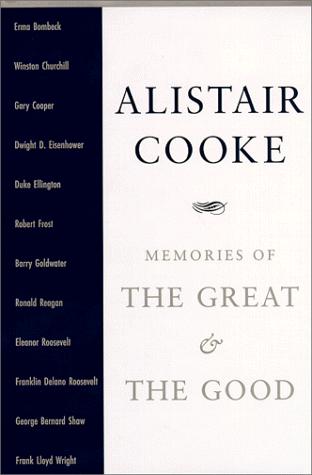
Memories of the Great and the Good is published in America by Arcade Publishing, also publishers of Nick Clarke's Alistair Cooke: The Biography. Reprinted by permission.
