The Idler's email list
To advertise in The Idler
Write a letter to the editor

(www.the-idler.com)
Volume II, Number 152






MAN OF THE AMERICAN CENTURY: Alistair Cooke: The Biography by Nick Clarke
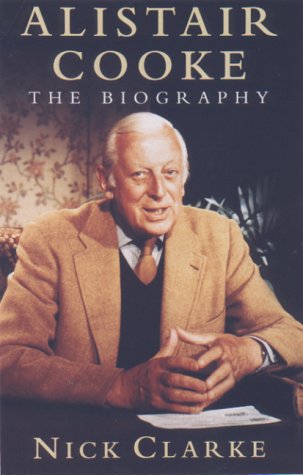
November 20th, 2000 was the 92nd birthday of Alistair Cooke. And although the timing may be coincidental -- the British version was published last year -- no better birthday present might be imagined than the appearance in American bookstores of Alistair Cooke: The Biography by Nick Clarke.
After more than a half-century as a newspaper correspondent, author, radio broadcaster, and television host, Nick Clarke -- himself a BBC broadcaster -- has finally given Cooke his due. Alistair Cooke: The Biography is a magnificent work of research and reporting, over 500 pages long, based on dozens of interviews as well as archival research. The book doubles as a chronicle of significant "tipping points" in the 20th Century -- events in which Cooke either participated or witnessed personally. As Clarke's saga makes clear, the title Man of the Century has never been so richly deserved.
His incredible climb from a lower-middle-class existence bordering on poverty in the Manchester suburb of Salford, England (Cooke's father was an iron-worker, and his brother became a butcher) to his present-day Fifth Avenue apartment reads like a tale out of Dickens, an author who is not surprisingly one of Cooke's favorites, according to Clarke. Like David Copperfield, Cooke has been both lucky and smart. He received scholarships to Cambridge, Harvard, and Yale. He worked for the Times of London, the Manchester Guardian, the BBC, NBC News, the United Nations, all three American television networks as host of Omnibus, and for PBS as presenter of Mobil's Masterpiece Theatre.
Long before the term "role model" was fashionable, Cooke was an icon of sophistication and respectability, epitomizing the sophisticated New Yorker of the 1950s, frequenting the salons of New York socialite Ben Sonnenberg, dining with Jackie Kennedy and Truman Capote, summering in Long Island, being psycho-analyzed, getting divorced and remarried.
He became an American citizen in 1941, causing some resentment among his British colleagues at the BBC facing the Blitz. Yet it is clear from reading this biography that Cooke became an American not out of cowardice, but out of a deep love for the United States. Clarke suggests that it was exposure to American servicemen billeted in his mother's boarding house during World War I that began Cooke's love affair with America.
For America offered Cooke something England did not, a land of unlimited opportunity, where one did not need to "know one's place." Here, a person was judged on what he had accomplished, rather than an accident of birth. And Cooke meant to accomplish a great deal.
Among Cooke's greatest achievements was to persuade NBC to broadcast his miniseries America, a personal history of the United States, in honor of the nation's 1976 Bicentennial. That a foreigner who was naturalized as an American citizen in 1941, could be permitted to interpret America to its own citizens on national television was the fulfilment of a lifetime's quest as an Americanist. He also enjoyed the rare privilege of addressing a joint session of Congress to celebrate the Bicentennial.
While his love of America comes through Clarke's account clearly -- and surprsingly for those who think of Cooke as a typical English gentleman, there is much more to his story. Just a few examples of Cooke's gift for being in the right place at the right time, as recorded by Clarke, give a hint of a dramatic life hidden behind his sang-froid exterior:
Witness to the Rise of Hitler
In 1931, Cooke travelled to Germany with a friend from Granta, Lionel Grunbaum. Visiting Munich, they attended a speech by Adolf Hitler at National Socialist Party Headquarters. Cooke remembered the moment clearly: "He played with his audience. He had pathos, tenderness, decisiveness, frightfulness. I thought, "'Wow! Who is this guy?"
His early exposure to Nazism led Cooke to distrust all grandiose political movements, and to beware ideologues of all stripes. As Clarke notes, "he drew a moral: that even the most horrific events and attitudes are likely tohave a rational explanation, and that explanation is worth pursuing."
The Abdication of Edward VIII
Cooke was there as well, covering the crisis live from London for NBC News. When Cooke came down with the flu, NBC arranged for lines to be put into his home so that he could continue broadcasting from his sickbed. His broadcasts were so successful that CBS sent Edward R. Murrow to London in order to compete.
Charlie Chaplin
Cooke worked as a personal assistant to the Little Tramp on a projected film about the life of Napoleon. Chaplin had been invited to be Best Man at Cooke's wedding to Ruth Emerson, but the bride's mother objected to the film star's living in sin with actress Paulette Goddard. Cooke quit his job at Chaplin Studios to begin his career as a broadcaster with the BBC.
Pearl Harbor
While reporting for London's Daily Herald, Cooke mentioned gossip he heard from a Korean traveller that the Pacific could "blow up in the first week of December." When the American fleet in Hawaii was bombed by the Japanese on December 7th, the Herald posted Cooke's prediction in its advertising placards.
The Trial of Alger Hiss
Cooke attended both the first and second trials in New York District Court, covering them for the Guardian and his book A Generation on Trial, a work personally commissioned by Blanche Knopf, co-founder with husband Alfred of the publishing house that would be Cookes' American literary home for some fifty years (his last book, The Great and the Good was published by Arcade in 1999, also the American publishers of Nick Clarke's biography).
Cooke warned against the twin dangers of Communism: "the reality of the threat and the epidemic fear of it." This eminiently sensible position did not endear him to some commentators more persuaded of Hiss's innocence.
Arthur M. Schlesinger, Jr., for example, savaged Cooke in the Saturday Review, berating him for not taking sides and accusing him -- falsely -- of witch-hunting tendencies. Such venom directed at Cooke is instructive, and Clarke quotes it verbatim: "Mr. Cooke runs wild in his endeavor to demonstarte that the New Deal was a kind of pro-Soviet front populaire, in which Alger Hiss was just a bit more activist than the rest. His facts are inaccurate, his logic is faulty, and even his prose, ordinarliy crips and incisive, becomes in his opening chapter diffuse and garralous."
Luckily for Cooke, others disagreed. The New Yorker declared A Generation On Trial "not only the finest report of the case, but one of the best descriptions of an American political event that has ever been written."
The Assassination of Robert F. Kennedy.
Cooke was at the Ambassador Hotel just a few feet from where Kennedy was shot, an event which affected him deeply.
"I for one do not feel like the accessory to a crime and I reject almost as a frivolous obscenity the sophistry of collective guilt, the idea that I, or the American people, killed John Fitzgerald Kennedy or Martin Luther King or Robert Francis Kennedy," Cooke wrote at the time.
There is so much more in Clarke's rich and rewarding biography that it is almost impossible to summarize. A few mentions to point the way: Cooke as Jazz aficionado, playing records with Mrs. Simpson, Cooke as Cinematologist, writing monographs for the Museum of Modern Art, Cooke as International Diplomatist, promoting the United Nations, Cooke as Presidential Intimate, on close terms with Walt Rostow and Lyndon Johnson, Cooke as Historian, writing and presenting his television mini-series, America,Cooke the Golfer, Cooke as socialite and bon vivant, living the High Life in Long Island.
And of course, the Cooke we all know -- host of the longest-running personal commentary program in the history of Radio, the BBC's "Letter from America."
Clarke's fascinating book makes clear that Alistair Cooke helped envision and promote an America that was sophisticated, sensible, and just. He personally embodied the taste, intellect, and sensibility of a country that was both Great and Good. He is the most civilized man in America. He sets an example that others may follow. (And he has had many admirers, ranging from William F. Buckley, Jr. to Jackie Kennedy).
The post-war generation in America, like Cooke, is of middle-class origins with an appreciation for the finer things in life, a generation opposed to decadence, injustice and ostentatious display. As the son of a Methodist lay preacher, and father of a Congregationalist minister, Cooke took this vision and broadcast it, evangelically, to both England and America.
Alistair Cooke's vision of America resonates on both sides of the Atlantic, because it is consonant with his life, a life brilliantly documented in Nick Clarke's Alistair Cooke: A Biography.
