Click Here To Download
The Idler's Mobile Version

The Idler's Home Page and Table of Contents
The Idler's email list
To advertise in The Idler
Write a letter to the editor

(www.the-idler.com)
Volume II, Number 160





A TOAST TO SAMUEL J. TILDEN
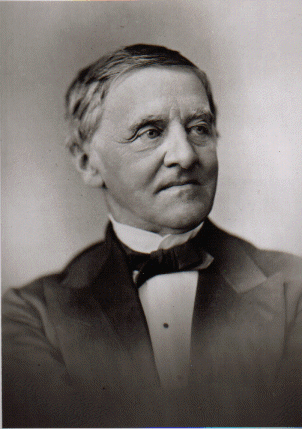
Samuel Jones Tilden, winner of the popular vote for President in 1876. (photo courtesy Nikki Oldaker)
When Nick Clarke, author of Alistair Cooke: A Biography, and host of BBC Radio 4's The World At One was interviewed by Natalie Cortes at the Freedom Forum Newseum a week ago (the interview will air on C-Span's BookTV on December 23rd), he was asked what he thought of the ongoing dispute over the American election.
Clarke's answer consisted of a surprising anecdote. He mentioned that he had attended a book party in his honor at the National Arts Club on Gramercy Park in New York City. At the party, he was told that the Arts Club was the former home of Samuel Jones Tilden (1814-1886), the Democratic governor of New York who lost 1876's contested election to Rutherford B. Hayes, when a Congressional commission decided a dispute over two competing sets of Florida electors in favor of the Republican candidate -- along partisan lines.
There is evidence of a secret deal with Southern Democratic leaders in which the Republicans agreed to withdraw Union troops safeguarding Reconstruction in exchange for throwing the election to Hayes. Tilden publicly accepted the verdict, hoping to avoid violence.
On his death in 1886, Tilden's home was purchased at auction by the Arts Club. Members of the Arts Club include editors of art news publications, promienent radio personalities, TV broadcasters, and high-profile artists, celebrities, and authors. Had Tilden become President, his home may never have been sold, and they would not have their own home-away-from-home
So, when informed of the historical context to his cocktail pary, Clarke concluded his tale to the Newseum audience, "we all raised our glasses, and drank a toast to Samuel J. Tilden."
Nick Clarke may have become a Tilden aficionado as a result of his visit to the Arts Club, but he is not the only one to admire the erstwhile President. Indeed, the Arts Club is a bit of a Tilden shrine, displaying a bronze bust of Tilden, and a campaign poster emblazoned "Tilden for President" in its Trask Gallery.
And those who have used the New York Public Library also have reason to raise their glasses in a toast to the unsuccessful Presidential candidate -- and popular vote winner -- of 1876. Upon his death ten years later, Tilden's personal library and fortune (he made his money as a railroad lawyer specializing in reorganization cases) were donated "to establish and maintain a free library and reading room in the city of New York."
Tilden's $2.4 million legacy paid for the purchase of the site and construction of of the Carrere and Hastings Beaux Arts building on the site of the old Croton Reservoir at 42nd Street. The building opened in 1911. To this day, his name is engraved in stone for all to see as the patrons pass under the inscription to the Astor, Lenox, and Tilden Foundations on the entrance of the Fifth Avenue building. (Researchers interested in Tilden can find an inventory of his estate in the New York Public Library Humanties division's Rare Books and Manuscripts collection.) In literal sense, the New York Public Library is his monument.
Prior to his Presidential bid, Tilden had been corporation counsel for New York City, a member of the state legislature and state constitutional convention, as well as chairman of the New York State Democratic committee from 1866-1874. He was a "free soil" Democrat who had supported the Union in the Civil War (other New York Democrats supported the South). Tilden is perhaps best known as an advocate of reform who attacked Tammany Hall, Boss Tweed, and the "Canal Ring," beginning in 1871, continuing his efforts as governor from 1874-1876 to break up the criminal conspiracy some estimate as having defrauded New York taxparyers of up to 200 million dollars.
Perhaps most remarkable among Tilden fans is Nikki Morgan Oldaker. A Connecticut hairstylist and makeup artist who worked on Senator Joseph Lieberman's coiffure and face for the 1992 Democratic Convention, as well as his personal appearances, she went on to manage the hair and makeup room for the 2000 Democratic Convention, Oldaker fell in love with Tilden, whom she calls "Samuel," while researching a screenplay about the Internal Revenue Service.
She discovered Tilden the reformer, who busted up the Tweed Ring, and who took on the corrupt administration of General Grant, only to be cheated out of the Presidency. He became her hero, and in 1995 she wrote a movie script about his conflict with Rutherford B. Hayes, called Tilden.
Oldaker did research for "Tilden" at the New York Public Library and the Arts Club, reading books and newspaper articles, visiting locations where Tilden lived and worked, going through contemporary documents and newspaper accounts to write a compelling screenplay about the four months of conflict and riots that uncannily prefigured the Bush-Gore dispute.
Amazingly, Oldaker even called Senator Lieberman before the election to warn him that 2000 could be a replay of Tilden v. Hayes.
In 1998, she had presented her idea to C-Span and PBS, as well as pitching the concept to a number of Hollywood contacts she had made working backstage at the Democratic Convention (among those she has worked on is producer/director Sydney Pollack). But no takers emerged. Undaunted, Oldaker produced her own 5-minute video documentary, and uploaded it onto the internet (it can be seen on I-Film). She also developed her own website dedicated to Samuel J. Tilden. (Inspired by Tilden, she even ran for Senate as an independent in Florida, where she had moved from Connecticut, and found herself incredibly, caught up in the replay of the contest over Florida electors today.)
But with the election deadlocked, Oldaker's personal interest suddenly became internationally relevant. Once the election was deadlocked, she decided the parallels between Tilden-Hayes and Gore-Bush were so timely, that Oldaker uploaded her screenplay onto the Web, where it has been getting up to 17,500 hits per week.
As the only existing screenplay about Tilden v. Hayes, it is currently under consideration by her Hollywood contacts.
"I didn't do it for the money," Oldaker told The Idler. "I did it for the people. That's what I learned from Samuel."
And one of the lines, uncannily, in Nikki Oldaker's play is the same as that spoken by Nick Clarke at the Arts Club, "A toast to Samuel J. Tilden." So, over a century after his death, Samuel J. Tilden continues to inspire writers, artists, and members of the public. In a sense, in the long run, Tilden was the victor.
After his 1876 loss to Hayes -- and Tilden privately believed he had won the Presidency until the day he died -- Samuel J. Tilden retreated from public life.
On his tombstone are carved the words: "I Still Trust In The People."
