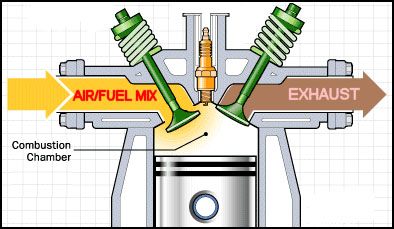
MPG-Caps after being placed into your gas tank and dissolving run through your fuel system. The chemicals from the MPG-Caps produce a catalytic coating in the combustion chamber. This catalytic coating provides an infinite nano-phase surface area for the catalyst to deposit on. This catalytic coating causes a catalytic reaction to occur in its presence.
So now we utilize the fuel to carry the MPG-CAP, in its dissolved state, to the combustion chamber, where the heat of combustion activates the chemical compound, and creates a very thin coating on the metal surfaces of the internal components within the combustion chamber.
What this catalyst does, for our purposes, is to cause a change in what is called the "in-cylinder rate shaping" of the combustion. This, in turn, provides for a 30% increase in pressure on the down stroke of the piston, in a time frame slightly altered from a non-catalyzed state. This results in the improved performance.
The teflon comparison: Here�s an easy way to explain MPG-CAPS to first time customers. Ask them if they know how a non-stick frying pan works. They�ll be familiar with the way the coating keeps stuff from sticking to the surface of the pan. That�s how MPG-CAPS work too, by coating the combustion chamber of your engine with sacrificial catalytic coating. This micro-thin coating acts to catalyze pump fuels and dramatically improve your performance. As long as you continue to use the MPG-CAP, the catalyst will continue to inhibit detrimental effects of sulfur molecules and other impurities found in pump fuels, retarding the formation of sludge, varnish and acids that are harmful to your engine. Your engine runs smoother, cleaner, has more pep, and you get the benefit of better gas mileage.
Below is a video in which Jerry Lang shows you exactly how MPG-CAPS work.