 Sikhism
|
|
|
|
|
|
|
|
A progressive religion well ahead of its time when it was founded over 500 years ago.
Sikh religion today has a following of over 23 million people worldwide and is ranked
as the world's 5th largest religion. Sikhism preaches a message of devotion and remembrance of
God at all times, truthful living, equality of mankind and denounces all superstitions and blind rituals. Sikhism is open to all through the teachings of its 10 Gurus, enshrined in the Sikh Holy Book and Living Guru, Sri Guru Granth Sahib.
If
you have any questions just email us and we will be glad to help you.
Sikhnet.com
Sikhs.Org
Hemkunt
Sahib Temple
Here
are some basic definitions.
Sikh basically means a student, a disciple, or a person who is always learning.
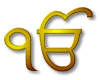
Ek Om Kaar means, There is only one God. One Savior.
The
first two words in the Guru Granth Sahib are one of the cornerstones of
Sikhism.
They
appear at the beginning of the Mul Mantra written by Guru Nanak,
describing
the qualities of God in the Japji Sahib.

The Khanda is the symbol
of the Sikhs,
like
the Cross is to Christians or the Star of David is to Jews.
It
reflects some of the fundamental concepts of Sikhism.
The
symbol derives its name from the double-edged sword (also called a Khanda)
which
appears at the center of the logo. This double-edged sword is a
metaphor
of Divine Knowledge, its sharp edges cleaving Truth from Falsehood.
The
circle around the Khanda is the Chakkar. The Chakkar being a circle without
a beginning
or an end symbolizes the perfection of God who is eternal.
The
Chakkar is surrounded by two curved swords called Kirpans.
These
two swords symbolize the twin concepts of Meeri and Peeri - Temporal and
Spiritual
authority introduced by Guru Hargobind. They emphasize the equal emphasis
a Sikh must place on spiritual aspirations as well as obligations to society.
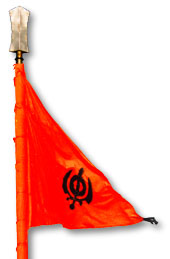
Nishan
Sahib is the name given to the flag which is seen flying outside
every Sikh Gurudwara (Temple). It is a triangular piece of ochre or saffron
colored cloth with the Khanda emblem in the middle. The flagpost also has
a Khanda or spear
on
top and is usually covered with the same cloth as the flag. The use of
the Nishan Sahib
was
first introduced by Guru Hargobind Sahib Ji.
