Benthos sampling on the Belgian Continental Shelf (BCS)
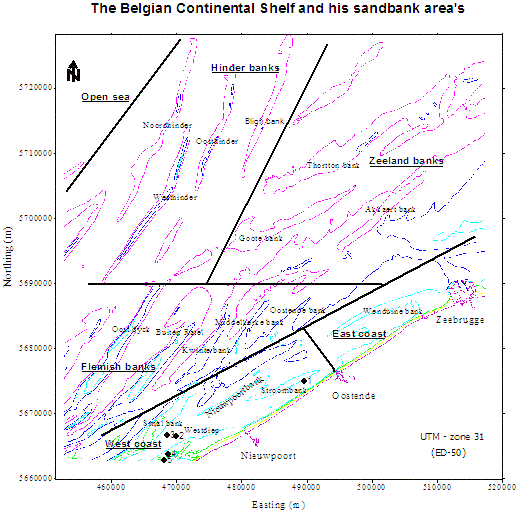
1) Geomorphology of the Belgian Continental Shelf (BCS)
Figure 1 with the indication of the different zones and sandbanks and the five stations sampled on the cruise.
Figure 1. Benthos map
Sedimentology
- There are different classes of sediment: muddy, fine sand, medium sand and coarse sand
- Top of a sandbank consist mainly of well sorted medium to coarse sandy sediment (station 4)
- The flank of a sandbank consist of fine to medium sandy sediments (station 5)
- The gullies between sandbanks consist mainly of fine sandy sediments (station 3). In the Westdiep gully an area of coarse sediment exist (station 2).
- Patches of compact mud are found in the gully along the Stroombank (station 1)
Benthos
Benthos are the animals that live in or on the ocean bottom; The ocean has a great diversity of physical and nutritive conditions evolving in different densities, with different taxonomic representatives of the benthos in different areas (eg different sediments).
There are different ways of studying benthos. This practical exercise emphasis on methodology, biological diversity and dispersion (zonation).
-- Benthos can be studied according to oceanic biozones
littoral -------- sublittoral --------- bathydal ----------- abyssal
LT-HT 0-200m 200-4000m 4000-6000m
* Benthos can also be studied according to place of occurrence and mesh size of the sampling sieves
*
Most common classification
Endobenthos (living in bottom)
Macrobenthos (> 1mm)
Meiobenthos (42 µm < xx < 1mm)
Nanobenthos (2 µm < xx < 42 µm)
Epibenthos (2 cm < xx < 40 cm and living near bottom)
Hyperbenthos (> 1mm and living in the lower part of the water column)
...
For each type of benthos a specific sampling methodology exists.
The stations during this exercise are chosen for their different representation of macrobenthic communities, mainly due to the different sediments (different locations: slope and ridge of the sandbank
Samples will be taken with the 'Van Veen' grab (at the sea) and cores (along the beach). Replicates will be taken at the different sampling stations. Other sampling devices, such as the Reineck box core (typical for meio-benthos) and the beach sledge (hyper-benthos) will be demonstrated. (pictures available)
The sorting of samples will be done in the field, including filtering with appropriate mesh sized sieve (1mm- macro benthos); conserving the samples with 8 % formaldehyde and staining them with the indicator Bengale Pink.
The different benthic components:
- Meiofauna: very small organisms (in µm), mainly Nematoda, Copepoda...Sampled with a Reineck Box corer.
- Macrofauna: organisms > 1 mm, mainly Polychaeta, Bivalvia, Gastropoda, Amphipoda, Echinodermata. Sampled with a Van Veen Grab.
- Epifauna: organisms living on the bottom in a narrow association with the sediments, like Sea stars, demersal fishes, crabs... Sampled with a Beam trawl (not demonstrated).
Some typical macrobenthic communities:
The Abra alba - Mysella bidentata community
* High densities
* High species diversity (No) and high Shannon wiener index (N1)
* Prefer fine sandy sediments with some mud content
* Common species are: Abra alba (Bivalvia), Lanice conchilega (a tube building polychaete that form 'riffs', station 5), Owenia fusiformis (Polychaeta), Nephtys spp. (Polychaeta), Actinaria spp. (Anthozoa), a lot of Gastropoda,...
* Sampled in station 3 and 5 (with Lanice conchilega riffs)
The Nephtys cirrosa community
* Low densities
* Low species diversity (No) and low Shannon wiener index (N1)
* Prefer well sorted medium sand
* Common species are: Nephtys spp. (Polychaeta), Gastrosaccus spinifer (Mysidacea), Echinocardium cordatum (Echinodermata), Donax vittatus (Bivalvia), ...
* Sampled in station 4
The Ophelia limacina - Glycera lapidum community
* Very low densities
* Low species diversity (No) and relative high Shannon wiener index (N1)
* Prefer coarse sand
* Common species: Ophelia limacina (Polychaeta), Echinocardium cordatum (Echinodermata), Glycera lapidum (Polychaeta), ...
* Normally to be sampled in station 2, which is situated in the coarse sandy area in the Westdiep gully, but only sample 1 of station 2 consist of coarse sand. The other 2 samples consist of finer sandy sediments.
The Barnea candida community
* Low densities
* Low species diversity (No) and relative high Shannon wiener index (N1)
* Prefer compact mud
* Common species: Barnea candida (Bivalvia), Ensis spp. (Bivalvia), Nephtys spp. (Polychaeta), ...
* Sampled in station 1
This document was updated most recently on April 18, 2002
 You
can send comments, remarks, questions by electronic mail to [email protected]
You
can send comments, remarks, questions by electronic mail to [email protected]
This page can be found online at http://www.geocities.com/dawod.rm/benthos.htm