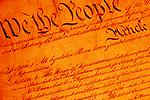
| The U.S. Constitution is an amazing document and a precious national treasure. For most Americans, the freedom of religion is the most important freedom our Constitution protects. The freedom of religion is the first promise of America. The First Amendment stands for the proposition that every human being has a natural right to worship God freely and openly without fear from the government. According to the First Amendment, the Government of the United States may not establish a religion or pass any law respecting an establishment of religion. In addition, the First Amendment prohibits the United States Government from interfering with the free exercise of religion. It is true that the phrase "the separation of church and state" does not appear in the U.S. Constitution, however the idea does. The concept of the separation of church and state is clearly taught in Article VI to the Constitution. In Article VI, the Constitution prohibits a religious test for federal office holders. To prohibit a religious test for a federal office holder is a clear separation of the institutions of government and the church. In America, our political leaders are not required to subscribe to a theological dogma in order to hold federal office. In addition, American political leaders do not have the authority under our Constitution to bind, enforce or in any way impose a theology on the people. This is what the separation of church and state originally meant in America. Some conservatives object to the phrase "the separation of church and state" because the words are not in the Constitution. Please be advised that the words "religious freedom" or "the freedom of religion" do not appear in the U.S. Constitution either and yet no one disputes that these rights are protected by the First Amendment. A New Definition of the Separation of Church and State However, since the 1960's, a new attitude toward religion and the public expression of faith has emerged. An attitude that is largely intolerant and hostile. Beginning with a series of court decisions in the early 1960's, the U.S. Supreme Court has promoted an attitude of intolerance toward religion. The U.S. Supreme Court has adopted a new extremist definition of "the separation of church and state." As a result of this new definition, the long standing practice of voluntary classroom prayer has been abolished. A practice which lasted for more than 170 years in America's schools. In addition, prayer at school football games, the display of the Ten Commandments in the public schools has also been prohibited by the government. This is not what the separation of church and state meant to the framers of our Constitution. From the beginning, America has acknowledged the existence of God. This can be seen in documents like the Mayflower Compact, the Declaration of Independence, the Gettysburg Address, in songs like "God Bless America" and in our national motto, "In God We Trust." To Americans, faith in God has been a source of unity and strength for the country. Unfortunately however the High Court does not share this view. The U.S. Supreme Court has foolishly divided America over religion. No one divides America over religion more than the Supreme Court. Absolutely, no one. The Court has managed to do what no religious fanatic or destructive cult could do before in American history. They started a culture war over religion. My Practice as a Lawyer I am committed as a lawyer to restoring the traditional definition of the separation of church and state in the United States. I support voluntary school prayer, the display of the Ten Commandments on public property, and the public expression of faith. Like the framers of the Constitution, I believe that faith in God is good for America and good for her future. I do not support the government promotion of sectarian theology. I do support the proposition that government as an institution should and must acknowledge the Sovereignty of Almighty God. This was the belief of Thomas Jefferson in the Declaration of Independence and George Washington in his Farewell Address of 1796. I hope you will join the fight to restore the values that made America great. I hope you will support values like faith in God, the family and patriotism. Blessings to you. |
 |
| CONSTITUTION LAW |
 |
|
 |
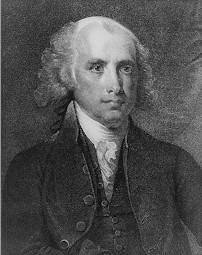
James Madison (1751-1836) James Madison has been called the "Father of the Constitution." Madison was the architect of what is known as the "Virginia Plan." The Virginia Plan called for the creation of a national executive, a national judiciary and a national legislature made up of two branches. The plan was submitted to the constitutional convention by Governor Randolph of Virginia. James Madison however was the brainchild of the plan. The Virginia Plan favored the large states. It effectively gave control of the national legislature to the large states. At the time, Virginia was ranked with the large states. In opposition to the Virginia Plan, William Paterson of New Jersey proposed the "New Jersey Plan." This plan favored the small states. It was a rehash of the Articles of Confederation. The debate between the supporters of the Virginia Plan and the New Jersey Plan was intense. Benjamin Franklin offered what became known as the "Great Compromise." The compromise involved the national legislature which was to be made up of two houses. In the Senate, each state would have two Senators thus meeting the demands of the small states for equal representation in Congress. However, in the House of Representatives the larger states would be favored. The House membership would be based on the state population. This would meet the demands of the larger states for more power in Congress. Did you know the average age of the members of the constitutional convention was 42? The youngest member was Jonathan Dayton of New Jersey. He was 26. Benjamin Franklin of Pennsylvania was the oldest. He was 81. |
 |
| ALL RIGHTS RESERVED. CONTENTS MAY NOT BE REPRODUCED IN WHOLE OR IN PART IN ANY FORM WITHOUT THE WRITTEN CONSENT OF DAVID W. NEW. |
| COPYRIGHT 2002-2005 DAVID W. NEW |
 |
| THE MATERIAL POSTED ON THIS WEBSITE IS FOR INFORMATION PURPOSES ONLY AND DOES NOT CONSTITUTE LEGAL ADVICE. FURTHER, THE ACT OF SENDING AN EMAIL MESSAGE DOES NOT CREATE AN ATTORNEY-CLIENT RELATIONSHIP. |
 |

|
 |
| LINKS TO THE CONSTITUTION AT THE U.S. NATIONAL ARCHIVES |
| CONTACT INFORMATION: David W. New, Esq. 6701 Democracy Blvd. Suite 300 Bethesda, MD 20817 301-468-4905 EMAIL ME |
| Would you like to understand why America has more religious freedom than any other country in the world? Read my booklet and you will: "Religious Freedom in America for Beginners" |
|
 |
| Would you like to understand the First Amendment? Read my booklet and you will: "The First Amendment and the Bill of Rights for Beginners" |
|
 |
| Would you like to understand the U.S. Constitution? Read my booklet and you will: "The Constitution for Beginners" |
|
 |
| Would you like to understand how the Ten Commandments became the foundation for American law and government? Read my booklet and you will: "The Ten Commandments for Beginners" |
|
 |
 |