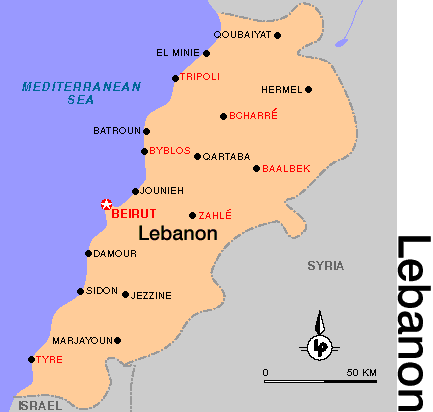
Find out about the country at the Lonely Planet Lebanon info page.
|
Find out about the country at the Lonely Planet Lebanon info page.
|
The Lebanese customs building reminded me of the channel ports on childhood holidays to France. We'd queue in a large shed divided into several aisles, with long benches on either side where unfortunate redfaced tourists would have to re-pack their dirty laundry into overstuffed cases in front of cars full of sniggering children. After my parents gave up their multi-coloured flower stencilled VW Kombi, which screamed 'search me' to customs officials, in favour of a less conspicuous vehicle, we generally avoided the vehicle equivalent of a strip search. However, this may have been because the customs officers couldn't face the prospect of unpacking a minivan stuffed with a family of four and all their clothes and camping equipment for a two week holiday, not forgetting the four bicycles on the roof. They would have had to unroll the roof like the top of a sardine can.
Fortunately the Lebanese official wasn't interested in the contents of the various bags and unusually shaped luggage strapped onto the bikes and he filled out our carnets in no time while demonstrating his command of Arabic, French and English. I had assumed everyone would speak English so was a little nonplussed when the immigration official addressed us in French. Rusty cogs turned as we hesitantly tested long forgotten words and phrases. The last time I attempted to speak French was in a Paris restaurant in 1990. I confidently ordered our dinner in what I thought was perfect French, only to be shamed into silence when the waiter laughed at my pronunciation and thereafter spoke to me only in English.
The immigration officer was a little more understanding and somehow we managed to communicate. We had to pay for our visas in local currency and he directed me to a moneychanger in the street. Ever suspicious I asked the money changer what the official bank rate was, 'I am the bank' was the reply and the end of the matter.
Another soldier had heard we had Australian passports and was keen to tell us that his family all lived in Auburn in Sydney. This was to become a common occurrence, meeting Lebanese with an Australian connection, no surprise really if it is true what someone told us that there are more Lebanese living in Australia than Lebanon.
The first thing we saw when we reached the Mediterranean coast was the lines of tents housing some of the large numbers of displaced Palestinans who have fled to Lebanon over the years. The coastal strip between the road and the sea was packed for several kilometres with makeshift villages and the narrow rocky beach itself was piled high with plastic bottles and mounds of rotting rubbish. It was a clear reminder that the troubles that have plagued the Middle East for so many years remain very much unresolved.
As the tents were replaced with houses and flats, we passed into the outskirts of Tripoli, and then into Tripoli proper. Tripoli was not as badly damaged as Beirut during the Lebanese civil war and many of the old buildings remain. The old city with its narrow alleys and souqs is largely intact and in places is being refurbished, with the help of the Saudi government. When we stopped in the main square, Saahat at-Tall, to ask directions, a Dutch couple who recognised the bikes from Aleppo came up to say hello and suggested we stay at their hotel.
We gratefully followed them to the Pension Haddad, really a family home with rooms for rent, on the third floor of an ancient tenement block which had an open central well joining it to an adjacent hotel. We were shown to a narrow room with timber shuttered windows, crammed with four beds all covered with embroidered bedspreads and doillies draped over every surface. Quaint but very comfortable. A whole extended family lived here and in the rest of the tenement, and we couldn't quite work out who was a family member and who was a paying guest. One man wandered round in a vest the whole time and his wife who wore the full black outfit would quickly cover up her face any time I entered the room. Another man slept on the couch at night and late into the morning, then would disappear for the rest of the day; presumably he was a distant relative whose room was rented out when a paying guest arrived. Various children shuttled between the pension and the flat opposite and above and I suspect that wherever the children ended up at dinnertime they would be fed.
We went out for a wander and negotiated our way through the traffic which consisted mainly of Mercedes taxis all tooting at us. This seemed a little bit odd. Surely if you want a taxi, you know in advance and don't just suddenly realise you need one when a taxi toots at you. It got very annoying, very quickly.
To our delight we soon found our way to a modern mall with a cafe selling alternatives to kebabs, and a cinema showing English language films. We were surprised by the number of films showing but disappointed by the selection (how could we admit to seeing 'Miss Congeniality'). We opted for a film with Ben Stiller, Natasia Kinski and Jason Patric ('Your Friends and Relations'?) and soon realised how so many films could be showing in such a small place. There were only about twenty seats in the entire cinema and the projectionist seemed surprised that anyone had turned up at all. He hadn't even turned on the film and when he did we'd missed the first five minutes. Oh well, it was still a real treat.
After the lack of internet cafes in Aleppo, we were relieved to find them everywhere in Tripoli. We spent most of one day and half of another updating the site and catching up with email. It might seem like a waste of time to spend it in front of a screen when we could be out exploring an ancient city, but it has become a really important part of the trip. I suppose in the past we would have installed ourselves in a cafe somewhere and written letters and postcards so this really isn't much different. The real improvement with email of course is that it is two way and we both really enjoy and appreciate the email that is waiting every time we log on.
In the cool of the evening we went for a look around the old city which really is a maze of narrow cobbled streets. There is a famous 'khan' or old caravanserai which has traditionally housed the soapmakers of Tripoli. The young heir to the family business collared us, asked us where we were from, then explained enthusiastically how the Lebanese had introduced soap to most of Europe and to Britain in particular, where until then, he said in a tone of disbelief and disgust, people didn't wash!
We bumped into a young Lebanese Australian bloke in the street who had returned to Tripoli with his family for a year and wasn't exactly delighted about it. I think he missed the footy and his 'bros' from the 'hood. He seemed pleased to be able to talk to some fellow Aussies, even if we didn't speak ocker, as he admitted his Arabic wasn't up to scratch. He was also keen that we come and meet his Lebanese brother-in-law who had a hair salon, 'Salon Fathi's'. Since I'd been struggling in the heat with a beard, it seemed like a good opportunity to get a proper shave, so we agreed to go along next day.
Fathi was delighted to see us and as he is shortly to move to Sydney himself, was keen to find out how easy it would be to find work. Not knowing a great deal about the employment market for hairdressers in Western Sydney, we just said no problem of course he could find work. So I was treated to a haircut and wet shave that took almost an hour and a half. I tried to describe the style I usually have and Fathi finally summed it up, "Yes! Just like Ricky Martin!" Mo snorted and said if Fathi could make me look like Ricky Martin she would give him an extra big tip. It was all very civilised, all of us sipping Turkish coffee and wondering over Australia's defeat of France in the football. Mo sat patiently, occasionally telling Fathi what a good haircut it was and yes I do have lovely hair and yes you do bear a remarkable resemblance to Robert De Niro and yes that lacquered look really suits Dave, yes a little more hairspray...etc.
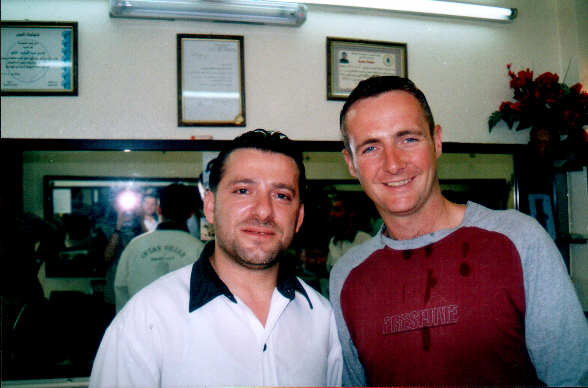
Robert de Niro and Ricky Martin my arse
So we left the salon with good wishes all round and me with a rock hard and waterproof crust on my head. We got a 'service' shared taxi (ignoring the tooting taxis, we had to find the rank for shared taxis which for some reason don't cruise their customers) to the Corniche and strolled along the waterfront in the sunshine eating ice cream and admiring the speedboats in the harbour.
We returned to the pension for our last evening there and sampled a home-cooked Lebanese meal. It was the best food we've had in the Middle East, a simple selection of mezze and vegetable dishes plus a big bowl of fried sliced potato. And then to top off the evening, while searching resignedly through piles of Lebanese magazines full of pictures of local socialites in dark suits or little black dresses, we happened on a couple of British mags, and spent a happy few hours reading. A very relaxing few days.
Lebanon is a relatively small place, so on our way to Beirut, which is only 90km south of Tripoli, we thought we'd make a couple of detours. Two of the most popular tourist spots in Lebanon are the Cedars of Bcharre, the last remaining forest of biblical cedars which are reputedly more than 1500 years old, and the Roman ruins of Baalbek, both of which can be visited on an arc between the two main cities.
We got detailed directions from the hotel owner who insisted the Bcharre road was very simple to find. The first turn we tried to take was a one way street and the second led us back to where we started. Fortunately, and not for the first time, a man on a motorcycle got exasperated trying to direct us and led us out of the city himself.
The road to Bcharre passes through what is reputedly some of the most beautiful scenery in Lebanon and rises from sea level to around 2000m in the course of a one and a half hour drive. It was particularly lovely on the bike with lots of challenging curves and hairpin bends, although the precipitous drop was more effective than any speed limit sign. The road passed through small villages, where people stood talking in the street and old moustachioed men sported the traditional trousers with the crotch at knee level, and past vineyards and olive groves, climbing higher and higher until we were looking down on a steep sided gorge where we could glimpse the red tiled roofs of the houses and the spires of several churches.
We arrived at the ancient cedar forest, tucked in a fold on the otherwise empty hillside, immediately identifiable by the enormous tree forcing the road to twist around it and by the row of shops selling the usual tourist junk, but made unique to 'Les Cedres' by mounting the junk on lumps of cedar. We didn't get close enough to actually see what was for sale but I could guarantee there was at least one cedar mounted clock. The forest itself was sadly depleted, originally by the Phoenicians to sell to the Egyptians and to Solomon to build his temple, and more recently it seemed by enterprising locals to make attractive wall ornaments.
We had an uninspiring lunch overlooking the small forest and got chatting to Sammy from Sydney who was visiting his relatives, and who insisted on giving us his number in case we got into any trouble. The busload of tourists heading through the gate towards the trees inspired us even less, so we zipped up our jackets for the first time in a while and headed upwards again.
The top of the pass is well above 2000m and is a popular ski area in the winter, although like Scotland the hills are very exposed. There were still a few snowdrifts melting in the sunshine, so I took the opportunity to throw my last snowball for a while. Poor Mo was the only available target and I was pleased how I managed to catch the edge of her visor in just the right way, so that the snowball disintegrated and went straight down the front of her jacket. The pass then dropped dramatically and the temperature soared as we headed towards Baalbek.
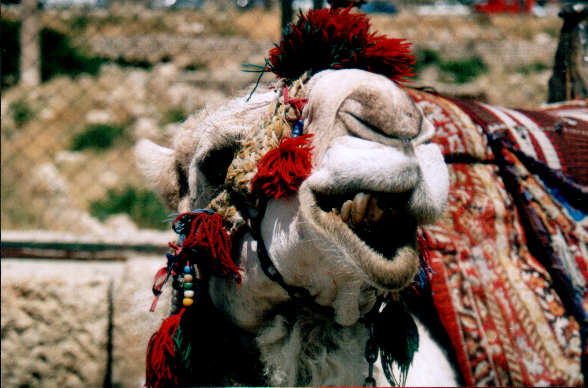
Give us a kiss - camel at Baalbeck
The ruins are right in the middle of the town of Baalbek which I didn't realise until we turned a corner and there was an ancient temple in the middle of the road. The city has been destroyed and rebuilt over the years and it is surprisingly complete today. Some of the 20m high columns are still standing and are an impressive sight. It is still used for 'cultural' events and they have theatrical and musical performances; Sting is playing there in a few weeks. We spent a couple of hours wandering around the various temples and the excellent museum which managed to hold our attention for half an hour which is a real achievement. It's amazing how much everyone resents paying entry fees to places like this. $5 or $10 seems like a lot of money when you're on a budget. In India, the entry fee to the Taj Mahal has recently been raised to $20 and all the backpackers have stopped going, with the result that the cheap local hotels are closing down. I wonder what sort of people we'll meet at Petra where the entry fee is $35. Baalbek was certainly worth the $8.
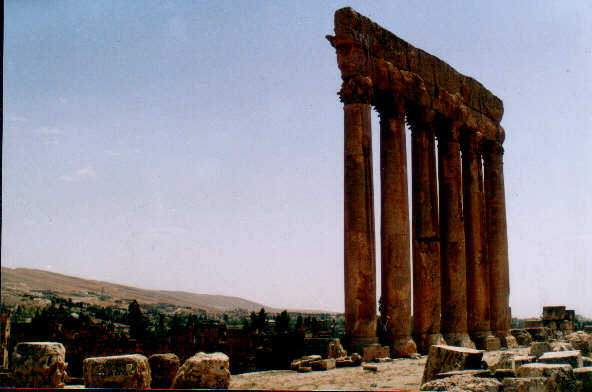
You can just spot a tiny Mo at the base of the first pillar to give this some scale
With only an 80km drive to Beirut, we were lookng forward to arriving in time to go out for a proper Saturday night in a city famous as the party town of the Middle East. The road was straight and not too busy and we were doing around 80km/h when I looked in my mirror and suddenly Mo had disappeared. Thinking she'd stopped for a photo, I pulled over to let her catch up. Then a van pulled up and the driver leaned out of the window shouting in Arabic and gesturing behind him. I did a u-turn and sped back down the side of the road with my heart in my mouth.
Mo was standing at the side of the road surrounded by a small group of men, several of whom were holding up her bike. As I pulled up in a panic Mo immediately reassured me she was okay but pointed first to the bike which was all scuffed down one side, and then to the road which had deep lines gouged out of it for about 20m. Mo was in a state of shock and couldn't work out what had happened, she seemed to think that maybe the back wheel had fallen off. After a quick look it became clear that the back tyre had picked up a really big tack and immediately gone flat, sending the back end into a violent weave, leaving Mo fighting for control and frantically trying to slow down before the inevitable happened. She must have slowed done quite a bit before the bike hit the ground and did the last 20m on her side, managing to move away from the bike. A lot of drama then but neither she nor the bike was seriously hurt.
Fortunately, but suspiciously, there was a tyre repair place 500m back down the road, so I repeated the by now familiar routine of getting the back wheel off and carrying it to the garage. Mo had chosen her accident scene quite well as we were right outside a Yoplait factory and the office had a little parking area where she and the bike could rest on the forecourt. Two guys stopped to see what had happened, an English bloke Kevin and his mate, both working for the owner of the factory. They were very concerned, and interested, and Mo got another emergency phone number to call. When I came up they were all sitting chatting which I think gave Mo a chance to recover and not think too much about the crash.
So we got back on the bikes and headed for Beirut, still 80km away, but only about an hour's drive, we thought. As we drove south, the road got busier and busier and the traffic slower. It appeared that the villages flanking the main road had all joined up and that the suburbs of Beirut extended 50km north. We slowed even further as we passed military checkpoints. To make matters worse, the driving was abominable with cars overtaking on blind corners and in the face of oncoming traffic. We were relieved when the road widened into dual carriageway and we began the final climb over the hill to Beirut. Lines of Mercedes and BMWs, almost the only cars you see here, forced their way past us in a race for the city, pushing us into the verge. We reached the ridge and below us lay Beirut, a vista of white houses and apartment blocks blanketing the hillside all the way to the sea.
It's never much fun arriving in a big city, but Saturday night in Beirut was a bad time to be doing it. We just aimed for the sea and hoped to find our way north or south to the hotel we'd chosen, from wherever we ended up. We hadn't taken into account the Saturday night cruising traffic which forms an almost stationary line along the fashionable seafront. Eventually with much relief we spotted the 'golden arches' of McDonalds, not because we craved a Big Mac but because we knew the hotel was only a few hundred metres away.
We spotted a carpark and drove in hoping to leave the bikes in safety for a few minutes while we explored. Smiling at the attendant and indicating we would only take five minutes, we were amazed when he shrugged and said, "one dollar". This was the limit of his English and he didn't speak French either (or at least he didn't understand my accent), so he just repeated hmself, "one dollar". I made some nasty remark about his dubious parentage and Lebanese hospitality and we went off to park in the street.
The hotel was right next door on the third floor and seemed fine, if a little basic, so we wheeled our bikes into the lift lobby where we'd been told we could park for free. Unfortunately an irate man who I assume was the building manager appeared and told us in no uncertain terms to get the bikes out - he didn't accept my argument that they'd raise the tone of his building. So the hotel manager pointed us to an alternative parking spot, in the carpark next door... So we had to return to our friend the carpark attendant and ask if we could park in his lovely carpark for three nights, and could we have a special rate please? Humble pie has a really bitter taste I find.
The ride had taken us two and a half hours and it was after nine thirty by the time we went looking for food and drink. Mo was understandably exhausted so after a quick look at the trusty guide book, we settled for a sub sandwich on Bliss Street, the cafe district opposite the American University which is a major landmark in Beirut. We wandered down to the corniche, or waterfront, which was absolutely mobbed with all sorts of people. Families had brought vast picnics and most of the furniture from home, kids rollerbladed and scootered up and down the promenade and young guys sat in their open cars with the music cranked up, while others swam from the rocks in the dark sea below. I had a McDonalds coffee, which I have to say was a nice contrast after all the strong and sweet Turkish coffee. And then we went to bed.
Beirut in most people's minds is still a warzone. Images of shell-torn buildings were such a staple of the news for the 16 years of civil war that engulfed the country until 1991, that it will take a long time to persuade people of the city's renaissance and allow it to regain its reputation as a Mediterranean resort town.
More than $20bn has already been spent on the reconstruction of Beirut, mainly in the old city centre, which had been levelled during the war. We wandered through the new business district and were really impressed by what has been done. In such an ancient city, the new buildings are sympathetic to the existing buildings that have been renovated. During reconstruction, various archaelogical discoveries were made and some of these have been preserved and incorporated into the new city. Next to a modern piazza of swanky clothes shops and cafes, there is a large area below street level of ancient ruins, which you can wonder at over a cafe latte. This part of the world is full of evidence of previous civilisations and the ancient past is really a part of life like nowhere else we've ever been.
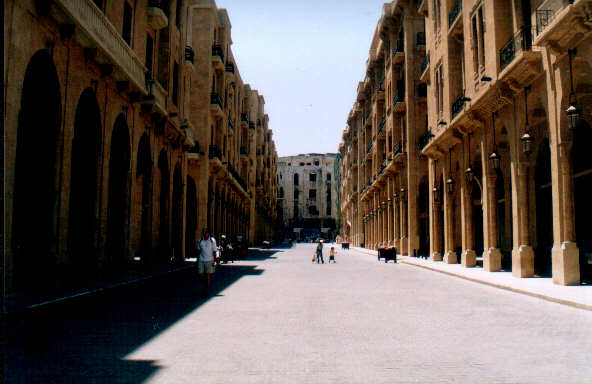
Sunday morning in the all new Beirut city centre
As we left the central district and wandered through areas still awaiting renovation, the scars of the war were all too evident. Almost all the buildings are pockmarked with bullet holes and some of the larger buildings have shell damage visible. It's not difficult to imagine how terrifying it must have been to live here during that time. What is difficult though is to see how those same people who fought each other so viciously can still be neighbours now.
We found our way back via empty streets of closed shops to the familiar territory of Bliss Street. It's Sunday and unlike other Middle Eastern countries, Sunday is the day of rest here. Fortunately the 'Bliss House' was open so we managed to get an extremely good sandwich. We spent the rest of the afternoon doing the website then walked to the city centre again to the 'Hole in the Wall' pub, which had been recommended by Kevin, the English bloke from yesterday. It was lovely to sit in a comfortable bar and have my first pint of Guinness for a very long time. And then, in this obviously cosmopolitan area, we even managed to find a baked potato shop. It was probably the best potato in the world. What a great place Beirut is, we've been here 24 hours and haven't even had a kebab yet.
On Monday morning we had to go and get our visas for Jordan and to find Mo a summer dress for Greece, which she clearly deserves after those weeks of wearing a tent. We got up early and had asked various people for directions to the embassy but it wasn't until we spoke to the girl in the Holiday Inn (from Sydney) that we found out that it was a public holiday. Doh! No embassy and no shops. So we ended up in a really nice internet cafe for about 6 hours updating the site. We noticed quite a few American accents around the city, but don't know if they were expats or whether they are taught the American accent at the university.
We'd noticed that the local cinema was showing 'Charlies Angels' with Cameron Diaz and Drew Barrymore so we jumped at the chance, especially when we found Monday was cheap night. This time it was our fault that we missed the first five minutes of the film, but the way that the plot progressed, or rather jumped, made us think we'd missed a lot more than that. Although there were holes in the plot, references to events we hadn't witnessed and various unexplained characters appeared and disappeared from the story, we enjoyed it nonetheless. It wasn't until the credits rolled after a total of one hour and ten minutes that we realised that massive chunks of the film had been deleted. Just as well it was cheap night. So of course now we're going to have to get the film out on video when we get back.
We waited until what we thought would be a quiet time after the rush hour and headed east without any real idea of where we were going. We have made several attempts to buy detailed road maps but haven't found any good ones, so we've navigated our way around the middle east using a map where the whole region is the size of the palm of my hand. Fair enough when you're sticking to highways, but not too helpful in downtown Beirut.
Once again luck was on our side and a friendly local took pity on us and led us out to the main road in his car. He needn't have bothered though, as it turned out that the main road east is the same as the main road north, ie the road over the hills that we arrived on. So we negotiatd all the steep hairpin bends and lunatic drivers all over again. The road was also being resurfaced and the top layer had already been scraped off, a very unpleasant surface on a motorbike as the tyres tend to follow the direction of the grooves, so for twenty kilometres we were led by the gouges in the road, which occasionally headed straight for the verge, presumably where the scraper driver had stopped for lunch.
We made a last stop for petrol before the border, Lebanese petrol being half the price of Syrian and to use up our remaining Lira. We had been confused the first time we filled up because the price displayed didn't seem to bear any relation to what we were actually charged. Apparently they advertise the cost of 20 litres. How useful.
So we arrived at the Lebanese border where some kind of efficiency record was broken by both the customs and immigration people. Having left Lebanon, it was then a further 5km or so through barren and rocky hills, where we could easily picture a sniper behind every rock, before we eventually reached the Syrian border post.
 |
 |