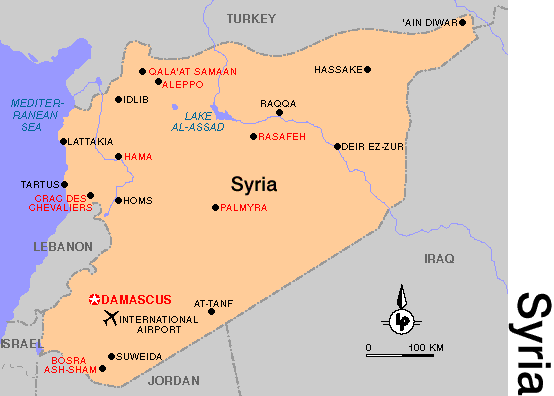
Check out the Lonely Planet Syria page for more info.
|
Check out the Lonely Planet Syria page for more info.
|
Through the gate and the first requirement of the Syrian authorities was that we ride the bikes through a trough of disinfectant. Who knows what infection they thought we might have but they took it very seriously as after we had parked we had to walk back and press the soles of our boots into a foamy sponge to clean them too.
Thoroughly cleansed we headed into a little shed for customs clearance. The officer was stout and baby faced with what you'd call a fine head of hair and bright blue eyes. He was very much In Charge. "Welcome in Syria, welcome, welcome. This your wife? Your friend?" "Yes, my wife." "Wife, friend, no problem, welcome, welcome." He started looking through our documents and picked up Dave's passport. His eyes narrowed, "Thomas DAVID. David is Jewish name. You are Jewish?" "No, David's a very common name in the West." "No, it is Jewish name. Jewish?" He clearly wasn't seriously accusing us of being Jewish based on Dave's name, but he was pretty unpleasant nonetheless. We said "No, no, we're Christian." "Christian? Muslim, Christian, in Syria, same, equal, brother, sister, welcome. Jews, bad." and he screwed up his face. There wasn't much we could say to any of this so we just sat and let him play his game.
He was probably the most unpleasant customs official we had met so far but he knew what he was doing and worked his way through the carnets very professionally. Then, out of the blue "Now you give me $80." A stunned silence and then we remembered that Syria requires you to have third party insurance, the first country so far to have done so. It still seemed a little dodgy as he explained "Insurance $29. Tax $12. That means each person $40." Well, strictly speaking... but it didn't seem worth arguing. When he slipped the money into his top pocket, and then offered to change our Turkish lira for a good rate we were pretty sure we'd been done (but talking to other travellers later, it seems $40 is the going rate).
Back on the bikes and one kilometre up the road was the shabby little immigration office. We handed over our passports, expecting them to be handed back a minute or two later. But the officer showed them to another officer. And he called another one. They all stared at our passports, then examined each page in turn. They all went off into another room, then one came back out and looked at us. Then they all came out and looked at us. Then, with much belly scratching and pensive rearranging of crotches, they worked their way through our passports again. Finally one of them showed us what the problem was. Our visas, which we'd arranged in Sydney, both had the same visa number on them. I could see their point, that this was a bit unusual, but what to do about it? We said these were the visas we were given, that we had applied together, that maybe this was how they did it in Australia. Finally they all disappeared in a little huddle, made a phonecall to a superior, and came back with our passports stamped. We were in.
While we'd been waiting another traveller had come in to the office - a fantastic looking Arab. He was wearing a long white robe with a fine loose coat over the top, a kind of hessian colour with gold braid round the edge. He had a white headscarf on, with the points hanging down on either side of his face, a circle of black cord sitting on top of his head holding it on. Every now and then he would carefully push the two tails back, like a woman with long hair. He had a huge nose and solid, strong hands, and he just looked so... Arabic, it was great.
So we were off into Syria. I tried to ask the immigration men which side of the road Syrians drove on but couldn't make myself understood and it was a worryingly long time before we managed to work it out for ourselves. There didn't seem to be any very clear system - cars and trucks just appeared and shot along the road wherever they fancied. We rode along - it was still flat and hot but the land was totally cultivated, huge fields of golden... something, wheat maybe? We passed farms and fields and mud or brick houses. Passed a scarecrow dressed in the same type of Arab outfit as the man at immigration - a long white robe and a kaffiyeh, the checked headscarf best known in the West as the signature accessory of Yasser Arafat. There was obviously some sort of harvest in progress as every few miles a huge piece of farm machinery would lumber into view, waving men perched high on the back.
We finally reached the outskirts of Aleppo, the city we were planning to stay in. Asking directions an old man asked "Allemande?" "No, Scotland, Ecosse." "Ah, Scotlanda!" We worked our way through the city searching for our hotel and finally asked directions from a young boy on a bicycle. He spoke French so Dave dug deep into his murky school days and eventually made himself understood. The boy said he would show us the way and peddled off furiously. We puttered along behind, slowing to a crawl on the uphills and glided in a regal little cavalcade through the streets of Aleppo. On the steeper uphills Dave reached out and pulled the boy up to the top. After ten minutes of this we arrived at the hotel and our little guide waved and sped off again. The hotel was on a tiny dead end street, full of parked cars. The shopkeepers sitting chatting outside their shops noticed that we couldn't get through so a few of them got up, lined up behind a pick-up that was blocking the way, and bodily lifted it to one side. Dave squeezed through, then me, and they put it back down. Smiles and waves all round.
The hotel was charming, tall and skinny with steep stairs and a sitting room on each floor with sofas, cushions and, bizarrely, a small fountain, it was like an old Parisien pension. Our room had three shuttered windows, two beds, a table and a sofa so it felt quite palatial. We went out to explore Aleppo. The whole city had a strikingly European feel, with tall shuttered buildings towering above narrow streets. We ended up in the Baron Hotel, sipping flat Syrian beer. The Baron was once one of the chic-est hotels in the world and has counted T.E. Lawrence and Agatha Christie among its guests. In fact T.E. Lawrence spent a lot of time here at one point and in a glass cabinet in the bar was his unpaid bill from 1914. Unfortunately most of the furniture seemed to date from about the same time. It was pretty shabby, but you could see how amazing it must have been in its heyday, and it obviously still attracted the ex-pat set who were lounging around sipping on beers and reading magazines.
We had dinner in a rooftop restaurant nearby. It was a perfect temperature to sit out in and you know, as kebabs go, it was a bloody good one. We looked down onto the street at the native Aleppans, a real mixture. Still lots of women in headscarves, and quite a few totally covered with a black veil hanging down over their faces. One woman walked past with her face shrouded but from under her long coat we could see silky trousers and high-heeled black shoes. Odd. Some other women looked rather different - beefy legs clad in tight leggings, leopard-skin tops, high heels, weirdly dyed hair. We found out later that there is a big Russian contingent in Syria and, without making a sweeping generalisation about Russian fashion, suspect that these women were part of that.
Dave needed to do some work on the bikes and set them up outside a little shop down in the street, with the owner sitting on a little stool watching him. I went down to give some moral, if not any practical, support and the shopkeeper got out another little stool for me to join him. He then got out a teapot and some glasses and offered me a glass of some sort of hideous Syrian concoction - with the glass three quarters full of green herbs he sprinkled some sugar on top and then poured hot water over the lot. An ornate silver tube was in the glass (a really classy straw, basically) and we sipped up the dark, cloudy liquid from underneath the thick floating layer of herbs. It was just foul. "You like?" "Well..." He laughed and poked himself in the ribs with his forefingers, "Good, good." So it's good for your sides apparently and you know, my sides have been feeling pretty good ever since.
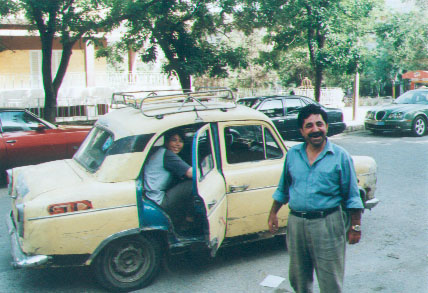
This car is in bloody good condition by Aleppo standards
Dave had a horrible time with the bikes - wrestling with bolts done up too tightly by the mechanic and trying to fight off helpful locals eager to show him how much they knew about a motorcycle five times the size of any you could get in Syria. When he had had enough we went off to explore the old city, walking up through little alleyways to the citadel. Most of the shops seemed to be run by and for Russians and sold some of the worst clothes I have ever seen. There were also a huge number of places selling underwear - far more than you would think a town of this size could support. Barrows and stalls were stacked with nasty cotton high-waisters, but many of the shops sold full-on sexy lingerie. We saw a group of black clad, head scarfed women clustered round a window full of really hard core stuff, all feathers and zips and red vinyl. Is that what's going on under these black tents? Surely not. In the end I concluded that they were just standing there gripped by a kind of appalled fascination, much as I was myself.
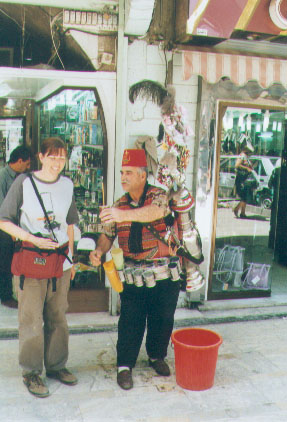
We just wanted a photo but ended up drinking a glass of unidentified liquid
That evening we went out for dinner with Mart, a Dutchman staying at our hotel and owner of a shiny red BMW F650 that we'd spotted in the street outside. He was travelling alone and announced to us in no uncertain terms that he was in need of some company so we all went out together for a beer and some food. He was good company, very funny about the perils of being a lone traveller, and a gay one at that. Just as people were intrigued by our childlessness, they were very concerned by his single status. In the end he got sick of saying that he had never married and contending with people's bewilderment, so he started telling people that he had been married and his wife had died. That certainly stopped the questions, sometimes prompted a few tears, and on one famous occasion got him a free dinner when the owner of the restaurant he was in got to hear of his personal tragedy.
Mart told us that he had been approached in the citadel that morning by a man asking him to contact Amnesty International on his behalf. The man claimed that he had been jailed twice for speaking out against the political regime in Syria, in other words the Assad family, which has controlled the country in police state conditions for the last 30 years. The man said that he was forbidden to talk to foreigners and Mart asked how he was able to talk to him now. "It's Friday. The stupid secret police are all in the mosque." It was interesting to hear something about the political situation as the most obvious thing about Syria, something that you are aware of first thing in the morning and last thing at night and every minute in between, is the ubiquitous presence of the Assads. They could teach the Ayatollahs and Attaturk a thing or two about public iconography, having taken it to saturation proportions. Every shop window, hotel lobby, building-side or billboard has a portrait of the late President Assad, his late son Boris, or his other son, the current President. Every roundabout, or park, or city square has a statue or bust of one or all of them. Every single car, bus or truck has at least one picture of them on the windows, sometimes stuck on so comprehensively that there is virtually no visibility in or out of the vehicle. The late President usually sports a suit and tie and stares down beadily, with a sort of steely intelligence. The sons get to be a bit sexier - sometimes in combat gear, sometimes with mirrored shades, every now and then on horseback. It really is an incredible show of power. From what we've read it seems that the Assads hold completely fair and democratic general elections every few years at which they receive 99.9% of the vote. That's certainly something for Tony Blair to aim for.
The next day, Saturday, we explored the old Christian quarter. Many of the Christians who fled from Turkey during Attaturk's regime ended up in Syria, and most of them in Aleppo. It says something for the Syrians, and the Assads, that the country and its people showed enough religious tolerance to accept them (although clearly that religious tolerance doesn't stretch to Jews.) The Christian quarter was lovely - tall stone buildings, narrow canyon alleyways, more weird underwear shops. We got lost and it was hot so I was struggling a little. An old man sitting in his shop noticed this and invited us in to sit beside his fan for a minute. He spoke good English and he told us he had learnt it from the soldiers who had come through Syria during the war. "From many countries - British, Australian, New Zealand, Indian. They come and then they go. To Egypt. To Tobruk." He told us that he had worked for the army as a driver and had gone to Egypt. "Did you go to Tobruk?" Dave asked. "No, no, I go to Egypt, and come back." "Wise decision." He agreed, and told us that he was now 80 years old and had ten children and, we counted them up together, 29 grandchildren.
We had lunch in an old converted house in one of the little alleyways. It was beautiful as a restaurant and must have been stunning as a house, with a shaded courtyard and steps down to cool rooms underneath. One of the waiters took us down a little set of stairs, down and down until we reached a hand dug cellar, 10 metres deep. It was cool and there was a breeze coming from a tunnel allegedly leading all the way to the old citadel. The whole area was so nice that we came back for dinner to another converted house/restaurant and Mart joined us. We had pasta and salad and it was the best meal we'd had for weeks. We said our goodbyes to Mart. He had changed his plans and was heading off for Saudi Arabia and Iran. (He had asked me to rate the attractiveness of the men in the countries we had visited and I had mentioned that the men in Iran had a certain male-figure-skater look around the behind and this seemed to have inspired him.)
The roads were pretty good quality so we sped along, ending up in green countryside. Lots of fragrant pine trees, silvery olives and darker cherry trees. We passed one tall cherry tree being harvested, brightly dressed women hanging all over it like Christmas decorations, dropping the red and yellow cherries into wide baskets. At the side of the road little boys sold fruit - cherries and apricots balanced in perfect pyramids.
We were trying to get to the castle of the famous Muslim warrior Saladin. Saladin is a hero in the region as he spent his life fighting, and beating, the crusaders and finally signed a truce with Richard the Lionheart which allowed the interior of the country to remain Muslim. In spite of this high status Mart was right, there were no signs for the castle. Dave stopped and asked directions every few miles and we were sent under and over and around hills. At one point someone showed us the way for a few miles on his moped, at several points no-one had ever heard of Saladin (the Arab and, to be fair, correct pronunciation of his name involves, as do many Arab words, a sort of strangled choking sound that we'd never quite got the hang of). Round and round we went and just when it seemed that we were never going to find it, round a corner there it was, astonishing. The castle itself was a ruin but it was the location that grabbed you. Perched on top of a jagged point of rock, a deep ravine dropping vertically in front of it, and your heart went out to any poor crusaders who had tried to storm it.
We set off again into the signless countryside, this time looking for Apamea, an ancient ruined city. We asked directions frequently, tried little roads, retraced our steps, asked again, were given conflicting advice and finally ended up in a town. Dave consulted a guard outside an army barracks and was confidently waved on. A little further on he asked again, and was confidently waved to the left. Again, and was told yes, go down there to the left. The road was just about to leave the town when it dawned on me - there was the gate, the guard, we'd come a full circle and were back where we started. Dave looked at me, got off the bike and took the map to the guard hut. A brief chat, and the guard pointed confidently up the road. The road we had arrived on. The road we had been riding around on for two hours. Dave said reasonably that he was fairly sure that wasn't the right way. Yes, the guard said, you need to go to the village of Sunfeh. They stood for a minute looking at the map and then Dave, the unflappable, the reasonable, just completely lost it. "Sunfeh!" he shrieked. "SUNFEH! What would I want to go to f***ing Sunfeh for?! We are here." stabbed the map. "We want to go... here." Stab stab stab. "And SUNFEH," frantic stabbing, "is over HERE!" The thing was we'd been to Sunfeh, it was one of the villages we'd passed through earlier, and there was nothing there, no major road, no signpost, no earthly reason for that to be where we wanted to go. The guard seemed unfazed by this outburst, he just kept mumbling about Sunfeh as Dave walked of indignantly.
In the end we admitted defeat and gave up on Apamea. We just rode around until we found a sign for Hama and followed it. We did manage to get lost one more time before finally arriving in Hama, making it a 380km journey to a town 130km away from our starting point, but we'd seen a bit of the country and spoken to a lot of nice people and getting lost is part of what it's all about. In fact sometimes it's all of what it's all about.
Hama was a bustling town with an active neon light industry - even the minarets on the mosques were clad in blue strips. We found our hotel, the Riad, and got settled. For some reason I had a thumping headache so I crashed out and Dave went for dinner himself. I'm not sure what he had but if anyone would like to make a small wager...
We were up early on Monday as we had booked to go in a hotel car to Palmyra, the top historical site in Syria. Another couple had booked to go too, Simon and Lisa, from Melbourne, so there was a lot of Aussie chat to catch up on. The car arrived - a beautiful 1952 Pontiac, white and chrome, with a charming driver - and we set off. First stop was to have a look at an old crusader castle. We walked up the hill to it and Simon and Dave climbed the walls and explored. Lisa and I just panted in the shade - all of 9.30am and it was roasting hot. Next stop was to look at some traditional Syrian houses built in a beehive shape - not sure why - which turned out to be full of children who swarmed around us not unlike bees, demanding pens and dollars, neither of which we were willing to part with.
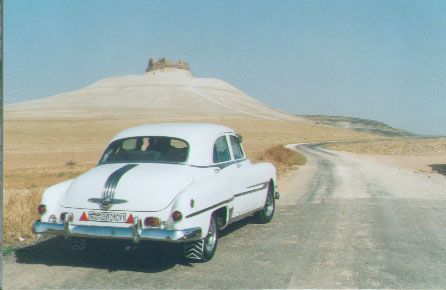
The only way to travel
We finally arrived at Palmyra and discovered that it certainly deserves its reputation - it was incredible, and huge, an oasis city dating from the second century. A massive stone temple was at one side with a road of columns leading from it, over a kilometre, to another temple and above it a huge citadel. The scale was just astounding, so astounding in fact that I was a bit overwhelmed at the thought of trying to look at half of it. It was hot. Really hot. But Simon and Lisa were real ruin veterans, having come from Egypt, so we battled on. First to some tombs, one a tower five storeys high, the other one underground with beautiful bas relief carvings. You weren't allowed to take photos so we didn't until the caretaker nodded that it was OK. Then he demanded his baksheesh.
Next was the Temple of Bel, a huge impressive stone structure. That part of the site had obviously just had some sort of festival so the whole place was festooned with tatty red, white and blue bunting and strewn with plastic chairs which spoiled the ambience somewhat. The heat was getting to all of us by this time so we decided to retire for lunch. The driver took us to a place he recommended and it seemed OK so we settled in. I wasn't hungry so I just had a snack, but the owner passionately recommended a traditional Bedouin dish, mensaf, a sort of risotto type thing. The food was fine but when the bill came it was astronomical - ten times what you would pay in a cheap cafe in town. We were all a bit shocked and Dave said "That seems very expensive." "Ah, OK, less for you," the owner said. "Price not important, cleanliness important," and he dropped the price by a few cents.
We set off again to see the main set of ruins and wandered down between towering pillars and archways. There was a theatre with rows of circular seats which was only discovered in the 1950s, and various temples. It was all very interesting but it was just so hot and I was starting to feel pretty terrible. I wondered about faking a collapse and having Dave carry me back to the car but that seemed a bit much so I just said to the others that I would meet them back at the start and trudged off on my own. Collapse was still a possibility though and I tried to stick to the higher ground so that I would have a better chance of being spotted if I did feel the need to lie face down in the sand for a while. I finally made it to a temple next to the road and staggered into the shade of the high portico. Two Arabs in long robes and headscarves were there drinking tea and looked at me in astonishment. I felt like I had just crossed the Sahara and obviously looked like it too. They hurriedly poured me a glass of tea. "No no, I have water." "No, tea better in the desert," one of them said and the hot, sweet tea did feel good.
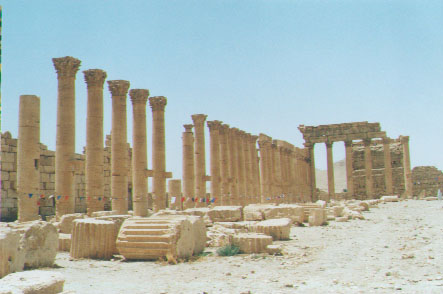
Palmyra High Street
The temple was near one of the smart hotels where busloads of tourists were wandering around so I asked the men if they were bus drivers. "No, we have camels," one said. Cool! He pointed and sure enough, there was a stout German tourist being heaved up onto a beautiful white camel to have her photo taken. We chatted about where I was from, how hot the desert got (they reckoned it was only about 40 that day, and told me that it had reached 52 last summer but that that was exceptional), and about camels. Were they intelligent? "Same like horses." "So how much for a camel?" "For one hour?" "No, for ever." "It depends on the camel," he said reasonably. "Some for $300, but for the best, $3000." I complimented him on his good English and he told me he had taught himself by reading and listening to the radio. "To be or not to be," he announced unexpectedly. "I read your William Shakespeare. But in Arabic," he admitted.
Eventually the others appeared and we headed back to the car. Next stop was the citadel and the old Pontiac laboured up the steep hill towards it. I was feeling so bad I knew I didn't want to go in so Dave and I sat outside while the others explored. There were lots of boys selling postcards and souvenir t-shirts (there wasn't one saying 'I thought I was going to die at Palmyra' so I didn't bother), and once it became clear we weren't going to buy anything, one of them gave up and sat and chatted to us. We asked him about the Assads and he explained that the old President had died a year ago and now his son was in charge. "And is he good?" "Oh yes! He is my number one!" He seemed to be a genuine fan, so maybe we've got the situation all wrong.
The others reappeared and we debated whether to stay for sunset. I was making all sorts of deals with God if He would only let me get back to the hotel before I was sick and He obviously took me up on one of them as the others decided that it was too cloudy for a good sunset and we should just get going. We hopped in the car and with me unobtrusively clutching a plastic bag Just In Case we sped back to Hama. I went straight to bed and waited to die or get better. Fairly soon I was dividing my time equally between the toilet and the bed and all I can say is thank goodness cleanliness was important at that restaurant - imagine how sick I might have got if it hadn't been...
The next day I was still feeling bad so I just stayed in bed/on toilet all day while Dave explored, wrote emails and ate a wide and exciting range of local delicacies. Lisa and Simon called in a couple of times to sympathise, drop off their bags, organise a bit of currency exchange (I'll see you a Jordanian dinar and raise you a million Turkish lira...) and collect their bags, so I didn't get bored. By the evening I was feeling a bit better so we agreed to get going the next day. The other site we wanted to see was Krak des Chevaliers, the best of all the crusader castles, but it was on the way to the Lebanese border so we thought we could just stop off on the way, road signs permitting.
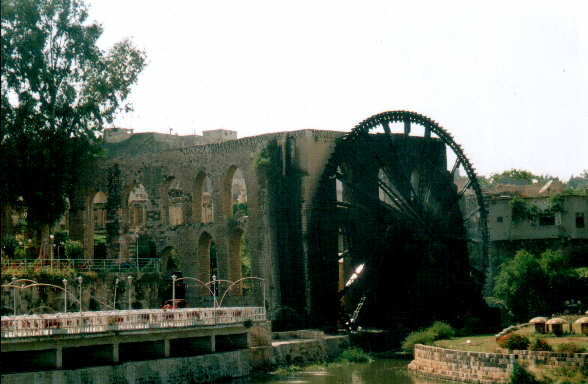
The famous waterwheels of Hama, visited by Dave
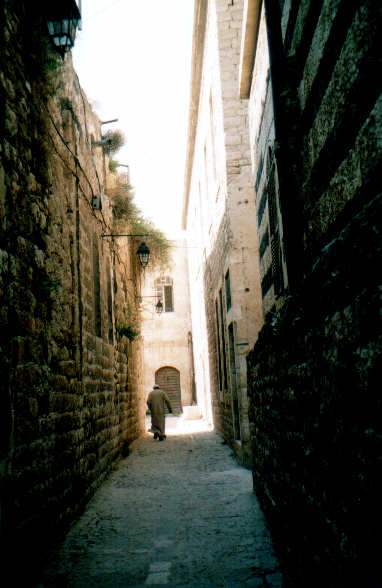
The old city of Hama
I was feeling weak the next morning and was being awfully brave about it, but it's a weird thing that whenever I've felt ill I always recover as soon as I get on the bike and that's what happened. We got going and I felt fine. We rode through fields of olive trees and pine trees and passed hillsides covered with new, raw, hair-transplant forestry. Again there were no signs for where we were going but we had been warned of that by Simon and Lisa so we just kept going. In the end we actually spotted the castle ourselves without the aid of signs. You really couldn't miss it - high on the edge of a hillside with a village spilling out below it, it was a proper castle. We weaved up and up, round hair-raising hairpins and finally got there just in time to see a busload of French tourists disappearing in in front of us. Merde!
T.E. Lawrence, well-placed to make such a statement, described the Krak des Chevaliers as 'the finest castle in the world' and he would get no arguement from us. It definitely ranks as one of the most memorable places we've visited on this trip. The Krak was built in the 12th century by the crusaders and although it often played a key role in their battles with the Muslims it was never breached. And what a place - turrets, battlements, stables, baths, hallways, chapels, archers' slit windows, little winding stairways, deep dark tunnels - it has every possible thing you can imagine that a castle should have. If it wasn't for the possibility of falling down the little winding stairways or disappearing into the deep dark tunnels it would be the most perfect place on Earth for a bunch of children to play. It is, as they say, a good Krak (hey, some jokes just cry out to you...) and we wandered around for two hours trying to take photos without ample French behinds in them.
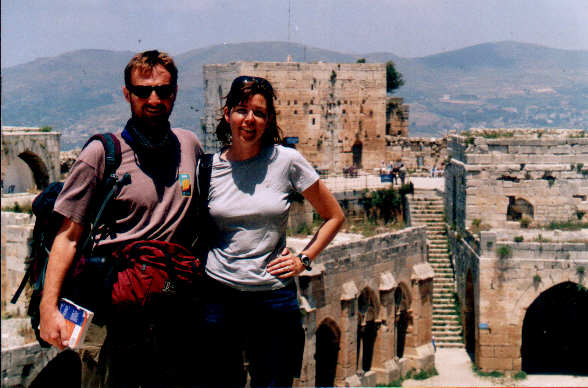
Not an ample behind in sight at the Krak
A quick lunch and we were off down the hill and along the freeway to the Lebanese border. The Syrian officials didn't seem worried about our strange visa numbers - they just wanted to know where we were heading after Syria (no, not Israel) and how much Dave's bike cost (they didn't want to know how much my bike cost) and then we were off to Lebanon.
 |
 |