| The Daniel James Community School Race Team Web Site |
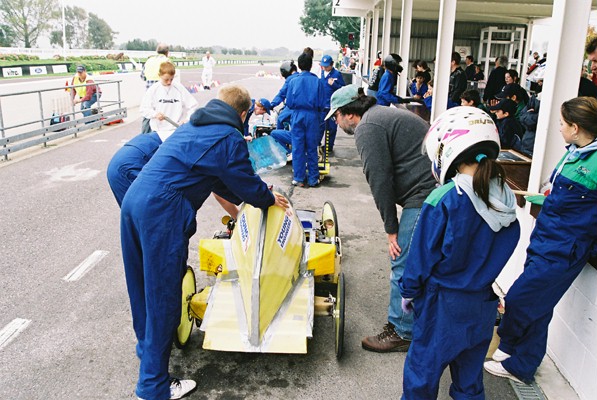
Q Do your pupils have a special aptitude for this type of project? A Nonsense, I used to work in an all girls school with no previous experience of this type of project to draw upon, but when we became involved with this project, we saw a two-fold increase in the numbers of students opting for GCSE Resistant Materials. It seems that we had the kids all right, but we werent selling the subject in the right way. Q What do you do if you havent got the resources in the school to do this? A When we started, We had to borrow and beg things like a welding set, a trailer etc, but on the strength of our endeavours we have been able to secure funding from several sources, such as our PTA, so that now we do have pumps, battery chargers and socket sets etc. Also, you will have parents with the skills you need, but for usIt has also meant that the staff have increased their practical skills and knowledge to. Q How much does it cost? A It doesnt have to cost too much. In theory you could use only recycled materials and components. All of our funding has either come from sources such as the PTA, the BARC or one of our industry links. No pupil has had to put in their own money and neither has the department. Q What do you if you havent got the expertise in the school to do this? A If you dont have the expertise, find people who do. My schools catchment area has a great deal of social depravation, so initially, instead of looking for parental help and support, we turned to local industry. This was very successful in part, but I had made a glaring mistake by ignoring the talents that our parents could bring to this project. This was demonstrated at our last race, when our Kart failed 5 minutes before the start of the race. Luckily for us, one of the parents who was spectating, quickly identified the fault and the helped us to replace the part which enabled us to take our place on the starting grid. Q How do you find the time? A Yes time is always against us, but I have tried to keep this project inside the allocated curriculum time. Following consultation with the WJEC, each of the students involved with this project was assigned a responsibility for one specific part, e.g. 1 pupil to design the drivers seat, another to be responsible for bodywork and aerodynamics, with somebody else to design the steering etc. With up to 8 pupils working on the project, a great deal can be achieved in quite a short space of time. We also have run an after-school club one night as week for 1� hours. This has allowed us to tap into the monies recently made available for after school activities. Many schools are now introducing an alternative curriculum for pupils who have problems accessing the full range of GCSEs as envisaged by National Curriculum, and in my opinion, this project would be ideal for that kind of student. Other opportunities to integrate this project into your curriculum would be as a project in a CoE or GCSE Motor Vehicle Studies Course, GNVQ Engineering course, or an A level Design Technology course. I have even heard of a colleague who has under taken parts of this project with small groups of year 9 special needs pupils, using it as a hands on method of delivering significant parts of the key stage 3 programmes of study such as :- Systems and control (including electrical and mechanical systems). Structures. Materials etc. There are indeed lots of excuses for not being involved with such a project, but for us there have been many substantial plusses. Through the media exposure we have received, we have brought kudos to the Department, Faculty, and the School. In my school, the high profile departments have always been, Art, Drama, Music, and PE. I saw no reason why Technology should not be seen as another standard-bearer for the school. It has created interest in what we do down in the workshops, especially amongst the pupils. When building a race car you never have to explain to the pupils why you are building a race car (the answer being, to race it) - just how, when and where. This project has also helped us to highlight what Technology is all about, i.e. designing and making, research, solving problems, combining a wide variety of parts and materials, and testing those ideas, as opposed to the older-out-of date concept of woodwork and metalwork. The number of students opting for the subject has doubled and our GCSE passes for Resistant Materials, have also increased since becoming involved with this project. This is due to the fact that all the participants have fuller folders, with evidence of realistic and relevant research, specifications, models and their development, speaking to experts, and testing etc. Infact, the WJEC GCSE marking scheme could have been created for just this sort of task. It has allowed us to establish meaningful school/industry links. It has brought new materials, equipment and skills into the department. This has been the most rewarding and fun project that I have been associated with since starting my teaching career. I hope that this convinces you that such a project is as attainable in your school as it is in ours, and I look forward to racing against you in the future. |
 |
|
 |
| Frequently Asked Questions |
 |
|
| The On-line home of the Welsh Champions 2000-2008. |