
By
Dave Gowdey
Copyright 2002 All rights reserved.
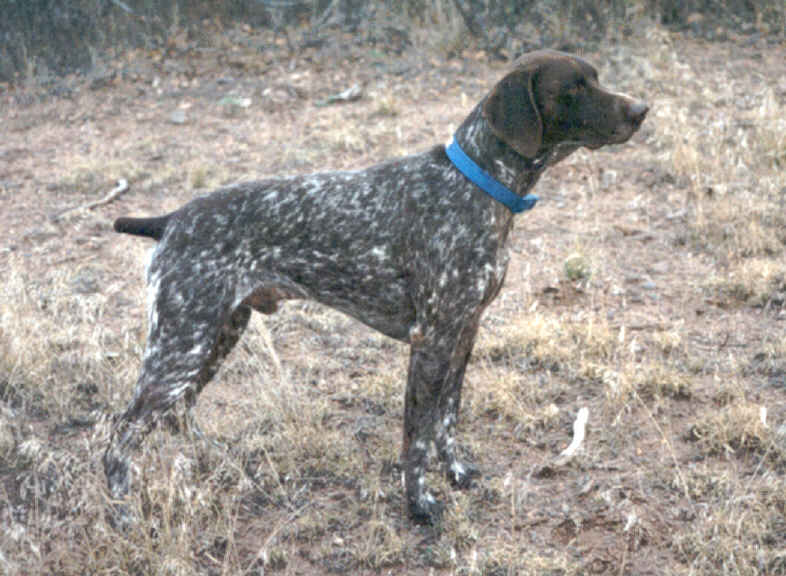
In the hot, dry conditions Billy picked up the faint scent trails the other, faster moving, dog missed. He worked at a moderate pace that enabled him to pick up both air and ground scent. When the
On the ride home that night Scott was enthusiastic. He had been impressed by Billy's remarkable scenting ability, his good manners, his intensity on point and strong desire to retrieve, but most of all by the fact that Billy hunted for the gun. I don't carry a whistle, and don't hunt my dog with an e-collar, because I don't find them necessary. Scott was used to hunting with dogs that required both. He liked the fact that Billy kept track of us, checking in periodically, and while the range at which he worked wasn't much different from the Brittany - we saw Billy much more. He put in a standing reservation for a pup the next time I bred Billy.
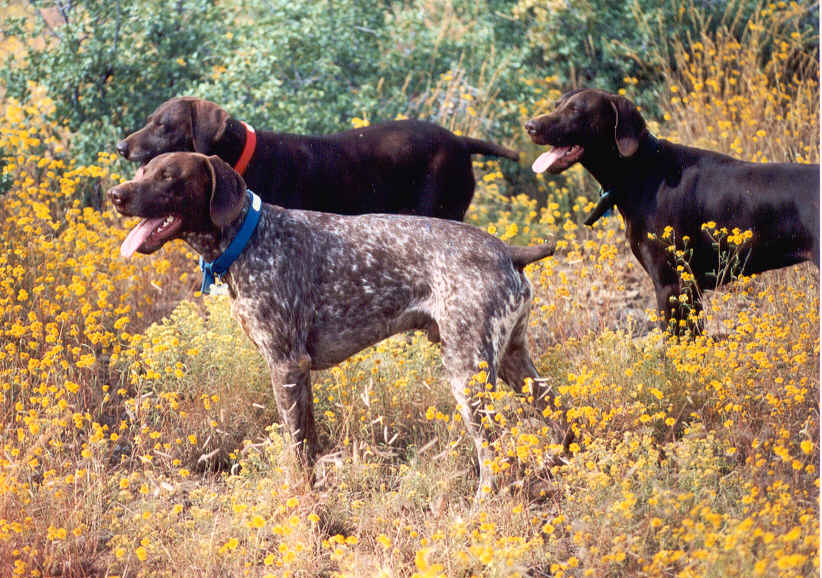
Over the last seventy five years, German Shorthairs have been steadily winning similar converts among American hunters. Other breeds have risen in popularity and fallen, while the German Shorthair just keeps increasing it's solid base of support among hunters. The reason for this probably lies in the breed's history.
Significant social changes in Germany in the 1860s opened the sport of hunting, for the first time, to middle class hunters. Prior to this, the right to hunt had been limited to the aristocracy and their servants. However, the average German didn't have room for the dozens of hounds, retrievers, and pointers that a nobleman would have as a matter of course. They wanted a dog that would be a good family dog five days a week, and then enable them to hunt furred and feathered game on the weekends. At this ultra-nationalistic time they also wanted the dog to be indisputably GERMAN.
With Teutonic thoroughness, the early breeders formed themselves into a group dedicated to giving the German hunter such an all around dog. At first, a good portion of the group saw their mission as one of "restoring" the German pointer. This was a mediocre hunting dog developed in Germany in the 1600s, but whose slow, plodding nature and hound like build had led it into disfavor among German hunters. It was completely outclassed by the stylish English and French pointers of the day. For almost two decades, these German breeders tried to create a stylish, versatile dog that had the hound like conformation of the old German Pointers. Such efforts were doomed to failure. Finally, in the late 1870s, Prince Albrecht zu Solms - persuaded many of the breeders that "form follows function," and that the breeding program should focus on the requirements without worrying too much about outward appearance.
Progress after this came rapidly. To the old German pointer - itself a combination of the Spanish Pointer and the St. Hubert's hounds, was added scent hound, (often described as bloodhound) to give the breed a keen nose. English Pointer, French Braque, and even a bit of Irish Setter were reputedly added in to get the breed's nose up and add a little style. By the mid -1880s, the breed was winning pointer and setter trials in Germany. Twenty years later, the breed had largely been refined into the German Shorthair that we know today.
(Continued)