| a hunting prodigy. He was staunch on point and eager to retrieve. However, the 1997 season proved to be a different story. He was a bit older and more full of himself in 1997, and began thinking that maybe he could do this hunting thing by himself. Added to this was the fact that finances prevented me from putting him on too many birds, and he got to the point where he was beginning to ignore or forget his training. Finally, after a couple of tries, Billy disgraced himself and all of his ancestors by bumping and catching a plump ringneck pheasant. Once he figured out he didn�t need me along, he spent the last two months bumping birds as he tried to rush them after his point. He knew better, but discipline and scolding didn�t seem to have any impact on him. He became Billy the Bird Bumping Bonehead. In the off season we worked hard on getting him to steady (freeze) on command, and he got so good that he would slide to an immobile stop out of a full run if I yelled steady. I wasn�t sure if I would be able to steady him when he was pointing a live bird, but I knew that there was only one way to find out. I also knew that the true lesson on why he needed me along, and why he needed to remain solid on point, would be taught best by wild birds, and there are no better, wilder teachers of such manners than Gambel�s Quail. This trip was his first trip to the school of bird dog hard knocks. |
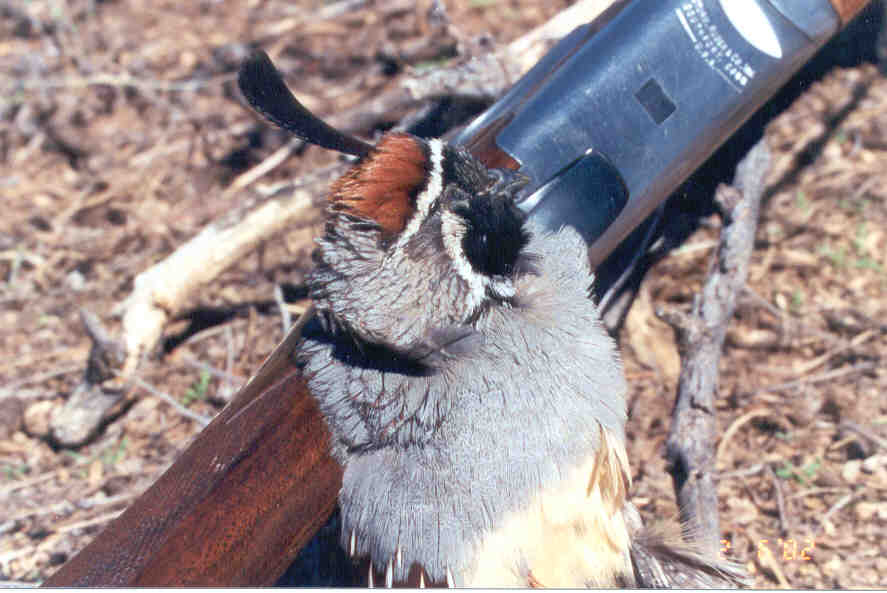
| For those who have never hunted Gambel�s Quail, there are no tougher gamebirds to hunt in North America. They live in one of the harshest climates in the world, surrounded by efficient and intelligent natural predators. To survive they have to be tough, resourceful, and smart. When a Gambel�s covey�s is feeding, they post sentries to watch for danger. If the sentry warns them in time, they quickly run into cover that usually is covered with spines. Most of the time you'll never know they were there. On the other hand, if you can flush the sentries, the covey will flush probably 60% of the |
 |
| time, and if the covey flushes then you are in business. By Eastern standards this is a bit backward. With Bobwhite, you focus on hunting coveys with the odd single on the side. This lets you hunt with fast moving dogs that hunt with their heads held high - confident that even with half a nose they can smell the concentrated scent of a covey of fifteen birds in plenty of time to stop. However, a Gambel's covey holds a lot more birds, sometimes as many as two or three hundred, and covey's tend to run while singles and small groups tend to hold very tight. So those of us that hunt Gambel's with pointing dogs tend to bust the covey, and then concentrate on hunting the singles. For a dog, hunting singles is a game of intelligence and finesse. The "covey dog" gets most of the press because of its flashy pace and long casts, but it's the "singles dog" that puts birds in the bag. Unless it's incapable of scenting, most gun dogs can smell the concentrated scent of a 15 bird covey with relative ease. However, it takes a discerning nose to be able to pick up the faint traces of the scent of a single bird. Hunting the singles isn't easy, and hunting Gambel's singles is the most difficult hunting of all. |
 |
| There are a few reasons why hunting Gambel's Quail singles is the most difficult hunting for a bird dog. First, Gambel's Quail live in some of the most rugged terrain in North America. Most of the cover either sticks or claws you. Second, the air is bone dry, and doesn't carry scent very well. A dog needs an extraordinarily keen nose, and the ability to use both air and ground scent to find and locate birds. Finally, Gambel's Quail are some of trickiest gamebirds in North America. They are not intimidated by a pointing dog, and will often run out from under a dog's nose if they see advantage in doing so. A Gambel's Quail can run as fast as 15 miles per hour and can easily run away from a an unwary dog. If you add these three factors together, difficult terrain, tricky quarry, and unfavorable scenting conditions - you can see why hunting Gambel's singles is such a challenge. We were still a couple of hundred yards away from the edge of the arroyo when Billy first locked up on point. I was surprised because it was an area of open land covered sparsely with grass and interspersed with Mesquite bushes - not area in which I would normally have expected to find Gambel's quail. I waited as he catwalked up, looking for all the world as though he were walking on eggs and trying not to break any. From his demeanor I could tell that the quail were moving, and that he was trying not to push them so hard that |
 |
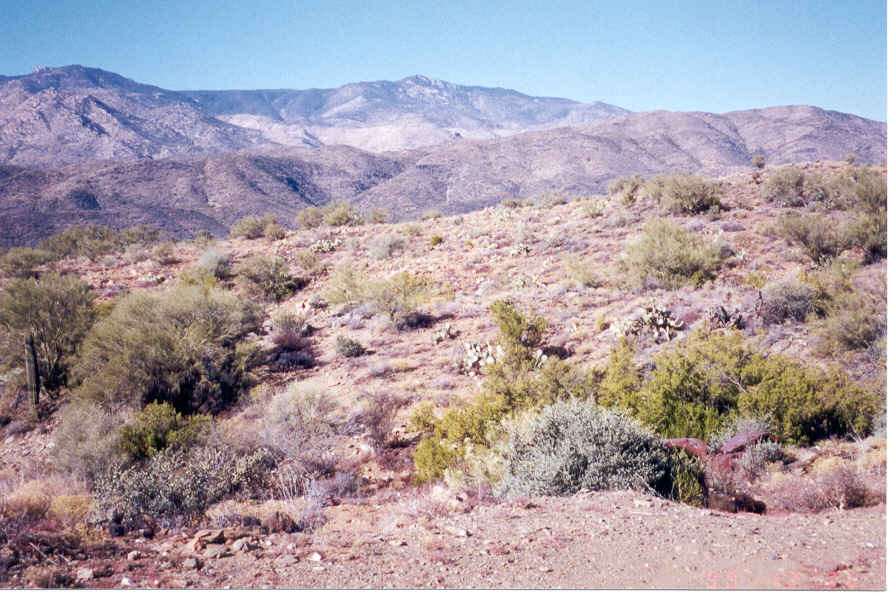
| Scenting conditions are almost always bad in the hot, dry air of gambel's country. |
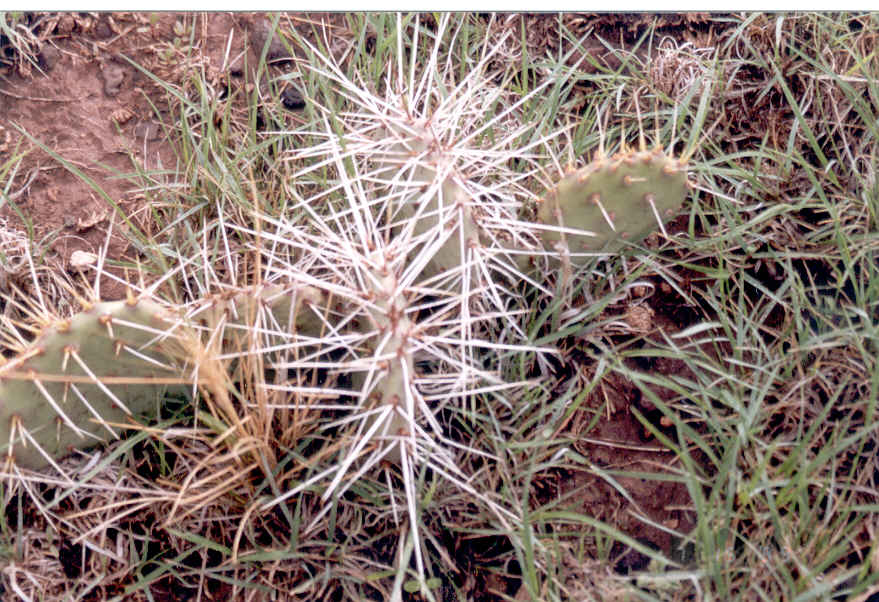
| It sometimes seems as though every plant sticks or scratches like this prickly pear cactus. |
| they would flush or run away. I must have followed him for fifty yards as he stopped and started, pointing then catwalking, before he finally stopped for good. I could tell by the absolute immobility of his tail that he believed the birds were close. If he were going to jump in and bump the birds, this was the time he would do it. As I walked around to flush the birds, I kept waiting for that awful pounce, but it never came. He held as staunch as a statue, completely hypnotized by the scent emanating from the quail. I came up to the Mesquite bush towards which he was pointing, and kicked at the base of the bush. Instantly, six Gambel's quail burst out - looking and sounding like tiny gray helicopters. Fast helicopters. I picked one from the group, one that was heading almost |