 |
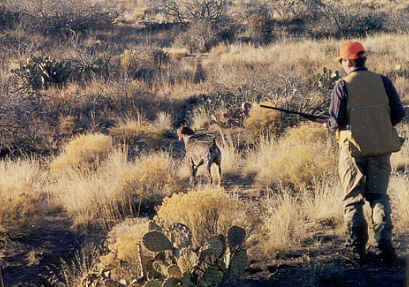
| that was heading almost straight away, and then fired. It fell and lay motionless about twenty yards away. I then picked out another quail curving away to the right, and pulled the trigger instinctively. It arched behind a Mesquite bush about thirty yards away. At the first flush of the birds, Billy had taken off after them, waiting for one to fall. When it did, he was right on it. Gambel's hunters traditionally allow their dogs to begin a retrieve at the sound of the bird's flush in order to enable the dog to get to the bird as quickly as possible. They believe that this helps recover |
| crippled birds that would otherwise have quickly run into pack rat dens or impenetrable cactus thickets. Billy's performance was a good advertisement for the soundness of this belief. By the time I looked up after downing the second bird, Billy was halfway to me, a young Gambel's Quail carried gently in his mouth |
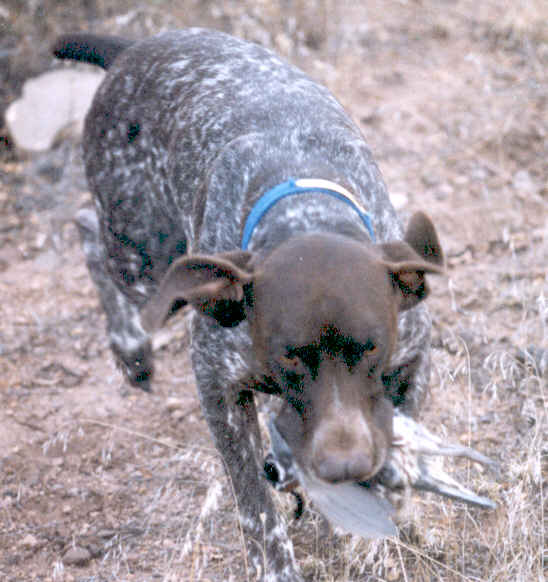 |
| After I took the bird, he raced off to find more quail to point, but I called him back. He came back reluctantly - his whole attitude one of exasperation. "But Dad, there's more birds out there - I just know it." "I know," I said to him, "but first things first. There's another bird down here and we need to find it - find the bird." At the sound of the last order, his ears perked up and he began racing toward the area I indicated, nose to the ground. As he quartered carefully through the area in which I saw the second bird drop I saw him freeze on point for a second, then pounce on something. As he turned around, I could see he found the second bird. After he had delivered it to me, I let him go down into the arroyo. The Southern slope of the arroyo was covered with catclaw and thick grass - ideal Gambel's cover. For some reason, |
| Shorthairs seem less bothered by catclaw than other breeds of hunting dogs. For those that don't know it, catclaw is a nasty bush that more resembles a huge ball of barbed wire than a plant.Each strong branch is covered with half inch curved thorns that look almost identical to the claws of a housecat - hence the name. The thorns are extremely sharp, and very strong. Once they catch hold of you it's difficult to get |
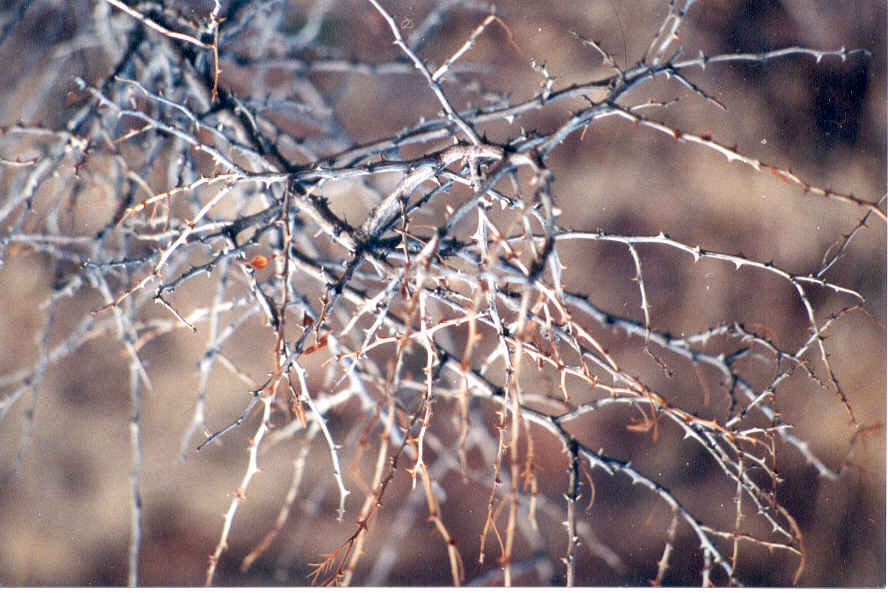 |
| free. They will shred a pair of blue jeans in a few minutes, and the lacerations on your skin look for all the world as though an angry tabby had scratched you. Somehow, the dense coat of the German Shorthair seems to be particularly good at turning aside catclaw thorns - and aside from the odd scratch on the ear or muzzle the seem to work in it with relative ease. Other hunting breeds have far more trouble with catclaw in my experience, which gives them a comparative disadvantage in Gambel's hunting because Gambel's Quail love catclaw. |
| Sure enough, he had only gone into the catclaw thicket about forty yards when I could see his tail start to wag frantically back and forth like a crazed metronome. He was on birds. A few yards beyond that, he froze on point. As I struggled through the catclaw after him, I was grateful for the brush pants I was wearing. The heavy cordura facings on the legs were all that made it possible for me to walk through that patch without shredding most of the skin off of my calves. Sure enough, the small covey decided to flush at the most inopportune moment for me - a trait annoyingly common with Gambel's Quail. I was perched precariously with one foot on a football sized rock that rolled ominously underfoot when the covey of fifty quail flushed. I quickly scampered to find more stable footing and raised the shotgun to my shoulder. By the time I had done all of this, most of the covey had ducked behind a large Mesquite bush, and I was only able to pick off a lone straggler. I was able, however, to mark where most of the covey had landed. Billy didn't see the dead bird fall for some reason, and I had to call him back to help search for it. Incidentally, for those who were wondering, the shade of gray on the feathers of a Gambel's quail are almost the exact shade of gray of a catclaw bush. Billy finally found the dead bird resting in the branches of a catclaw bush that I must have walked past and stared at five times. |
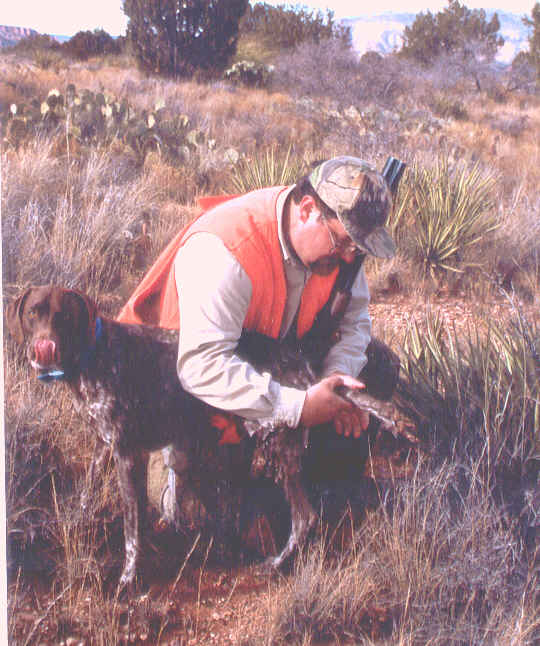 |
| We worked through the catclaw patch down to the bottom of the arroyo, where I called a temporary halt. I wanted to give the singles a chance to settle into cover and put out some scent. I pulled out the water bottle in my Game bag, and squirted a stream into Billy's mouth. He drank about half a liter of water before he turned away. Then I drank about the same amount. I then pulled out my hemostats, and began checking him for cactus quills. Most dogs learn fairly quickly about cactus, and soon learn to avoid them. However, when a dog gets a snootful of bird scent, such niceties are put aside. I don't believe my shorthairs even feel the sting of the cactus spines when they are on birds. Therefore I make it a practice to regularly check my dogs for cactus spines every half hour or so when I give them water. Billy was fairly clean, with only a few Prickly Pear spines |