
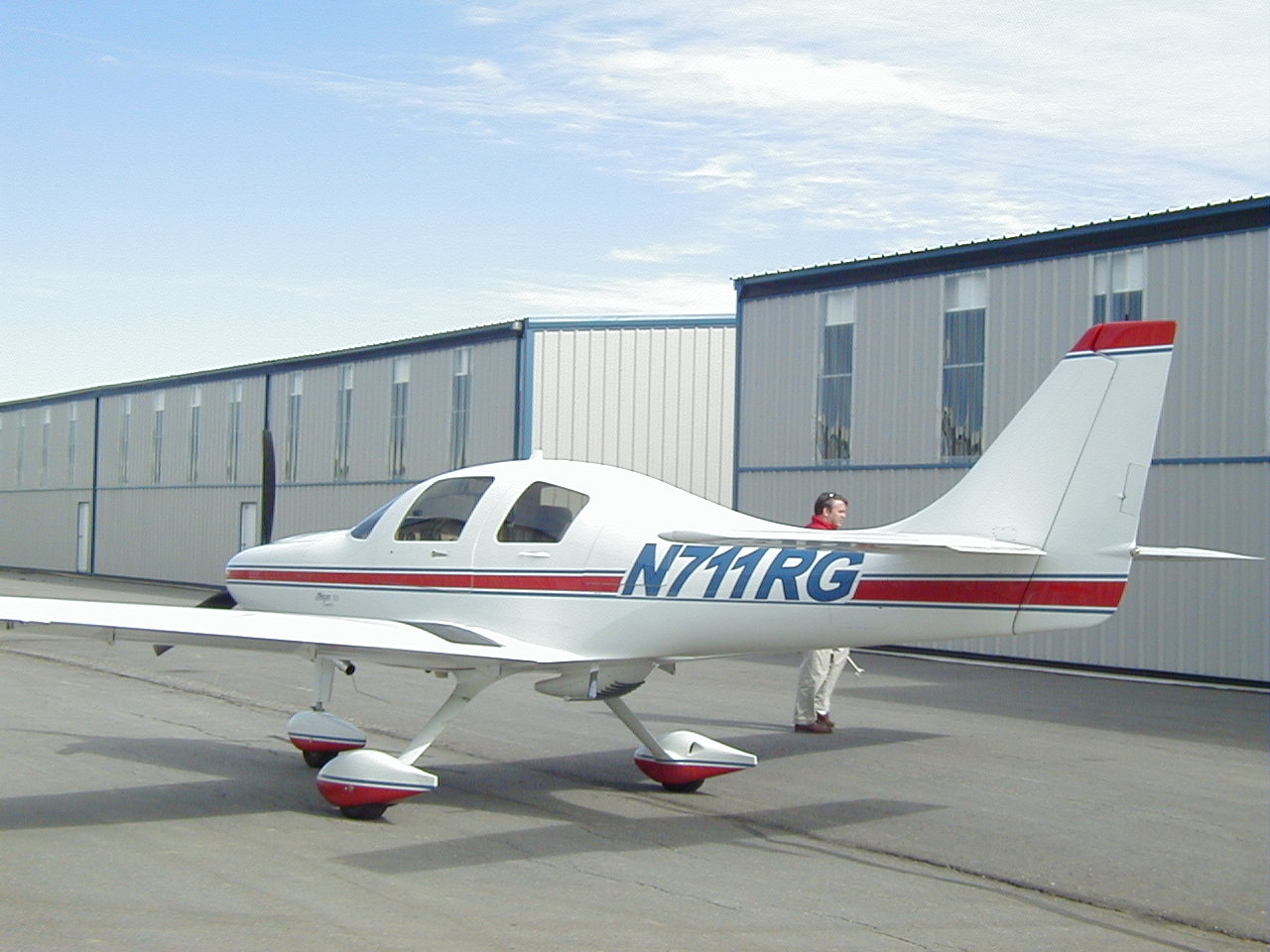
Objectives: 1. Maintain 75%+ for 1 hour.
2. Check Autopilot Hdg and Alt hold.
3. Calibrate Airspeed indicator.
4. Reach 190KIAS.
5. Slow flight until buffet onset flaps up/dn power on/off.
6. Fly until the right tank goes dry.
7. Make one landing to full stop.
Flight Narrative: After having some difficulty with the ignition system, electrical system and prop governor that delayed this flight, take-off and climb out were normal. After operating at greater than 70% power for 1-hour and checking the Autopilot was functioning correctly, I proceeded to explore the slow flight/stall end of the flight envelope. Slow flight was accomplished at 70 KIAS and flaps down. It was necessary to hold significant back stick pressure to fly level and this was not possible to trim out. This is a flight characteristic that does not meet FAR Part 23, which calls for enough trim authority for the entire performance envelope. This condition is at it's worst in this aircraft with a forward CG, no flaps, power back, and slow speed. To hold 90KIAS in this condition required a pull on the stick in excess of 5 pounds. Furthermore, at one point when I was in this condition I ran out of elevator nose-up authority. I started with the nose 10 degrees below the horizon and I slowly started to bring the nose up searching for pre-stall buffet. I could only get the nose up to 2-4 degrees above the horizon. I had a 1000-fpm descent rate and 85 KIAS with no stall. I simply didn't have the elevator authority to get the nose any higher, even using both hands on the stick! Other than those characteristics, the aircraft performed normally in slow flight and approach to stalls. Power-off stalls occurred at 62 KIAS with the flaps at full down and 80 KIAS flaps up. Power-on stalls were 59 KIAS and 76 KIAS respectively. They were preceded by a buffet beginning 3-4 KIAS faster than the actual "break". The break was usually accompanied by a wing drop. Recovery was quick and predictable by releasing the back stick pressure. Following the low speed portion of the flight, I accelerated to expand the flight envelope to 190 KIAS. Passing 185 KIAS I heard a loud bang from the airframe. After slowing down and visually inspecting what I could I could not find/see/ feel anything unusual. However, I decided to terminate the flight testing at that point and return to land. During the RTB the right main fuel tank was allowed run until empty. This was so that we could start from zero usable fuel and fill the tank while calibrating the electronic fuel gauge system. After switching tanks, the engine did not restart. I then pushed the primer button, which is wired to the high boost pump, and the engine did not start. I was establishing a glide and picking out a landing spot (I-70), when I selected LO boost pump on the rocker switch. The engine did not start. It didn't even try. At that point I was practicing my interviews for the news trucks that were sure to show up after I pulled off an engine out landing on the interstate below. I then selected HI boost pump with the rocker switch and the engine fired right up. I think I'll make a note of that in the emergency procedures section. Upon landing the aircraft darted to the right and required firm left brake to keep it near the centerline. During taxi in it was pulling right.
Post Flight Notes
1. Loud bang heard at 185 KIAS was determined to be the in flight failure of the right gear leg fairing. Since we were flying without wheel pants, the bottom of the gear leg fairing was unsupported. This failure has occurred on other Lancair ES's, yet there is no warning from the factory. 2. The right ignition switch was fused in the ON position. This was repaired.
Flight #3, 27 Sep 2002
CG 1 inch forward of center.
Objectives: 1. Fly 4 hours
2. Engine Break in.
3. Set AOA computer.
4. 190 KIAS
5. Stalls
6. Check climb and glide speeds.
Flight Narrative: Took off and proceeded to the Limon area. Calibrated the AOA computer. Dove to 190 KIAS. Performed climb and glide tests. Establish that the best glide is 90 KIAS with the flaps set down 10 degrees. Best cruise climb is 120 KIAS with the flaps down 10 degrees below 10,000. Above 10,000, cruise climb at 110 KIAS and flaps down 10 degrees. Explored slow flight and stalls with the further aft CG. Aircraft had much better elevator authority in this condition. Had a thunderstorm move through the practice area that required that I fly around it. Experienced moderate turbulence. Returned to make several touch and go's.