
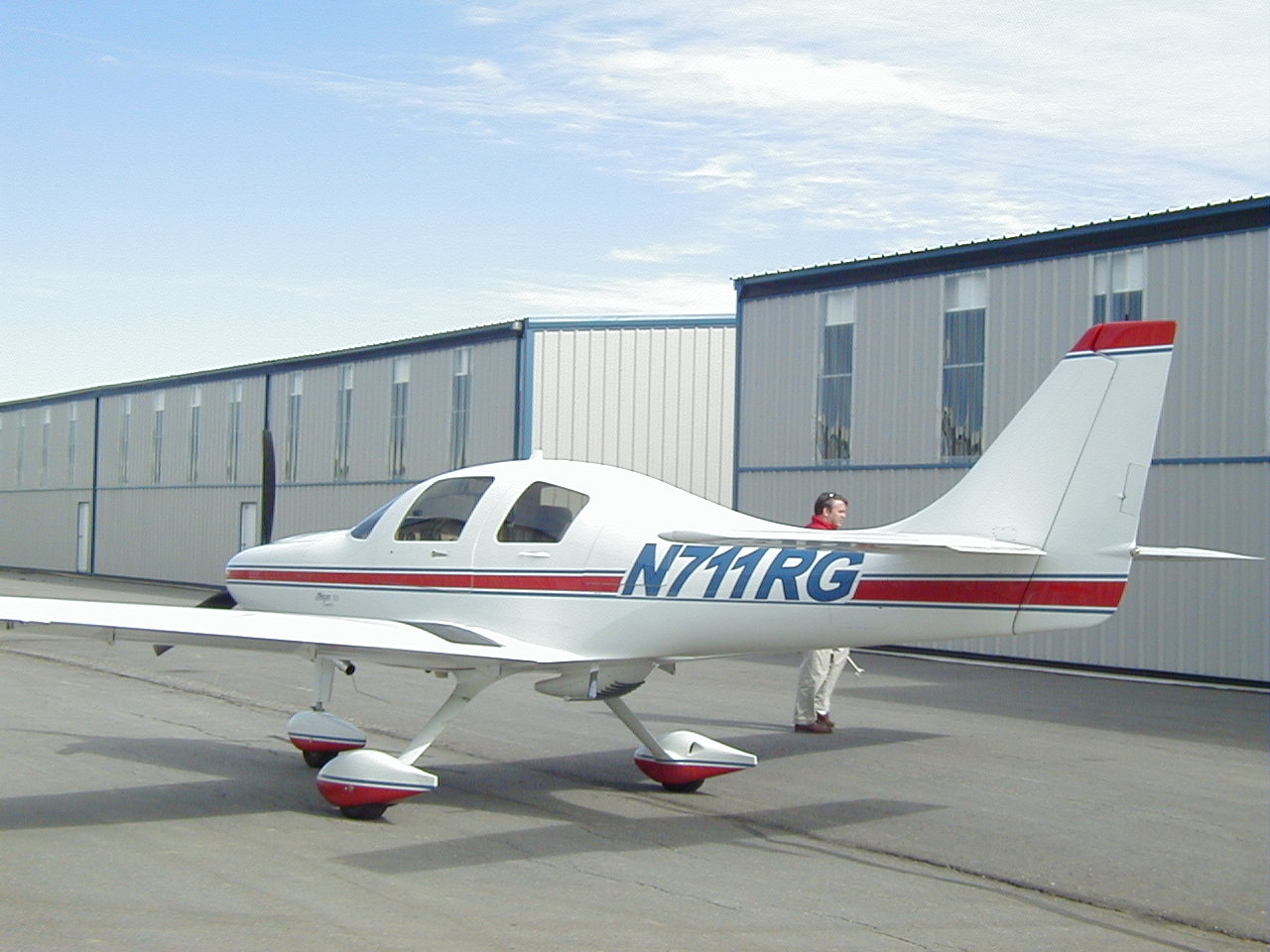
Builder - Ron Grob
Test Pilot - Dave Allen
Introduction: Starting on September 21st 2002 I had the pleasure of performing the flight tests for Mr. Ron Grob's Lancair Super ES N711RG. I found the aircraft to be a superbly equipped and well-constructed Lancair. It met all flying parameters and performed as expected. The following report details the flight-test period and results. I made a video tape of this test period that shows many of the interesting moments. This is available at my website. David Allen CFII-MEI/Test Pilot WWW.taildraggerdave.com
Preflight Inspection Sept 20th 2002.
I arrived at Front Range airport and began my pre-1st flight inspection. The DAR inspection had been completed and the airworthyness paperwork issued. Problems noted included a loose battery cable, excessive foreign objects throughout fuselage (including a billfold) and the most significant problems were in the rudder cables/brakes. Prior to each first flight one of the things I do is to simulate airloads on deflected flight controls to check integrity. While I was holding full rudder I had the A+P simulate an air load by exerting pressure by hand on the rudder itself. During this process the rudder cables failed. Had this occurred in flight the results could have been catastrophic. It was determined that the collars that connect the cables had been incorrectly crimped. This was resolved by recrimping all the flight control cables. It was also noticed during this examination that the brakes were unusable at full rudder deflection. The cause of this was determined to be a self-fabricated heater duct along the firewall. This piping was not in the plans and in fact interfered with the brakes operation. The ducting was removed and that resolved the problem.
First Flight 21 Sept 2002 - 1620L
Light weight - forward CG
Clear, 65 Degrees Light winds
No wheel pants installed.
Flight Objectives: 1. Fly Safely for 1 hour at 75%+ power.
2. Check general stability.
3. Check trims and flaps.
4. Slow flight and approach to stalls.
5. Check fuel/brakes/alternators/ignitions.
6. Check flight instruments.
7. Check nav radios.
8. Make 1 landing.
Flight Narrative: After extensive run-up checking the all electronic ignitions and dual alternators I advanced power for initial flight at 1620L out of Front Range airport (field elevation 5500ft), Colorado. The aircraft accelerated with authority and with noticeable torque and p-factor. All flight instruments and performance was as predicted. I orbited over the field below the Class B airspace for several orbits to ensure the airplane was going to continue flying normally. Then proceeded to the Southeast along I-70 to orbit over the Limon airport at 9500ft. After arriving over Limon, I switched fuel tanks and it operated normally. During climb out/initial level off the following was noted. Throttle prop and mixture all full forward to facilitate engine break-in. Rpm-2640, Manifold Pressure 20.6 inches, CHT-465 deg., Oil Pressure-36 PSI, Oil Temp-165 deg, Fuel flow-20gph, Amps-27, Volts-14.1. Everything was normal, except the CHT was slightly high. This was controllable by increasing the fuel flow. The initial guess about the true airspeed at the typical cruise power setting is 165 knots. I next checked all the Navigation equipment. The following items were working as expected. Both com radios, both VOR's, mode-C transponder, GPS. The following items were not checked: AOA, ILS, Autopilot, Stereo/CD player, TCAS system, and Air Conditioning. At this point in the flight I slowed to flap speed and extended and retracted the flaps 5 times to full. I also performed a controllability check by slowing to 80 KIAS with the flaps extended to simulate the upcoming landing. Everything was normal.
Problems noted on 1st flight: 1. The standby Alternator was inop., continued with main alternator and dual batteries. Recommendation: Repair 2nd alternator as soon as practical. 2. The engine is very sensitive to having the mixture set correctly. Recommendation: Information only. 3. Insufficient nose up trim authority. With the flaps down and the power back and the trim full nose up, you have to hold significant back stick pressure to keep the nose up. It's impossible to trim the back stick pressure away during normal approach. Recommendation: Contact the Lancair factory and ask about fixes. Otherwise continue flying with caution in that phase of flight.