|
|
History of the Sprints |
|
The following information was taken directly from www.iaaf.org:
Intro to the 100m
The shortest
race in the outdoor timetable, the 100m sprint offers the purest expression of
human speed and has become one of the "blue riband" athletic events.
The race was initially run on grass or "cinders" tracks over the
British distance of 100 yards (91.44 m) before Continental influence turned it
into 100 metres. Sprinters started from a standing position until 1887, when
Charles H. Sherrill (USA) dug small foot holes in the track and tried a crouch
start, a technique which, with a few variations, is still in use today.
In 1928-29 coaches George Breshnahan and William Tuttle (USA) invented starting blocks to facilitate more reliable starts. The IAAF officially sanctioned the use of starting blocks in 1937.A year later the IAAF stipulated that no official record shall be ratified without a wind gauge reading. The maximum tailwind permitted has remained 2 metres/second.
Primitive experiments with electrical timing of sprint races date back to the first quarter of the century. This technology improved to such an extent that the IAAF decided to accept, from 1 January 1977, only electronically recorded times as world records.The photo-finish camera (in use at the 1932 Olympic Games) has enabled very close races to be judged fairly. Today's technology permits winning margins of as little as 1 thousandth of a second to be visible on a photofinish print.The introduction of synthetic (all weather) tracks has also helped improve sprint times.
The first world record for 100 yards set on a synthetic track was in 1963 by Bob Hayes (9.1) while Jim Hines recorded a world record 9.9 for 100m at the 1968 Olympics in Mexico.
Men's achievements in the 100m
First under 11
sec: 10.8 Cecil Lee GBR 1892
First IAAF world record: 10.6 Donald Lippincott USA 1912
First under 10.5: 10.4 Charles Paddock USA 1921
First under 10.0: 9.9 Jim Hines USA 1968
Electronic timing:
First under 10.00: 9.95 Jim Hines 1968
|
Subsequent
record progression: |
|
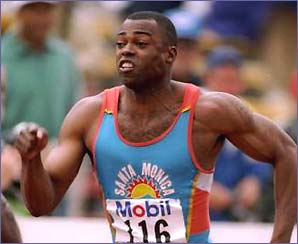
Leroy Burrell
Photo: news.bbc.co.uk |
§
Most durable
world record:
10.2 Jesse Owens USA 1936 (20 years)
Most legal times under 10.00:
Maurice Greene 43 (as at 8 Dec 2002)
Most Olympic
titles: 2 Carl Lewis 1984/1988
Most World titles: 3 Carl Lewis 1983/1987/1991 & Maurice Greene
1997/1999/2001
Youngest Olympic/World champion: Reggie Walker RSA 1908 (19)
Oldest: Linford Christie GBR 1993 (33)
Women's achievements in the 100m
First IAAF world
record: 11.7 Stanislawa Walasiewicz POL 1934
First under 11 sec: 10.9 Renate Stecher GDR 1973
First under 11.00: 10.88 Marlies Oelsner-Göhr GDR 1977
First under 10.80: 10.79 Evelyn Ashford USA 1983
Subsequent record progression:
10.76 Evelyn Ashford 1984
10.49 Florence Griffith Joyner USA 1988
Most durable
world record: 11.6 Helen Stephens USA 1935 (13 years)
Most legal times under 10.80: Marion Jones USA 15 (as at 8 Dec 2002
Most Olympic
titles: 2 Wyomia Tyus USA 1964/1968
Most World titles: 2 Marion Jones USA 1997/1999
Youngest Olympic/World champion: Betty Robinson USA 1928 (16)
Oldest: Fanny Blankers-Koen NED 1948 (30)
Intro to the 200m
This distance is
similar to the ancient Greek sprint event the "stadion" (literally
length of the stadium), but it derives from a mile-based distance, the furlong,
or one-eighth of a mile.
In the USA, the 200m was run in a straight line until around 1960. A curve was
only included in Europe and at the Olympics, where the distance first appeared
in 1900. The 200m with a full bend on a 400m track became universally accepted
in 1958, when two distinct sets of records began to be kept.
The 200m specialist must combine the basic speed of the 100m sprinter with a running technique that allows him to cope with centrifugal forces when sprinting around the bend. Times in a 200m straight race were estimated to be around 3 to 4/10ths of a second faster than races including a bend.
Men's achievements in the 200m
First under 22
sec: 21.8 Luther Cary USA 1891
First official world record: 21.2 Willie Applegarth GBR 1914
First under 21 sec: 20.7 Jesse Owens USA 1936
First under 20.5: 20.4 Henry Carr USA 1963
First under 20 sec: 19.83 Tommie Smith USA 1968
- Subsequent record progression:
19.72 Pietro Mennea ITA 1979
19.66 Michael Johnson USA 1996
19.32 Michael Johnson 1996
Most durable
world record: 19.72 Pietro Mennea (16 years)
Most legal times under 20.00: 24 Frank Fredericks NAM (as at 8
Dec 2000)
Most Olympic titles: 1 by 21 men; gold/silver by Andy Stanfield USA 1952/1956
& Carl Lewis USA 1984/1988
Most World titles:
2 Calvin Smith USA 1983/1987
2 Michael Johnson 1991/1995
Youngest Olympic/World champion:Percy Williams CAN 1928 (20)
Oldest: Pietro Mennea 1980 (28)
|
Women's Achievements in the 200m First under 24
sec: 23.6 Stanislawa Walasiewicz POL 1935
Most durable
world record: 23.6 Stanislawa Walasiewicz 1935 (17 years)
|
|
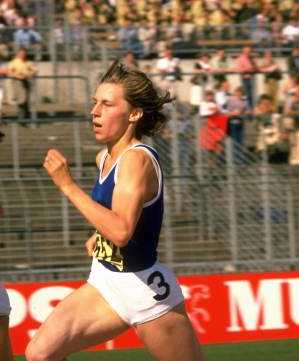
Marita Koch
Photo: merlene.subnet.dk |
Send me an e-mail!! [email protected]
**All Page Header & Footer Photos from: www.qatar.net.qa/sport
|
|
End of Page |
|