|
|
Concepts for
Sprinters |
|
|
Training Intensity & Volume In order to perform with intensity, a sprinter must train with intensity. In a perfect world, we could train with 100% intensity all day long and every day. It doesn't take a genius to know that is physiologically impossible. An important training principle to understand is that as the intensity of an activity increases, the body's ability to endure decreases. Running provides a perfect example of this. An Olympic champion sprinter can move at 12 m/s for barely 2 seconds, whereas a poorly-trained recreational jogger could move at 2 m/s for more than an hour. In terms of sprinting, I will illustrate "intensity" with the following example: If your
personal best time (pb) is 7.15 seconds over 60 metres, then that performance
represents 100% intensity. The key to sprint training is to find an appropriate balance between intensity and volume of training. For example, if an athlete were to attempt training at 100% for an entire workout, the ensuing soreness and fatigue would likely prevent any semblance of appropriate training for the rest of the week. A good approach would be to find an intensity that allows you to sprint 3 times per week with at least 48 hours between workouts. Specific workout regimens are outside the scope of this web site, but there's lots of information out there! Here's a link to a workout schedule that I really like by Brian Mackenzie in the U.K.: SPRINT WORKOUT - ANNUAL PLAN |
|

Rest/Recovery
Sprinters
thrive on rest!
It
is necessary to:
a) rest between repetitions in your workout, and
b) to allow recovery between workouts.
Allowing
the appropriate amount of time for certain physiological mechanisms to do their
work and prepare the body for the next bout of exercise is essential.
a) recovery between repetitions
Within
seconds after a sprint, the sprinter's muscles have replenished about 70% of
the phosphocreatine and muscle glycogen stores they started out with.
However, depending on the sprinter's level of conditioning, the rate of
replenishment slows rapidly as these energy stores approach 90-98% of
pre-exercise levels.
Depending
on the intensity of the workout, the body may require anywhere from 30 seconds
to 6 minutes of rest between repetitions. Bear in mind that NOT giving
the body enough rest will upset the balance between perceived exertion and
actual sprint performance on subsequent repetitions within the workout!
(i.e. you may feel like you are training at 80% intensity, but you are only
running at 70% of your best speed.)
If
the focus of training is to increase speed endurance, then it is
appropriate to shorten the rest intervals between repetitions. If the
focus is pure speed, then lengthening the rest interval will ensure good
speed in each repetition.
b) rest between workouts
Because
sprinting is anaerobic in nature, the period of recovery between workouts is as
important as the workout itself! Between workouts, the sprinter's body
goes into a state of heightened metabolic activity as it repairs, rebuilds and
replenishes the muscles and their energy stores. In a way, the body has
been broken down during the workout. During this time, the body attempts to
hyper-compensate for perceived inadequacies by allotting more resources to the
muscles used in the workout.
The
beauty of this system is that the body is attempting to become stronger and
faster so that subsequent workouts require less exertion. Athletes are
essentially exploiting this adaptive mechanism by continually coaxing their
bodies to higher levels of performance. This recovery process takes time,
however, and premature interruption of recovery with a subsequent workout will
catch the body in a weakened state. This can lead to a regression in
performance and acute or over-use injury.
It
is widely recommended that athletes allow 48-72 hours of recovery between bouts
of anaerobic exercise. Purely aerobic exercise, which is low intensity by
nature, can be performed on back-to-back days.
Stride Length/Stride Frequency
A
very simple equation:
Stride Length (m) X Stride Frequency (#/s) = Horizontal Velocity (m/s)
Therefore,
increasing stride length or stride frequency, or both, will increase horizontal
velocity...right? Not Quite!!
This
equation is used to analyze and compare sprint performances, but due to
limitations of the physical world, the variables cannot be purposely
manipulated by the sprinter himself (or herself).
This
means that an athlete who consciously tries to increase stride length will
likely find stride frequency decreasing, and attempts to artificially increase
stride frequency will result in decrease of stride length. This is due to
the fact that these variables are directly related to, and limited by, the
speed and power of the athlete's limbs. Therefore, Stride Length and
Stride Frequency can only be increased by becoming faster and more powerful.
The
usefulness of this equation comes from the ability to analyze sprint
performance, identify technical errors and spot relative strengths and
weaknesses of individual sprinters. Coaches and athletes can adapt their
training programs to improve performance and avoid common mistakes such as
over-striding.
The
height of the sprinter will also influence the stride length and stride
frequency. Tall sprinters will typically have longer stride
lengths (better top speed), whereas shorter sprinters are typically capable
of greater stride frequency (better acceleration).
|
Sprinting mind-Blow! |
Support Phase & Flight Phase
The
act of running, in humans, can be divided into two phases:
a) support phase - the period time that one foot is in contact with the ground
b) flight phase- the period of time that there is no
physical contact with the ground
These
two phases can be further broken down into sub-phases for even better analysis
and description of the running form.
|
|
Sprinting Mind-Blow! |
|
Reaction Time
The
sprinter starts from an inert position in the blocks and reacts explosively to
the starter's pistol. Studies have shown that this is a very trainable
aspect of the sprinter's performance, and reaction time is widely studied in
the world of psychology. However, I am not aware of any special training
techniques other than repetitive practice.
***The importance of rest between repetitions cannot be overstated here!!
*** If the focus of your workout is to reduce reaction time, then it
makes absolutely no sense to train in a state of fatigue! If you practice
slow, you will perform slow.
Here's
a tip I've heard from other coaches: Focus on reacting to the
"B" of the "Bang".
|
|
Sprinting Mind-Blow! |
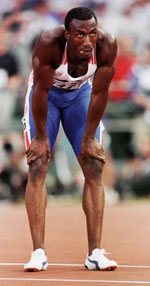
The Start
The
athlete typically starts from a four-point stance with the feet staggered, hips
high in the air, and a fair amount of weight on the fingertips. Movement
out of the blocks is as horizontal as possible, with the trail leg and opposite
arm driving forward. Skilled sprinters will maintain a pronounced forward
lean for the first several yard with eyes focused only about 10 metres down the
track. The first step of the race will be placed only a short distance
past the starting line.
Training
for the start is greatly enhanced by a coach who can carefully assess technique
(seeing video of yourself and elite sprinters can be very helpful, too).
There are numerous drills that will help with the development of fast
hands/feet, neuromuscular training for technique, etc.
NB!!
One of the most important aspects of the start is the generation of full-body
power! Power-lifting exercises such as the snatch and the clean-and-jerk
can be tremendously beneficial in developing this full-body power.
|
Sprinting Mind-Blow! In less than 0.4 seconds, sprinters will apply forces of several times their body weight to the starting blocks. |
|
Acceleration
Transition
to an upright running stride should be gradual and controlled, and should be
delayed as long as possible to force maximum acceleration out of the
body. (The limbs must move more quickly to prevent a forward fall).
Stride length is short at the beginning, with a slightly exaggerated stride
frequency for the first few strides. As the sprinter accelerates, stride
length naturally increases, and stride frequency adjusts to the sprinter's
individual sprinting characteristics.
Again,
drills for fast hands/feet will help here, along with careful attention to
technique and practice with extending the acceleration phase.
Top Speed
Typically,
sprinters reach maximum velocity from 50-70 metres of the 100 metre race.
Top speed sprinting is associated with minimal vertical displacement, high
stride length and frequency, minimal time in support phase, minimal braking and
backward velocity of the foot at the end of the flight phase. This phase
of the race is very brief.
Over-speed
training is a useful training tool for making improvements in top speed
sprinting. Some of these methods include towing and down-hill
sprinting. Over-speed training forces the neuromuscular system to undergo
a higher rate of contraction-relaxation cycling than it would be able to under
its own power. These techniques must be used with caution, as there is a
lot of soreness associated with these workouts, and some risk of injury.
For a very good discussion on the subject, check out the book "Sports Speed"
by Dintiman, Ward and Tellez.
|
|
Sprinting Mind-Blow! Donovan Bailey recorded the highest top speed for a human being at 43.8 km/h when he set the world record at the 1996 Atlanta Olympics. |
Deceleration
Almost
all sprinters are in a state of deceleration over the final 30 metres of the
race. However, highly conditioned sprinters are able to minimize this
effect and stay close to their top speed until the finish line. A
competitor with superior speed endurance may be able to overtake an opponent
that is decelerating more.
It
is therefore easy to see how speed endurance can be a valuable (and necessary)
component of a sprint training program. Improvements in speed endurance
can be achieved by doing repetitions that are longer in distance than your
event, and challenging your body to perform repetitions with less rest.
Sprinters can turn to their peers in the longer distances (i.e. 400m - 5000m)
for guidance on anaerobic threshold training, the Fartlek method, etc.
The Finish
The
sprinter whose trunk crosses the finish line first is the winner.
In close races, finishing technique can make a difference. At the moment
prior to reaching the line, sprinters lean forward forcefully from the hips and
throw their arms back.
Hip
flexibility is important for maintaining a powerful stride with the forward
lean.
Flexibility
|
|
Hip flexibility is EXTREMELY important for sprinters. This is especially true for the hamstrings, which are the hardest working muscle in the sprinting stride. Now, I have avoided going into lengthy explanations up until now, but I want to illustrate why flexibility is so important. I will do this by describing the incredible job that the hamstring must perform: The hamstring, along with the gluteal muscles, must provide most of the horizontal force to extend the hip and propel the sprinter forward. This is a powerful concentric contraction. The hamstring's work is not done there, however. It must then rapidly relax to allow recovery of the leg and extension of the knee to bring the foot back in front of the body. Before the knee can reach full extension, the hamstring must contract eccentrically to decelerate the forward movement of the foot and reverse the direction of the foot as it prepares to strike the ground. The hamstring makes the transition from eccentric contraction to concentric contraction in thousandths of a second so that the foot actually has a net velocity backward before it strikes the ground and begins the next powerful propulsion forward. Now, consider that this sequence of concentric contraction-relaxation-eccentric contraction-concentric contraction must occur in one stride, and that a sprinter makes more than 4.5 strides per second! As you can see, the demands on the hamstring are huge, and the best way to keep it functioning optimally is by keeping it loose and limber. Another reason that flexibility is of great value to sprinters is due to the importance of relaxation during the race. Total relaxation of all non-essential muscles in the sprinting stride allows for maximum efficiency of movement and minimal wasting of energy. Sprinters require loads of purposeful practice to achieve this perfect relationship between power, strength, and relaxation in the high pressure situation of a race. Flexibility training provides the sprinter with the time to focus on the state of his/her muscle tension, and to minimize the tension that would otherwise sap energy and slow movements during the race. It is easy to find information on flexibility. Sprinters should pay careful attention to all muscles that cross the hip joint, as well as muscles of the lower back and torso. Turn to hurdlers for the ultimate in hip flexibility movements and stretches! As well, sprinters will derive overall training benefits from keeping all other muscles and joints in a state of optimal flexibility.
|
Core Strength
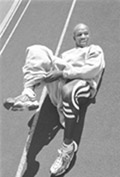
Core
strength generally refers to the stability of the muscles of the lower
back, abdomen and pelvic floor. In sprinters, these muscles must be very
strong to stabilize the pelvis and spine against the forceful, dynamic movements
of the limbs.
It
is useful to view the torso as being analogous to a bike frame. Mountain
bike frames are equipped with suspension to absorb energy being transmitted
from the ground. This allows them to cover very rough terrain, but puts
them at a speed disadvantage on smooth terrain because some of the cyclist's
energy is absorbed (wasted) by the suspension. On the other hand, a road
racing bike will have an extremely stiff frame to maximize the transference of
energy from the cyclist's legs to the ground. The stiff frame is exactly
what a sprinter wants, and core strength represents the stiffness of the
sprinter's frame.
Power-lifting,
plyometrics, medicine balls, physio balls, other abdominal work and A,B,C
drills can all contribute to core strength. Beginners should start with
abdominal exercises and phyio balls, working their way toward plyometrics and
power-lifting.
Send me an e-mail!!
[email protected]
**All Page Header & Footer Photos from:
www.qatar.net.qa/sport
|
|
End of Page |
|