


Benchmarking the supply chain
- Competitive benchmarking is the continuous measurement of the company’s products, services, processes and practices against the standards of best competitors and other companies who are recognized as leaders.
- Traditionally internal performance measurement focuses in things such as productivity, utilization, cost per activity, and so on. The shortcomings of such approach it that neglects the customer perception of performance, it does not compare against the “best in the class”, and just outputs are measured instead of measuring processes too.
- In some organizational units are difficult to benchmark because their product is a service, for example invoicing, collection, maintenance, Etc.
- An organization can benchmark against performing companies regardless of their industry sector.
- Some of the benefits of benchmarking are:
a) It enables to adopt the best practices from other industries.
b) Provides stimulation and motivation
c) Facilitates a better attitude towards changing, specially when the new ideas come from other unrelated industries
d) Helps to identify technological breakthroughs (bar coding came from the grocery industry, for example)
- The SCOR model is a framework utilized for benchmarking
a) Supply Chain Operations Reference from the Supply Chain Council
b) It is build around four major processes Plan, Source, Make, and Deliver.
Benchmarking the logistics process
- To improve outputs is necessary to improve processes. To improve processes in the supply chain is advisable to flowchart the steps along the chain starting with a customer order and ending with the delivery. Such analysis allows to identify critical points in which benchmarking should be made against the “best in class” companies.
Mapping supply chain processes
- When flowcharting the supply chain we should identify “value-adding” time and “non-value-adding” time.
a) Value-adding time is time spent doing something which creates a benefit for which the customer is prepared to pay.
b) Non-value-adding time is time spent on an activity whose elimination would lead to no reduction of benefit to the customer. Sometimes those activities are necessary, but should be minimized. Sometimes are inherited or imposed rules, such as economic batch, quantities, economic order quantities, minimum order sizes, fixed inventory review periods, production planning cycles, and forecasting review periods.
- Throughput efficiency in a supply chain can be measured as:
Value-added time
--------------------- X 100
End-to-end pipeline time
- Supply Chain Map is a time based representation of the processes and activates that are involved as the material or products move through the chain. It highlights the standing time in the warehouse.
a) Horizontal time in the map is time spent in process (transit, manufacturing, or assembly).
b) Vertical time is time spent nothing happening to the product (staging in the warehouse). No value is added here.
c) The figure depicts a map for the manufacture and distribution of men’s underwear.
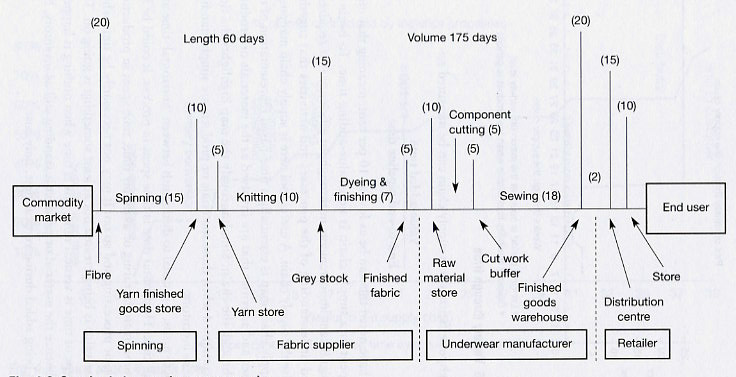
1) The horizontal time is 60 days. This is the time that it would take to respond to an increase in demand
2) It there is a downturn in demand it will take 175 days to drain the system (horizontal + Vertical time)
3) There are 175 days if inventory in the pipeline (the optimum would be 60 days)
Supplier and distributor benchmarking
- In reviewing supplier and distributor performance, the emphasis should be on assessing their contribution to reducing the total delivered cost and increasing end user customer service.
- The interfaces with supplier should also be monitored, for example knowing how other companies manage the transmission of orders to suppliers, or how do other company’s co-ordinate their production schedules with those of suppliers or customers.
Setting benchmarking priorities
- Priorities can be set by identifying:
a) Which processes and entities in the supply chain are of strategic importance
b) Which processes and entities in the supply chain have high relative impact on the business.
c) Where there is internal readiness to change.
- The ultimate guide to the selection of benchmarking priorities has to be the impact that an activity if function has upon competitive advantage.
Identifying logistics performance indicators
- Key Performance Indicators (KPI). They are the critical measurements that contribute more than proportionately to success or failure in the market place.
- The KPI derive from the strategic goals themselves and sometimes a balanced scorecard is utilized to determine them.