 |
|
|
|
|
|
|
|
|
|
|
|
|
|
|
|
|
|
|
|
|
|
|
|
|
|
|
|
|
|
Merengue ~ The exciting rhythms of the Merengue inspire dancers all over the world to move to the intoxicating beat. THere are two schools of thought as to how this captivating dance began. One says it started as a peasant dance in the Domicnican Republic by African slaves. The dragging of one leag relieved chafing of leg irons. Another says a returning war hero, a General Meringie, danced, dragging an injured leg. Wherever it began, the Merengue is an exciting Latin Dance that is Fun. |
|
|
|
 |
|
|
|
|
|
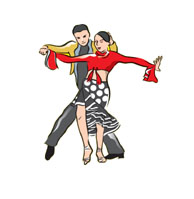
Paso Doble ~ The Spanish march or One Step. It makes an especially good exhibition routine when the man styles his body movements to look like a bullfighter's and leads his partner in and out of the patterns as if she were a cape. It is usually in 2/4 time. |
|
|
|
 |
|
|
|
 |
|
|
|
|
|
|
 |
|
|
|
|
|
|
|
|
|
|
|
|
 |
|
|
|
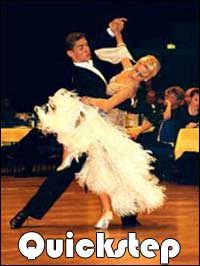
Quickstep ~ The English version of the Fast Fox Trot, which has quick hopping steps set in with the smoother gliding figures. It is very popular in Europe as a competition dance. It ranks among the "Big Five", the other three being the Slow Fox Trot, the Waltz, the Tango, and the Viennese Waltz. |
|
|
|
|
|
Rumba ~ The Rumba was originally a marriage dance. Many of its movements and actions which seem to have an eroctic meaning are merely depictions of simple farm tasks. The shoeing of the mare, the climbing of a rope, the courtship of the rooster and the hen, etc. It was done for amusement on the farms by the black population of Cuba. However, it became a popular ballroom dance and was introduced in the United States about 1933. IT was the Americanized version for the Cuban Son and Danzon. It is in 4/4 time. The characteristic feature is to take each step without initially placing the weight on that step. Steps are made with a slightly bent knee which when straightened, causes the hops to sway from side to side in what has come to be known as "Cuban Motion". |
|
|
|
 |
|
|
|
 |
|
|
|
|
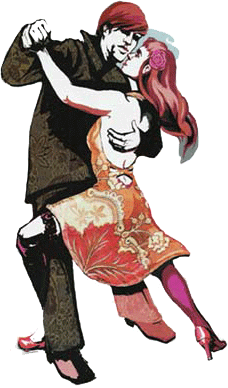
Salsa ~ This is a favored namefor a type of Latin Music which, for the most part, has its roots in Cuban culture and is enhanced by jazz textures. The word, Salsa, means sauce denoting a "hot" flavor and is best distinguished from other Latin Mysic musicians in New York. The dance structure is largely associated with mambo type patterns and has a particular feeling that is associated mainly with the Clave and the Montuno. |
|
|
|
|
|
|
 |
|
|
|
Samba ~ This Brazilian dance was first introduced in 1917 but was finally adopted by Brazilian society in 1930 as a ballroom dance. It is sometimes referred to as a Samba, Carioca, a Baion or a Batucado. The difference is mostly i n the tempo played since the steps in all three dance are very similar. The style is to bounce steadily and smoothly in 2/4 meter. They say that the Samba was introduced in the United States in 1939 by the late Carmen Miranda. |
|
|
|