| Our Political Beginning | The Coming of Independence | The Critical Period | Creating the Constitution | Ratifying the Constitution |

| Common Features of State Constitutions |
| Popular Sovereignty | The principle of popular sovereignty was the basis for every new State constitution. That principle says that govrnment can exist and function only with the consent of the governed. The people hold power and the people are sovereign |
| Limited Government | The concept of limited government was a major feature of each State constitution. The powers delegated to government were granted reluctantly and hedged with many restrictions |
| Civil Rights and Liberties | In every State it was made clear that the sovereign people held certain rights that the government must respect at all times. Seven of the new constitutions contained a bill of rights, setting out the "unalienable rights" held by the people |
| Seperation of Powers and Checks and Balances | The powers granted to the new State governments were purposely divided among three branches: executive, legislative, and judicial. Each branch was given powers with which to check (restrain the actions of) the other branches of the government |
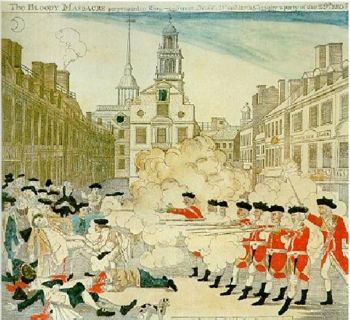 |
Boston Massacre The Boston Massacre was an incident involving the deaths of five American civilians at the hands of british troops on march 5 , 1770 , the legal aftermath of which helped spark the american revolutionary war. A tense situation due to a heavy British military presence in boston boiled over to incite brawls between soldiers and civilians, and eventually led to troops discharging their muskets after being attacked by a rioting crowd, 3 civilians were killed at the scene, another two mortally wounded and more critically injured as a result. |
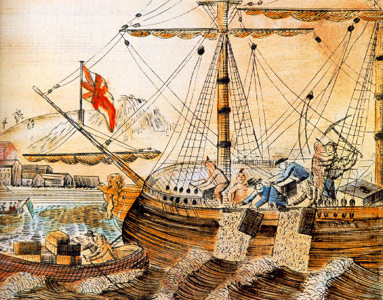 |
Boston tea party The Boston Tea Party was an act of protest by the American colonists against Great Britain in which they destroyed many crates of tea bricks on ships in Boston Harbor . The incident, which took place on Thursday, December 16 , 1773 , has been seen as helping to spark the American Revolution . |
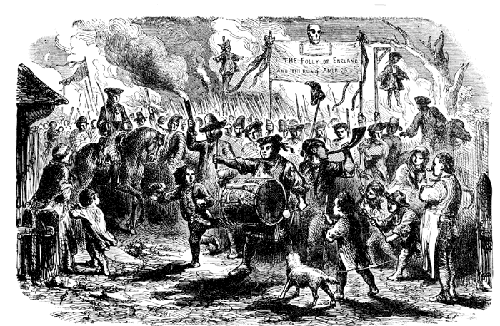 |
stamp act of 1765 The Stamp Act of 1765 was the fourth Stamp Act to be passed by the Parliament of Great Britain and required all legal documents, permits, commercial contracts, newspapers, wills, pamphlets, and playing cards in the American colonies to carry a tax stamp. The Act was enacted in order to defray the cost of maintaining the military presence protecting the colonies. |
Our Political Beginning | The Coming of Independence | The Critical Period | Creating the Constitution | Ratifying the Constitution