 |
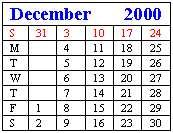
stamps issued in 2000 december |
|
stamps issued in 2000 december |
[Home][About Us][Membership][Member
List][Links][Kids][Feedback][Magazines][Dealers][Societies][Articles][WhatsNew]
| JEWELLERY :
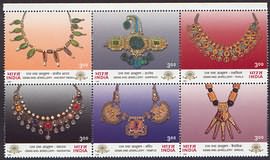
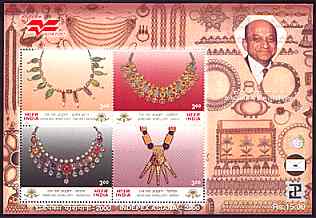
INDEPEX ASIANA-2000 India's tradition in jewellery is more than 5000 years old. The Department of Posts issues a set of 6 stamps on Indian gems and jewellery under the series of stamps issued to launch Indepex Asiana -2000, XIV Asian International Exhibition, the Department's tribute to 50 years of the Republic of India, and the New Millennium. By 3000 BC India was the principal production centre for jewellery making. Lapislazuli, turquoise, coral, camelian, jasper and a variety of semiprecious stones were imported into the Indus valley cities of Harappa, Mohenjodaro, Lothal, Kalibangan where they were cut, shaped and re-exported to destinations beyond India's maritime boundaries. The first stamp in the series portrays a bead necklace from Indus Valley of Ancient India. The Natyashastra classifies ornaments into four types: avedhya - that which is worn by piercing a part of the body, including ear-ornaments (kundala); bandhaniya -that which is tied up like girdles (sronisutra) and armbands (angada); praksepya -that which is worn like anklets (nupura); and aropya - that which is put around, for example, chains (hema-sutra) and necklaces (hara). The second stamp in the series portrays a necklace with such intricate craftsmanship in gold from Taxila. In the Mughalperiod 'meenakari' or enameling, a unique combination of gems, enamel pigments and precious metals became increasingly popular. Some of the fine examples of Mughal aesthetic detailing are seen in the items of jewellery made for the nobles, such as Sarpech, a turban ornament shown in the series. The "navaratna" concept with nine gems in uncut form studded in amulets, was believed to symbolise the relationship between man, the planets and their reigning deities, and hence functioned as mediums between human and Divine. Navaratna jewels were commonly made in the form of rings, pendants, bangles and necklaces, and incorporated ruby, pearl, coral, emerald, topaz, diamond, sapphire, zircon and cat's eye. Jewellery has always been associated with rituals for women in India. The 5th stamp in the series depicts a 'tali' (19th century AD), a marriage necklace from South India. There is a ritual of tying of 'Mangalsutra' on the wedding day (Bridal). Worship and propitiation
of the elements was absorbed in the jewellery design and
ornaments in ancient times are seen to function as a
canvas for myths and legends. The last stamp in the
series depicts a 'kanthla' necklace (181h century AD)
from Rajasthan, forming part of "temple jewellery".
|
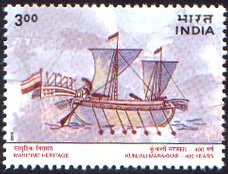 |
Maritime
Heritage - Kunjali Marakkar - 400 Years India's maritime heritage dates
back to the Indus Valley Civilization (circa 3000 B.C.).
The discovery of Lothal port and dock (circa 2400-1900
B.C.) bear testimony to this. After the landing of Vasco
da Gama in Calicut in 1498 A.D., the Portuguese slowly
gained influence and started interfering in the trade.
Mohammed Kunjali Marakkar, the first Admiral of Calicut
who offered to the Zamorin his sword, ships and services,
dedicated his entire energies in fighting the foreign
domination of Indian seas. He was the first of the four
Kunjalis who played a heroic part in the Naval wars with
the Portuguese. The most famous of the Marakkars was
Kunjali IV, who fought the Portuguese more fiercely than
his predecessors and with far greater success. However,
the initial successes appear to have made him arrogant to
the extent of ignoring the authority of the Zamorin. The
Portuguese clinched a deal with Zamorin to suppress the
'rebel' Admiral, and in 1600 jointly laid siege of his
fort, bringing to an end the long tradition of the
legendary Marakkars. Kunjali IV who surrendered to the
Zamorin was executed in Goa. The stamp design shows the
war-paroe, a small craft used by the Kunjalis, which,
manned by just 30-40 men each, could be rowed through
lagoons and narrow waters.
|
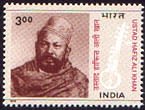
Ustad Hafiz Ali Khan Ustad Hafiz
Ali Khan (1888-1972), one among the great exponents of
the Sarod, was a torchbearer of the glorious musical
legacy of Gwalior. The present day sarod is the
improvised and modified form of old rabab which was first
introduced in India by the Afghans who came here from
Kabul and settled in many places of Northern India. Hafiz
Ali Khan was born in a family of musicians, particularly
famed for their mastery of the sarod. Hafiz Ali Khan was
given training in music by his father Ustad Nanhe Khan
from the age of 6 years and continued it for 13 years.
After the death of his father, he did not lose courage
but with hard rigorous practice he perfected his art and
soon earned the title of "Aftabe Sarod". After
different training stints, he returned to Gwalior and
became the court musician of Maharaja Madhav Rao Sindhia.
He has trained many disciples, amongst them is his son
Ustad Amjad Ali Khan of world - wide fame. He was awarded
the title of 'Padma Bhushan' in 1960 by the President of
India. The house where Ustad Hafiz Ali Khan used to live
in Gwalior has now been converted into 'Sarod Ghar' -a
museum for musical heritage, and stands as a testament to
the glorious contribution made by him to the world of
music.
|
 |
|
Personalities
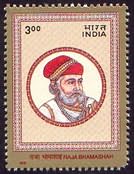
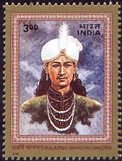
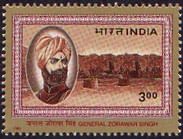
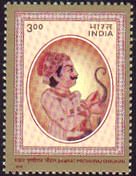
Series : Historical A set of commemorative stamps on four historical personalities of India has been issued by the Department of Posts. Samrat Prithviraj Chauhan (1162-1192 A.D.) ruled from Delhi at a crucial juncture of India's history. Known for his bravery, chivalry and kindness, he has been immortalised in Prithvirajaraso, an epic poem composed by one of his associates Chand Bardai. The manner in which he wooed and won Sanyogita, daughter of King Jayachandra of Kannauj has made him a romantic hero. The forces of Muhammed Ghuri regrouped themselves and a battle took place at Tarain in 1192, in which Prithviraj Chauhan was defeated and taken prisoner. Raja Bhamashah (1542-1598 A.D., approx.) was the childhood friend, colleague and adviser of Maharana Pratap, the legendary hero of Mewar (Rajasthan). Bhamashilh's loyal support was pivotal to the career of the Mallarana, right from the time his coronation. Courageous and possessing exemplary military skills, Bhamashah played crucial roles in the numerous military exercises of Mewar against the mighty Mughal army, including the famous battle of Haldi Ghati. Modern historians describe him as the "Uplifter of Mewar". Rajarshi Bhagyachandra ( 1740-1798 A.D.) was an enlightened king of Manipur who left his mark on history by successfully resisting the Burmese invasions, eliminating dissensions within the state, generating a cultural renaissance and leading Manipur to over-all prosperity. Gifted with native intelligence, Bhagyachandra realized during the early years of his reign itself that possible invasion from the Burmese side was a major threat to the stability of Manipur. Bhagyachandra consolidated the relations between the peoples of the hills and the plains, thus unifying and integrating the state of Manipur. Under his patronage, 'Raas Leela' and 'Nata Sankirtan' emerged as classical disciplines and triggered a cultural renaissance in Manipur. His spiritual leanings led to his being called, 'Rajarshi', meaning 'King who was also an ascetic'. General
Zorawar Singh
(1786-1841 A.D.) was a Dogra warrior who joined the army
of Maharaja Gulab Singh of Kashmir as a Sepoy and rose on
account of his soldierly qualities and military acumen to
become the Governor of Kishtwar and earned the title
'Wazir'. Ladakh was annexed for the first time in history
by Zorawar Singh in 1834. After Ladakh he campaigned in
Baltistan among the three states of Skardu, Gilgit and
Hunza. The techniques of mountain warfare employed by him
are considered text book examples of military science
even today. In 1841, he set out on an ambitious
expedition into Tibet, over-running Rudak and Gor.
Fighting the numerically stronger Tibetan troops in
extremely inclement whether conditions, General Zorawar
Singh laid down his life in the battlefield. For his
military skills, inspiring leadership and administrative
acumen, General Zorawar Singh has been named 'Little
Nepolean of India' by some historians.
|
| India Post issued a miniature sheet on the Gems and Jewellery featuring the most precious jewel of Indian Philately, late Shri DN Jatia on 11 December 2000. This was released by Shri Gautam Gupta, Member (O) Dept. of Post, and presented to Shri Sahadev Sahoo, President PCI. |
Ovr Sz - Overall Size Pr Sz - Printed Size
 |
 |
Stamps Issued in |
[Home][About Us][Membership][Member List][Links][Kids][Feedback][Magazines][Dealers][Societies][Articles][WhatsNew]
Copyright
(c) Dakshina Kannada Philatelic Association
http://www.geocities.com/dakshina_kan_pa