 |
stamps issued in 2001 january |
|
stamps issued in 2001 january |
[Home][About Us][Membership][Member
List][Links][Kids][Feedback][Magazines][Dealers][Societies][Articles][WhatsNew]
 |
St
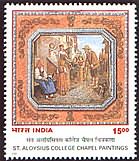
Aloysius College Chapel Paintings The paintings of St. Aloysius
College Chapel, Mangalore are among the finest specimens
of paintings in India, and truly constitute a national
treasure. Executed by Antonio Moscheni, a Jesuit Brother
from Italy during 1899-1901, the paintings are of three
types: frescoes (paintings on wet plaster), tempera (paintings
on dry plaster) and panels painted on canvas and fixed to
the ceilings. The masterly use of light and shade by the
artist creates a sense of depth, making his images life-like.
The rich colours and the delicate touch evoke the
mysterious presence of the divine. The layout of the
paintings follows a threefold division. The central
ceiling and the wall behind the main altar of the Chapel
depict the life of the noble youth, Aloysius Gonzaga, the
Patron saint of the College, who renounced a dukedom to become
a Jesuit and died in the service of the plague stricken
in Rome in 1591 at the age of 23. The stamp depicts one of
the panels from the central ceiling of the Chapel,
showing the early life of Aloysius Gonzaga. The stamp was
released on January 12, 2001, as it was on this day in
1880 that the St. Aloysius College was inaugurated.
|
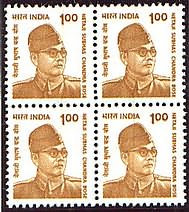
| The Department of Post for the first time released a special definitive on Subash Chandra Bose on his birthday 23-01-2001 |
 |
"To my
countrymen I say, forget not that the greatest curse for
man is to remain a slave. Forget not that the grossest
crime is to compromise with injustice and wrong.
Remember the eternal law - you must give life, if you
want to get it. And remember that the highest virtue is
to battle againt inequity, no matter what the cost may be."
- Netaji Subash Chandra Bose Born on 23rd January 1897, Subash Chandra Bose was deeply influenced by the philosophy of Swami Vivekananda. He formed the Indian National Army and proclaimed the Provisional Government of Azad Hind on October 21, 1943. He was hailed as Netaji, the leader by the people of India. |
| Pandurang
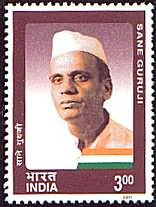
Sadashiv Sane Pandurang Sadashiv Sane alias Sane Guruji
(1899-1950), like thousands of others from his generation,
was drawn to the Freedom Struggle by the teachings,
philosophy and life of Mahatma Gandhi. He made extensive
use of the public platform during the Freedom Struggle to
develop national consciousness and promote the desire for
Independence. He was imprisoned many times. In particular,
he worked tirelessly to implement Gandhiji's teachings on
social reform. In a prayer meeting in Delhi, Gandhiji
paid tribute to his efforts in getting the temple at
Pandharpur open to the dalits. Sane Guruji was distressed
to find the spirit of religion distorted by social evils
such as caste system, and wrote the book "Bharatiya
Sanskriti" to clear up such prejudices and educate
people about the values of life, The Sadhana weekly,
started by him in August 1948 as a vehicle of socio-cultural
emancipation, continues to spread his message.
|
 |
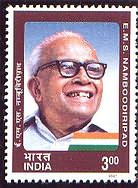 |
E.M.S.
Namboodiripad E.M.S. Namboodiripad (1909-1998) started
his public life as a Congress worker in Kerala during the
Freedom Movement, but was later drawn towards Marxism in
his search for solutions to the problems of poverty and
inequality .He was among the founders of the Communist
Party in Kerala and created history in the 1957 elections
by leading it to power in the state. As Chief Minister of
Kerala, he initiated the path-breaking land reform
legislation and many other pro-poor measures, bringing
solace to millions of people. Namboodiripad was also a
brilliant Marxist theoretician, whose vast body of
writing on a variety of subjects bears the mark of an
original and creative mind.
|
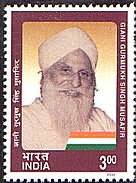
| Giani Gurmukh
Singh Musafir Giani Gurmukh Singh Musafir (1899-1976)
plunged into the Freedom Struggle at an early age,
stirred by anguish over the Jallianwala Bagh massacre of
1919. He threw himself into the freedom struggle movement,
calling people to action through his sensitive, poems in
Punjabi. He went on to play a crucial role in the
Struggle in Punjab, courting arrest many times. He was
drawn to the Akali Movement for social reform, in which
his sincerity of purpose and spirit of dedication took
him to the highest religious office of Sikhism i.e.,
Jathedar of the Akal Takht, Amritsar in 1930. After
Independence, he was actively involved in building up
Punjab as a model of growth and development. In 1966,
when the new state of Punjab came into being after re-organisation,
Giani Gurmukh Singh Musafirtook over as its first Chief
Minister.
|
 |
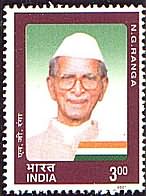 |
Professor
N.G. Ranga Professor N.G. Ranga (1900-1995) hailed
from Guntur in Andhra Pradesh. Deeply influenced by
western socialist thinkers at Oxford, England, where he
went for higher studies, the amelioration of the lot of
the peasantry became his major motivation, and he joined
the Freedom Movement and championed the cause of the
downtrodden peasants. He continued to be active in
politics in independent India, strengthening the Kisan
movement, striving for empowerment of women and working
for famine relief. He was instrumental in the formation
of the Swatantra Party along with Rajaji in 1959, though
he later returned to the Congress. Bold, uncompromising
and knowledgeable, he waged a tireless war against social
evils such as the caste system. Prof. N.G. Ranga is
remembered as champion of rural India.
|
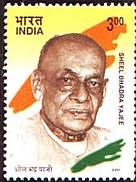
| Sheel Bhadra
Yajee Sheel
Bhadra Yajee (1906-1996) the fiery freedom fighter from
Bihar was associated with the non-violent and the violent
form of freedom struggle. Yajee's participation in the
freedom movement began in 1928 when, as a student, he
attended the Calcutta Session of the Indian National
Congress. He joined the Congress Socialist Party four
years later and became involved in the Kisan movement.
Later, he came in close touch with Subhas Chandra Bose,
as well as Mahatma Gandhi. In 1939 he joined Subhas
Chandra Bose to found the All India Forward Bloc. He was
actively associated with the INA movement. Yajee raised
his voice against caste prejudices and other social evils.
He was a firm believer in the active participation of the
peasants, workers and the middle classes in the struggle
for the transformation of society. He authored several
books like' A Glimpse of the Indian Labour Movement', 'Forward
Bloc and Its Stand', 'Is Socialism a Necessity to India',
and 'True Face of Monopolistic American Democracy'.
|
 |
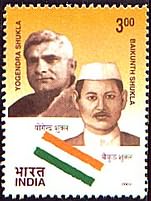 |
Yogendra
Shukla and Baikunth Shukla Yogendra Shukla (1896-1966) as well as his nephew Baikunth Shukla (1907-1934) hailed from village Jalalpur in Muzaffarpur (now Vaishali), district of Bihar and were torch bearers of the revolutionary spirit of freedom struggle. Young Yogendra made his greatest contribution to the cause of Indian freedom between 1930 and 1942, as one of the leaders of the revolutionary movement in Bihar and U.P. becoming "Almost a legendary figure for his many exploits". He was a close associate of Bhagat Singh and Batukeshwar Datta. He had to serve prison terms for a total of more than sixteen and a half years for his revolutionary activities. During imprisonment in different jails of India, he was subjected to extreme torture, which corroded his iron constitution. Baikunth Shukla was also
initiated into the freedom struggle at a young age taking
active part in the 'Salt Satyagraha' of 1930. He was
associated with revolutionary organisations like the
Hindustan Seva Dal and Hindustan Socialist Republican
Association. The execution of the great Indian
revolutionaries, Bhagat Singh,Rajguru and Sukhdev in 1931
as a result of their trial in the 'Lahore conspiracy case'
was an event that shook the entire country. Phanindra
Nath Ghosh hitherto a key member of the Revolutionary
Party had treacherously betrayed the cause by turning an
approver, giving evidence, which led to the execution.
Baikunth was commissioned to plan the execution of Ghosh
as an act of ideological vendetta which he carried out
successfully on 9th November 1932. He was arrested and
tried for the killing. Baikunth was convicted and hanged
in Gaya Central Jail on May 14th, 1934. He was only 28
years old.
|
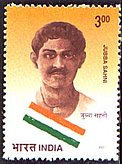
| Jubba Sahni Jubba Sahni (1906-1944) hailed
from a poor family in the Muzaffarpur District of Bihar
and was forced by circumstances to work as a labourer in
a large agricultural farm where British supervisors kept
watch. Jubba experienced the ruthlessness with which the
British supervisors treated the Indian workers. From the
Salt Satyagraha of 1930 to the Quit India Movement of
1942, his revolutionary activities were on the increase.
In August 1942, he led an armed revolt against the Police
Station in Meenapur in which the in-charge of the Police
Station, Waller was killed. Jubba Sahni took the entire
responsibility of the episode upon himself and was later
sentenced to death by a special court appointed by the
British Government. He was hanged to death in Bhagalpur
Central Jail, at the age of 38.
|
 |
Ovr Sz - Overall Size Pr Sz - Printed Size
 |
 |
 |
[Home][About Us][Membership][Member List][Links][Kids][Feedback][Magazines][Dealers][Societies][Articles][WhatsNew]
Copyright
(c) Dakshina Kannada Philatelic Association
http://www.geocities.com/dakshina_kan_pa