 |
jhanda uncha rahe hamara YV Jeppu |
|
jhanda uncha rahe hamara YV Jeppu |
[Home][About Us][Membership][Member
List][Links][Kids][Feedback][Magazines][Dealers][Societies][Articles][WhatsNew]
The Story of our
Tiranga retold through Indian Stamps
 The ancient Indians worshipped
the flag or Dhvaja. A seal from Mohenjo-daro shows four
men in a file, each carrying a standard. The great epic
Mahabharata describes the various dhvajas and the
ceremonies and rituals associated with the flag and
staff. The dhvaja has three basic parts (1) the pataka
or the triangular or rectangular part that is free (2)
the yasti or the staff and (3) the ketu or
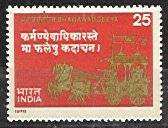
the emblem on the pataka. Arjuna the great warrior in
Mahabharata had a kapi dhvaja on his chariot with
the monkey or kapi. Hanuman the Hindu God with the face
of a monkey was supposed to have been residing on the
pataka during the Mahabharata War. The ancient Indians worshipped
the flag or Dhvaja. A seal from Mohenjo-daro shows four
men in a file, each carrying a standard. The great epic
Mahabharata describes the various dhvajas and the
ceremonies and rituals associated with the flag and
staff. The dhvaja has three basic parts (1) the pataka
or the triangular or rectangular part that is free (2)
the yasti or the staff and (3) the ketu or
the emblem on the pataka. Arjuna the great warrior in
Mahabharata had a kapi dhvaja on his chariot with
the monkey or kapi. Hanuman the Hindu God with the face
of a monkey was supposed to have been residing on the
pataka during the Mahabharata War. |
 |
 |
The French revolution and its
slogan "Liberty, Equality, Fraternity"
acquainted the Indians with the idea of nationalism. It
is said that when Raja Ram Mohan Roy was sailing to
England in January, 1831 he went across to the French
ship to greet the French flag. For him the French
tricolour was not a mere National - Flag but the symbol
of French revolution. In the French tricolour, the great
nationalist saw the dream of India's Independence. The
uprising of 1857 intensified the spirit of nationalism in
the people of India and they felt a need to gather around
a national symbol, a National Flag. |
 |
The quest for the national flag
assumed great urgency with the rise in the Swadeshi
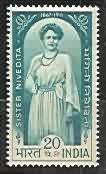
Movement in 1900s. Sister Nivedita, an Irish disciple of
Swami Vivekananda, was one of the first to conceive of a
National - Flag for India. In 1904, while on a visit to
Buddha Gaya with Rabindranath Tagore and JC Bose, she saw
the Vajra - Chinha (symbol). Vajra is a sign of
strength being the celebrated weapon of Lord Indra, the
war god. She designed a National Flag for India which was
square in shape, with a red field. It had a hundred and
one jyotis all along the border and Vajra in yellow at
the centre. Vande was inscribed on the left and Mataram
on the right of it in yellow colour in Bengali script.
She wrote ".. red implies struggle for freedom,
yellow means victory, and the white lotus denotes
purity..". |
 |
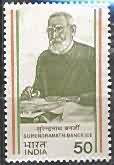 |
On August 7, 1906, the first
anniversary of the anti-partition movement, a big rally
was organized at Parsi Bagan Square (Green Park) in
Calcutta. This day was known as the Boycott Day in
protest against the partition of Bengal. A tricolour flag
was unfurled for the first time during the rally. The
flag was designed by Schindra Prasad Bose, a close
follower of Sir Surendranath Banerjee. It had eight half
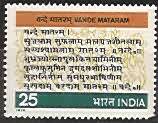
open lotuses on the green stripe, Vande Mataram in blue
on the middle yellow stripe, and the sun and moon
(crescent) in white on the bottom red stripe. Sir
Surendranath Banerjee hoisted this flag with the bursting
of a hundred and one crackers. |
 |
|
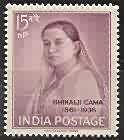
In the history of the India's
National Flag, the name of Madame Bhikhaji Rustom Cama
should be inscribed in letters of gold. She was the first
Indian to have raised an Indian flag on foreign soil and
announced to the world our political flight with
the British for the country's Independence. Madame Cama's
flag had green on the top, golden saffron and red at the
bottom. Eight lotuses, representing the eight provinces,
were lined on the flag. Vande Mataram was written in gold
with the Crescent towards the hoist of the flag and the
Sun on the other side.
Madame Cama quietly died
in Bombay, unwept and unsung on August 16, 1936. |
 |
 |
[Home][About Us][Membership][Member List][Links][Kids][Feedback][Magazines][Dealers][Societies][Articles][WhatsNew]
Copyright
(c) Dakshina Kannada Philatelic Association
http://www.geocities.com/dakshina_kan_pa