Day 1
The first day's action began as a limited attack to fix enemy forces and find their weaknesses. It turned into a day full of surprises-most of them good.
The 1st Cav. spent the first day on the extreme right flank continuing its series of raids. The moves kept Iraqi forces pinned near the border, unable to reinforce the hard-hit units to the west.
The Big Red One rolled through the berm toward the 26th Infantry Division. Before the war, the 1st ID had plows installed on the front of its Abrams tanks to clear paths through enemy mine fields. Expecting slow going into the teeth of a fierce defense, the division found the enemy hadn't placed any mines forward of its main defense line.
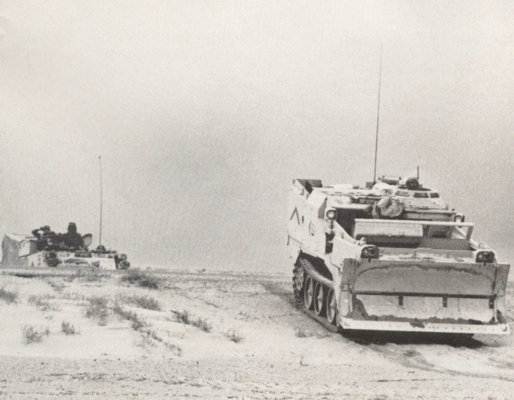
ACE (Burm Buster) engineer Vehicle
Further west, the 2nd ACR found nothing but daylight, sweeping through the desert from their flank position.
The battle reports were so favorable, at 1 p.m. the VII Corps commander agreed to speed up the timetable and launch the attack with only two-hours notice. Corps issued the order and the 1st and 3rd ADs followed 2nd ACR into Iraq at 3 p.m. The cavalry, meanwhile drove even deeper behind Iraqi lines.
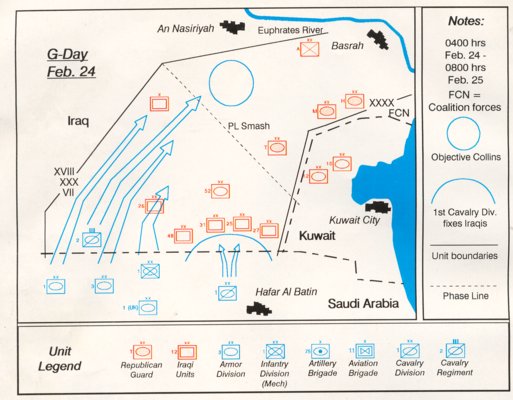
As events unfolded, it became apparent the corps had succeeded in its grand deception. The first day's attack met a demoralized enemy. The 1st Cavalry Division had four enemy divisions pinned in place near the Iraq-Kuwait border. Further west, the 1st ID drove its attack through Iraqi infantry defenses while 2nd ACR had light contact and increasing numbers of POWs. Saddam Hussein had fallen into a trap from which he never recovered.
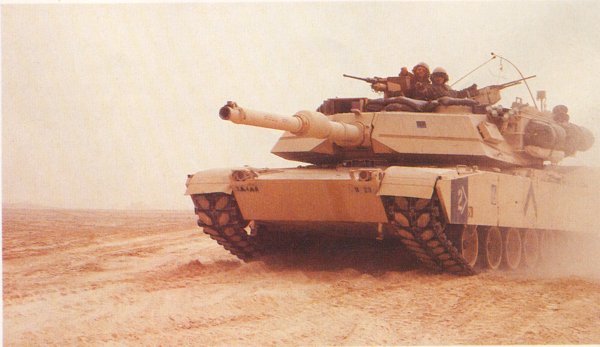
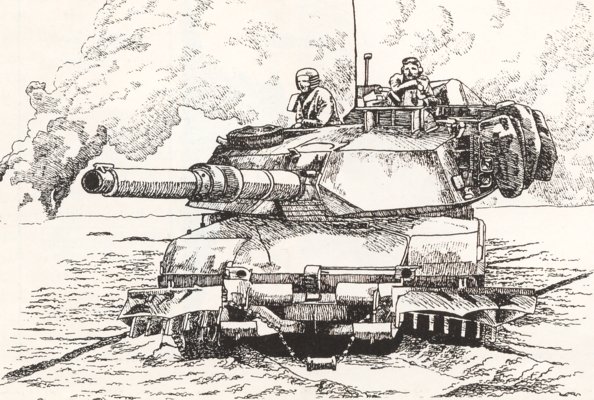
M1A1 Abrams Main Battle Tank
Feb. 25 dawned on a corps in motion. First ID continued to clear the enemy to its front. The 1st (UK) AD moved up, ready to pass through and attack the Iraqi's reserves to the east. As the day wore on, the 1st ID destroyed the Iraqi 26th Infantry Division's front-line brigades. Turning east, it struck into the flank of the Iraqi 48th Infantry Division. They expanded the breach as planned, then passed the 1st (UK) AD who turned east at noon to attack the 52nd Armored Division.
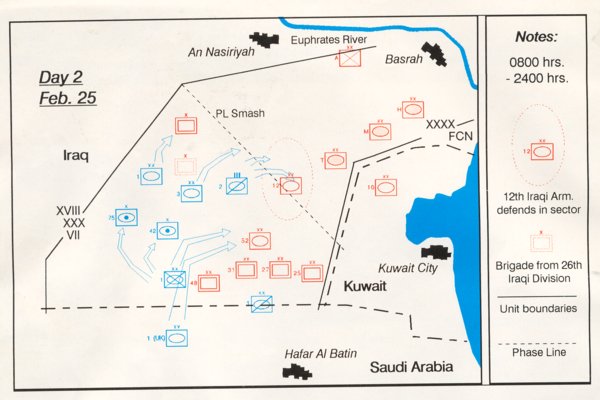
In the west, the 2nd ACR continued moving, shifting east to allow the 1st AD to pass to the west. Around noon, the cavalry came into contact with parts of the 12th Armored Division. Shortly afterwards, the 1st AD, operating on the far left, and the 3rd AD, now placed between the cavalry and its sister armored division, struck dug-in infantry from the 26th Infantry Division. Both divisions rolled over the opposition quickly and moved on.
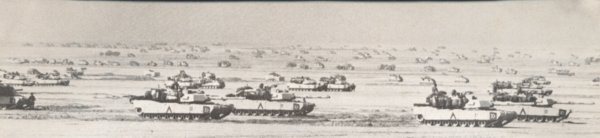
Tank Battalion
Later that day, the 1st AD engaged, using tactical air support and Apache attack helicopters, a reinforced infantry brigade dug in around an Iraqi logistics center near the small town of Al Busayyah. The 1st AD continued attacks during the night with artillery and then attacked and destroyed the enemy log center early the next day.
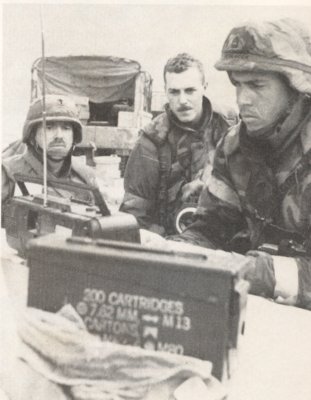
Army Chaplain and two soldiers listening to News on Radio.
The 3rd AD and 2nd ACR continued to push a running battle with isolated Iraqi units as they headed east into the night. Rain and sandstorms rolled in late in the day and through the night. That evening the corps shifted the attack east, deviating from the originally planned northeast attack, in anticipation of a massed three-division attack against the Republican Guard.
Day 3
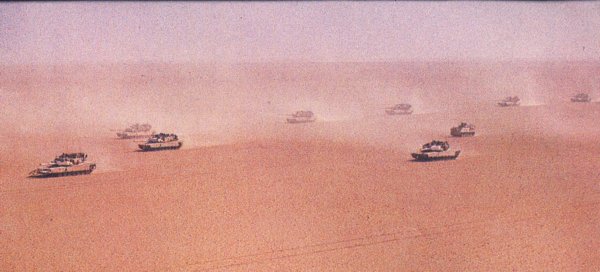
Tank Company on the move.
As the offensive intensified, so did the weather. Stiff breezes on the 25th turned into a raging sandstorm as dawn tried to break over the desert.
On the right, the British continued their relentless attack east. Reinforced by VII Corps Artillery units, the 1st (UK) smashed the enemy to its front as it moved east into the flank and behind the Iraqi infantry divisions along the border. Meanwhile corps ordered the 1st Infantry Division to leave a battalion task force in the breach and move the division to the northeast to join 1st and 3rd ADs in the three-division attack.
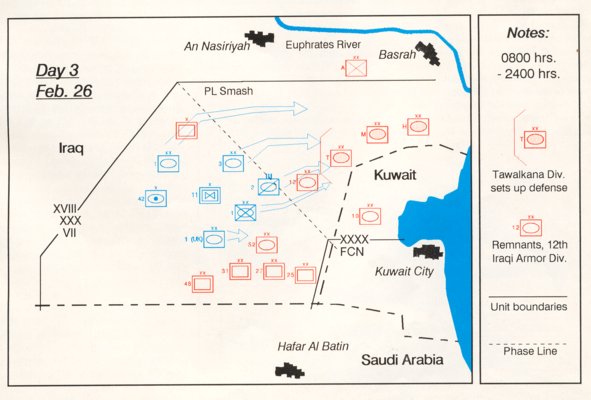
The 2nd ACR continued to put units from the 12th Armored Division out of action throughout the morning while it found and fixed the Tawalkana Division along its southern flank. The Spearhead Division, passing north of the cavalry, drove east attacking the Tawalkana.
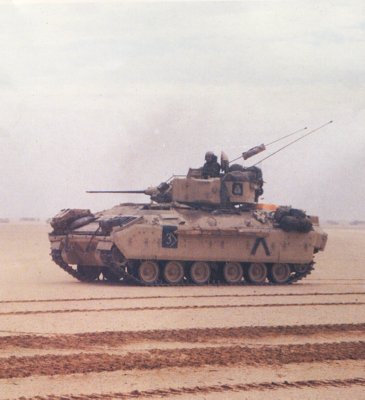
M2A1 Bradley Fighting Vehicle. The Carrier for Mechanized Infantry.
The next few hours developed into a mix of meeting engagements and fierce battles. "Cav" troopers found themselves facing mounting odds. They smacked into the Republican Guards repositioning and digging in across their front and began the Battle of the 73 Easting. Their thermal imaging systems gave them an edge over the Iraqi gunners they faced in the murky weather.
Around 6:20 p.m., the 3rd AD's cavalry squadron literally ran into the Tawalkana Guards. Opening fire at ranges less than 600 meters, the cav troopers blasted away at Iraqi tanks, armored personnel carriers and artillery, calling for artillery fire and alerting the corps that the decisive battle it sought had begun. Combat operations continued unceasingly for the next 38 hours.
At 9:45 p.m., 11th Aviation Brigade Apache helicopters joined the battle launching the first of two night-time deep attacks against enemy forces moving west to join the fight. The 1st ID made a night passage of lines with the 2nd ACR and attacked between the British, still fighting in the south, and the 3rd AD, now heavily engaged against the Republican Guard. On the corps' northern boundary, the 1st Armored Division rushed forward to join the four division night attack forming against the Republican Guard. Meanwhile corps ordered the 1st Cavalry Division released from theater reserve in mid-morning, moving them through the breach more than 250 kilometers to take up positions near 1st AD and prepare to attack east.
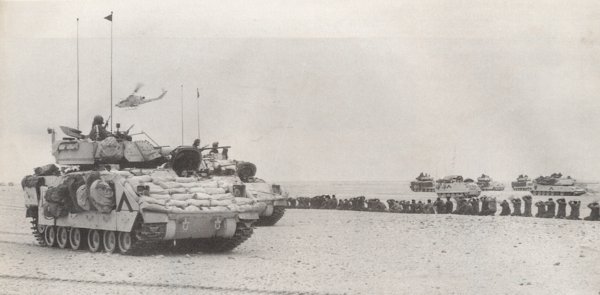
M2A2 with sandbags over engine compartment. Many soldiers reenforced thier vehicles armor with sandbags. This Taskforce is surrounding Iraqi Prisoners.
Day 4
By dawn Feb. 27, the corps attack gained momentum and was well on its way to completing the systematic destruction of many of Iraq's armored formations. From the Iraq-Saudi Arabia border in the south to the northern edge of the corps sector 150 kilometers away, the four-division assault carried eastward throughout the day. As one Iraqi POW later put it, "I stood and looked to the west and as far as I could see were tanks and more tanks. Tanks everywhere."
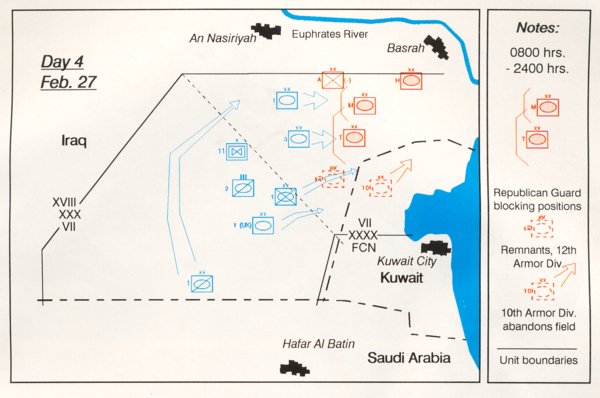
On the right flank, the British finished off the enemy 52nd Armored Division. It then closed the trap on three remaining infantry divisions still huddling in their positions which faced the wrong way. It then began an attack east toward Highway 8, just north of Kuwait City.
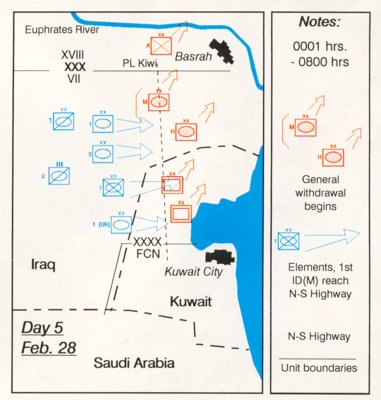
The 1st ID, next in line, overran two brigades from the Iraqi 12th Armored Division. Division elements pushed on, also aiming for the main highway running north and south from Kuwait City to the southern Iraqi city of Basrah. The Iraqi 10th Armored division melted away east of the 12th Armored position, abandoning their equipment and destroying their bunkers. Later in the day, elements of the Big Red One cut the Basrah-Kuwait City highway and began attacking north.
The 3rd AD, arrayed against the rapidly crumbling Tawalkana Division, crushed all opposition. Two attack helicopter battalions lent their firepower to the battle, the division's own and one from the 11th Aviation Brigade.
Meanwhile, 1st AD soldiers rushed eastward and, fresh from their battle at Al Busayyah, attacked through the right flank brigade of the Tawalkana division and a brigade from the Republican Guard's Adrian Infantry Division northeast of the 3rd AD battle. When the division encountered a brigade from the Madinah Armored Division (yet another Republican Guard formation), it destroyed them in a series of sharp actions.
The remaining Republican guard forces, VII Corps' prime target, streamed northward in full retreat in the face of a double envelopment VII Corps had begun earlier with 1st Cavalry in the north and 1st ID as the southern arm.
Day 5
The corps pushed on, with the 1st Cavalry Division now following the 1st AD in the north and the 2nd ACR backing the 1st ID in the center. The corps was within hours of closing the pincers of its double envelopment as the cease fire neared. Corps forces destroyed Iraqi bunkers, dug out the last stubborn defenders and began herding masses of POWs toward the rear. The corps continued to attack east and northeast until the cease fire at 8 a.m.
The aftermath
The VII Corps attack overcame tough logistics challenges while covering more than 150 miles. In little more than 90 hours, corps soldiers smashed their Iraqi foe. During the fight and afterward the corps captured or destroyed 1,981 tanks, 1,938 armored personnel carriers, 713 artillery pieces and 65 8 air defense systems. In doing so, the corps bagged more than 22,000 prisoners. Most important, the corps achieved what it set out to do 112 days earlier, liberate Kuwait.
Interrogations of Iraqi prisoners of war demonstrated the respect VII Corps earned from its foe. One Iraqi general commented that "You attacked us with the same NATO force that was designed to attack the Warsaw Pact ... and the entire earth shook."
While the intensive air war softened the Iraqi defenses, the ground war brought Saddam Hussein's reign of terror in Kuwait to an end. Throughout the country Kuwaitis rushed to greet and thank their liberators. The Jayhawk Corps had completed its immediate mission, and settled in to wait for a formal cease fire to begin.