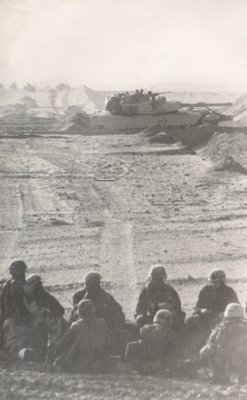
 Early morning was spent on "The Berm"
for Stand-To.
Early morning was spent on "The Berm"
for Stand-To.VII Corps in action
The Jayhawk Corps' desert experience began Nov. 8 when President George Bush announced that he was sending European and stateside based troops to Saudi Arabia to give coalition forces an offensive capability. VII Corps in Desert Shield would be made up of active and Reserve component soldiers and units based in Europe and the United States. Before corps units could deploy to the Middle East they needed to perform several tasks. They had to load hundreds of trains, ships and airplanes with thousands of tanks, armored personnel carriers, trucks and other weapons of war. They needed to adapt proven warfighting skills to the desert and the new mission. And they needed to adjust to the thought of going into combat.
Developing plans
A quick leaders recon to Saudi Arabia on Nov. 10 set VII Corps' planning in motion. While leaders developed plans for the deployment and for caring for families left behind, soldiers dug in with enthusiasm. Faced with a certain threat and a cause worth fighting for, soldiers steeled themselves for the uncertain months ahead.
Within four days the 2nd Armored Cavalry Regiment, which had patrolled West Germany's border with the east for more than 45 years, began loading for the quick voyage from Germany to Saudi Arabia. At the same time, the corps' support soldiers began assembling the commo, transport and life-support systems needed to carry the war to the enemy.
The deployment continues
The deployment continued at a fast pace. The first soldiers flew to Saudi ports, linked up with their equipment, and moved to the desert. The 2nd ACR took up screening positions in the northern part of what later became the VII Corps' initial sector, establishing security for the many soldiers yet to come. Signal soldiers set up communications systems ranging from ultramodern satellite and mobile-telephone systems to time-tested land lines.
Early morning was spent on "The Berm"
for Stand-To.
Engineers brought their heavy equipment to the desert to carve out defensive positions, roads and airstrips from the barren land. Mechanics, truck drivers and cooks set the stage for the bulk of the combat troops.
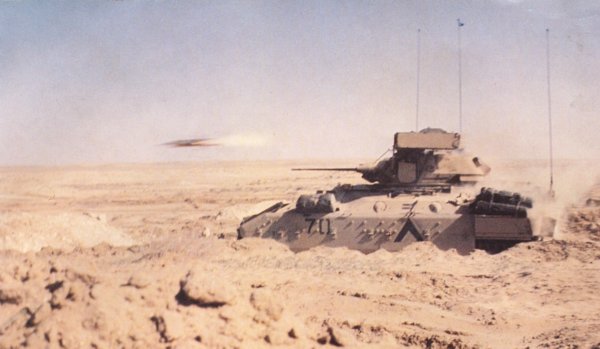
M2A2 BFV Firing TOW missile
Forming the corps
While waiting for their turn to deploy, the heavy divisions that gave the corps its striking power continued training while getting their equipment and themselves ready for war. Tankers and Bradley crews fired crew-level gunnery at Grafenwoehr and used simulators at their home bases. They trained with chemical equipment, rifles and other weapons. They learned about the hazards and customs of a new land. Doctors poked them and prodded them, lawyers wrote their wills and leaders drove them around the clock.
Many soldiers faced the additional challenge of learning to work with new faces. Force reductions in Europe and others factors combined to lead planners to assemble complete divisions from battalions and brigades from throughout the United States and Germany.
Corps-level combat support and service support units also carried a mix of active and Reserve component units under a single headquarters. For example, MPs from three active brigade and two Reserve component battalions deployed under the corps' own 14th MP Brigade headquarters. The 2nd Corps Support Command swelled from its peacetime strength of nearly 8,000 to more than 25,000.
Troop arrivals jumped from a trickle to a flood as December ticked away. More than 1,000 troops from VII Corps' inactivating 1st Infantry Division (Forward) deployed as a port support activity receiving soldiers and equipment off planes and ships. They sweated through providing shelter for a population that soon reached 30,000 and moved units out to the desert to make way for later arrivals.
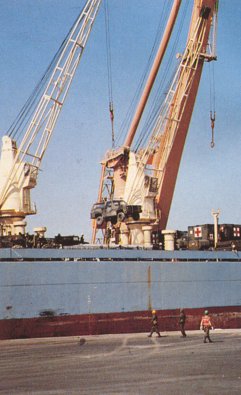
CUCV Being unloaded from Ship
Life in the port
Deploying VII Corps soldiers flew into airports near the ports of Al Jubayl and Dammam. They stayed in warehouses and tent cities while waiting for their ships to come in. On arrival, they painted combat vehicles a light tan to match the monotonous hues of the barren desert.
Deployment from Germany to Saudi Arabia was a monumental new challenge for VII Corps. The move to air and sea ports from Germany alone involved 465 trains, 312 barges and 119 convoys. All told, the Jayhawk Corps needed 578 aircraft and 140 ships to complete the strategic move. In addition to more than 100,000 active Army soldiers, VII Corps also eventually commanded 21,000 Army National Guard and Reserve personnel, and 24,000 British soldiers.
By mid-January tens of thousands of soldiers had married up with their equipment. The next step saw tanks, artillery and other "tracks" loaded on heavy equipment transports, with soldiers and baggage following in buses for the 300-plus mile convoy to VII Corps desert assembly areas. The long trip along Tapline Road introduced troops to the desert.
The deployment gave soldiers the chance to put long years of training to use and pick up new skills, too. Two brigades of tankers of the 1st Infantry Division from Fort Riley, Kan. turned in their 105mm-equipped Abrams M1 tanks for the 120mm-gunned M1A1 version. American soldiers put new German-built "Fox" chemical-reconnaissance vehicles through their paces. Hundreds of drivers turned in used tactical vehicles for brand-new "Humvees" more capable of handling the harsh desert conditions.
Soldiers sharpened their weapons skills at firing ranges throughout the desert. Other soldiers straight from the AIT gunnery ranges of Fort Sill fired more practice rounds in the weeks before battle than they would in a year of training at Grafenwoehr.
Aviators, guarding their helicopters from the harsh climate, nonetheless flew combat formations flying and firing everything from rockets to Hellfire missiles. Infantrymen, more accustomed to firing their weapons than most, found endless chances to fire, use demo and tear up targets with their Bradleys' 25mm chain guns.
Planning for the future
But, while the soldiers welcomed the new equipment and live-fire exercises, they had yet to come to grips with the human side of going to war. Many NCOs and officers had combat experience in Vietnam, Grenada or Panama. They used their experience gained under fire to come up with training that allowed their charges the best chance to make it through the imminent war with the fewest casualties.
The Jan. 17 start of the air war sent a signal to the world in general, and Saddam Hussein in particular, that the United States and her coalition partners meant business. It also told soldiers that their time for battle was that much nearer. While the world hoped the massive air campaign would bring Hussein to his senses and he would pull out from Kuwait, corps soldiers continued to train and assemble combat power.
SCUD attacks begin
As Iraq responded to its loss of control of its airspace with SCUD missile attacks on civilians, soldiers donned chemical protective clothing and filled sandbags to build bunkers. They waited and continued to train in their assembly areas while their leaders refined the final tactics for the battle plan.
As the air war continued, leaders and planners fine-tuned the scheme of maneuver and prepared their units for the upcoming battle. Following their strategic bombing of command centers and manufacturing facilities, coalition air forces concentrated on Iraqi troop positions and armor concentrations which further weakened the enemy's resolve. This saved countless lives when the ground war began.
In early February, the corps' deployment had nearly ended. In addition to welcoming the continuing flow of soldiers new to Saudi Arabia, the corps secretly took the British 1st Armoured Division and the 1st Cavalry Division under its tactical umbrella. The British pulled out of the sector they held in eastern Saudi Arabia and headed west. The 1st Cav. continued the defense of the Wadi Al Batin area north of the city of Hafar Al Batin, a mission they had since January. This began what would become known as the battle of Rugi Pocket.
The VII Corps battle plan was to envelop the more formidable Iraqi defenses in western Kuwait by crossing into southern Iraq far west of the Wadi Al Batin. Critical to the plan was making Iraqi forces believe the corps would attack through the wadi. The 1st Cavalry Division and Corps Artillery units had the job of making this deception credible. To ensure the deception worked, VII Corps waited until only days before the beginning of the ground offensive before rapidly shifting its divisions yet another 60 to 160 kilometers farther west to forward assembly areas. During the move they used the same battle formations they would use during the actual attack. Slowly, under the cover of the 1st Cav., the corps' positioning for the battle began to take shape
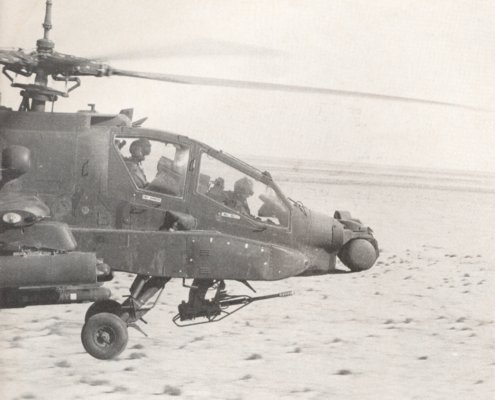
AH-64 Apache (Tank Killer) On Patrol.
Cross- border raids
In the middle of February, the 1st Cav. began a series of cross-border raids, and air and artillery attacks near the point where Iraq, Kuwait and Saudi Arabia meet. These attacks accomplished three main objectives.
First, artillery soldiers gained valuable experience firing under combat conditions. The VII Corps Artillery was able to spread the combat experience to many soldiers by rotating units through the area.
Second, since the attacks gave the Iraqis the impression that a ground attack would center on the Wadi al Batin, they entrenched a number of their infantry and armor divisions on the border of Iraq and Kuwait.
Finally, corps intelligence experts had a chance to develop their own picture of Iraqi intentions and morale. This built a sense of confidence in the chances for a swift success. The valuable lessons learned from these attacks were shared throughout the corps.
After the corps moved to forward assembly areas, the 1st Infantry Division began its own series of probes and artillery raids west of the 1st Cav. area.
On Feb. 15, Baghdad Radio announced Iraq was willing to withdraw unconditionally from Kuwait-provided the coalition granted certain conditions. This "cruel hoax," as President Bush called it, touched off a round of talks between Iraqi, Soviet and United Nations leadership; talks which most Americans realized held no promise for a peaceful end to the Gulf crisis. Most VII Corps soldiers knew their turn was coming.
Then on Feb. 23 the United States issued Hussein an ultimatum-begin to withdraw from Kuwait within 24 hours or face a ground attack. As the deadline ticked away, VII Corps soldiers headed for the border, poised to finally attack. Saddam Hussein's "Mother of All Battles" moved towards the stage.
Setting the stage
By now, the corps was in position, ready for action. The 1st Cav. began conducting a series of artillery raids and feints on the right, pinning down four Iraqi divisions. The 1st ID, in the center, moved toward its first-day objective, clearing a path to the main Iraqi defenses 10 miles north of the eight-foot dirt berm marking the Saudi Arabia-Iraq border. On the left, the 2nd ACR, which already had swept 30 kilometers north the day before, prepared to strike north and east, searching for enemy forces.
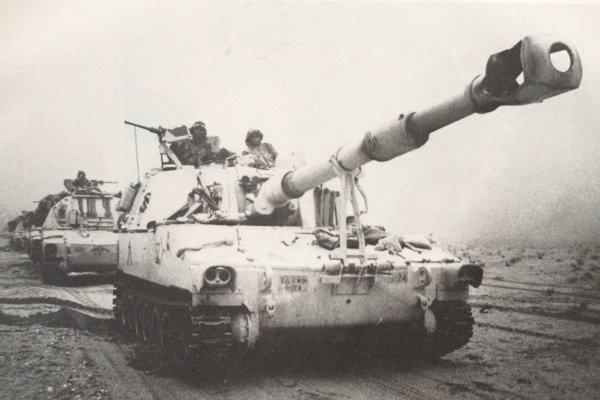
M109 (155mm self propelled) Howitzer with ammo carrier FASV.
The attack met an Iraqi force deployed in depth. The enemy had infantry units in the front, backed up by two levels of armored reserves. The Iraqi 7th Corps faced VII Corps' eastern sector with four infantry divisions on line backed by a single armored division. Two more infantry divisions had dug in further west.
Next in depth came the Jihad Corps, made up of two more regular armored divisions. Further north the Republican Guard waited in reserve. The main thrust of the VII Corps offensive aimed at destroying these supposedly elite formations, the best in the Iraqi army.
Surprised enemy
The Iraqis were not capable of meeting a modem army able to maneuver rapidly and attack them in depth. Many Iraqis threw down their arms as soon as there was ground combat, but others stayed and fought. The intense air and artillery bombardment left Iraqi communications in shambles, and air strikes made it difficult for Iraqi reserves to reach the battle. By the start of the Feb. 24 ground offensive, most Iraqi line infantry divisions had seen severe attrition. Their mechanized and armored formations proved stronger.