[home] [about me] [IIUM] [KULLIYYAH OF SCIENCE] [KOS1110] [assignment] [contact] [animations] [my friends] [islam and science] [acknowledgement]
"And your Lord taught the honey bee to build its cells in hills, on trees, and in (men's) habitations; Then to eat of all the produce (of the earth), and find with skill the spacious paths of its Lord: there issues from within their bodies a drink of varying colours, wherein is healing for men: verily in this is a Sign for those who give thought. (Surah an-Nahl (The Bee), 68-69)
The
lives of bees in the hive and their honey production have very interesting
contents. The bee, after discovering any new garden or flower, goes back and
tells its fellow bees the exact direction and map to get there, which is known
as ‘bee dance’. The meanings of this insect’s movements are expression
used to tell other bees the location of the flowers. This dance repeated many
times by the bee, includes all the information about the inclination, direction,
distance and other details of the food source that enable other bees to reach
it.The dance is actually an "8" figure constantly repeated by the bee.
The bee forms the middle part of the figure "8" by shaking its tail
and making zig zags. The angle between the zig zags and the line between the sun
and the hive, gives the exact direction of the food source. The
Qur’an mentions in the above verse how the bee finds with skill the spacious
paths of its Lord.
The
worker bee or the soldier bee is a female bee. In
Surah Al-Nahl chapter no. 16, verses 68 and 69 the gender used for the bee is
the female gender (fa’slukî
and kulî), indicating that the bee that leaves its home for
gathering
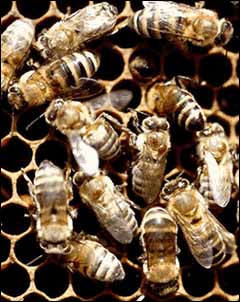
The infrastructure of the nest, the perfectly uniform and functional comb, is composed of beeswax and is constructed into a repeating series of almost perfect hexagonal cells. The comb is the stage for the activity of the colony and is used for almost everything imaginable, from larval nursery to pantry to message center. It is amazingly that hexagonal structure is the most suitable geometric form for maximum use of unit area. If the honeycomb cells were constructed in another form, then there would be areas left out of use; thus less honey would be stored, and fewer bees would be able to benefit from it. Hexagonal cell requires minimum amount of wax for construction while it stores maximum amount of honey. This result, obtained after many complex geometrical calculations, which cannot be calculated by bees themselves. These tiny animals use the hexagon form innately, just because they are "taught" and inspired so by their Lord. The hexagonal design of the cells is practical in many aspects. Cells fit to each other and they share each other's walls. This, again, ensures maximum storage with minimum wax. Although the walls of the cells are rather thin, they are strong enough to sustain a few times of their own weight.
Honey has healing properties. Honey is composed of sugars like glucose and fructose and minerals like magnesium, potassium, calcium, sodium chlorine, sulfur, iron and phosphate. It includes B1, B2, C, B6, B5 and B3 vitamins changing according to the qualities of nectar and pollen sources. Besides, copper, iodine, iron and zinc also exist in it but in small quantities. Also, several kinds of hormones are also present in its content. Honey is produced in much higher amounts than the requirement of the bees, is made for the benefit of man.
Royal
jelly is a substance produced by worker bees inside the beehive. Inside this
nutritious substance, there exist sugar, proteins, fats and many vitamins. It is
used in problems, which occur as a result of tissue deficiency or body frailty.
Honey had antibacterial and antifungal properties in which undiluted honey inhibits the growth of bacteria such as Staphylococcus
aureus, certain gut pathogens and fungi such as Candida albicans.
At a concentration of 30-50%, honey has been shown to be superior to certain
conventional antibiotics in treating urinary tract infections. The exact
mechanism of the anti-microbial effect of honey remains obscure. Low pH, osmotic
disruption of pathogens and the presence of bactericidal substances,
collectively called inhibine may all play a part. At a concentration of 40%,
honey has a bactericidal effect on various gut bacteria known to cause diarrhoea
and dysentery such as Salmonella, Shigella, enteropathogenic
E. coli and Vibrio cholera. In one study, honey given with oral
rehydration fluid was shown to reduce the duration of bacterial diarrhoea in
infants and children. Besides, honey is of value in treating burns, infected
surgical wounds and decubitus ulcers. Honey is very viscous, enabling it to
absorb water from surrounding inflamed tissue.
☼♀♂ BEES AND THE HIDDEN MIRACLES OF HONEY ☼♀♂
☼♀♂ ANTS' COMMUNICATION SYSTEM ☼♀♂
☼♀♂ THE GNATS' LIFE ☼♀♂