ENGINEERING DEPARTMENT - WARP INFORMATION

| U.S.S. BISMARCK
NCC-1108 B
ENGINEERING DEPARTMENT - WARP INFORMATION |
|
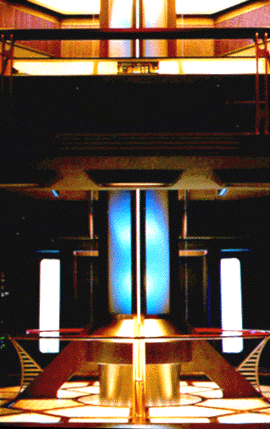
WARP
DRIVE INFORMATION
For the future, many developments are possible. Over a century since it was first envisaged, transwarp drive remains seemingly just beyond the reach of Federation science. Other lines of research involve co-axial warp cores, which allow instantaneous travel over sizeable distances, and slipstream technology, which could theoretically allow travel at hundreds of light years per second. If this latter technology ever came to pass, it would make travel on an intergalactic scale easily feasible. On the other hand, the idea of generating stable artificial wormholes for interstellar travel is also being researched and if successful this may render warp drive totally obsolete.
Matter/Anti
Matter Pods
There are two distinct fuel
storage systems on board any starship; the matter storage is generally
a single large fuel tank holding a large amount of slush Deuterium - in
the case of the Galaxy class there is 62,500 m3 of actual Deuterium within
63,200 m3 of tankage space - the rest being accounted for by internal
compartmentalisation of the fuel tank. The ship thus carries 12,500 metric
tons of fuel, sufficient for a mission period of three years assuming normal
use of warp and impulse drive, orbiting of planets, etc.
The antimatter is contained within much smaller pods; the standard starship antimatter pod is capable of holding 100 m3 of fuel for a total of 3,000 m3 in a Galaxy class Starship. Starfleet is somewhat reticent about revealing exactly how much antimatter is kept on board its starships, as this would allow threat forces to make detailed estimates of the total output of a ships power systems. It is known that the antimatter used in the Galaxy class is antihydrogen, and that it is kept stored within magnetic fields. In the event of a systems failure which threatens antimatter containment, the pods can be thrown clear of the ship by emergency systems of considerable reliability.
Reactant
Injections
Fuel from the pods is sent
to the reactant injectors; these are designed to condition and feed streams
of matter and antimatter into the warp core. The matter reactant injector
is located at the top of the warp core; it is a conical structure some
5.2 metres in diameter and 6.3 metres high. The injector is constructed
of dispersion strengthened woznium carbmolybdenide. Shock attenuation cylinders
connect it to the deuterium fuel tank and the skeletal structure of the
ship, allowing it to 'float' free within the structure.
Within Starfleet vessels, the MRI contains redundant sets of crossfed injectors. Each injector would consists of a twin deuterium manifold, fuel conditioner, fusion pre-burner, magnetic quench block, transfer duct/gas combiner, nozzle head, and related control hardware. Other designs are in use by civilian craft and other species. Although operation varies from class to class, in general slush deuterium enters the inlet manifolds and is passed to the conditioners where heat is removed. This brings the deuterium to just above solid transition point; micropellets are formed and then pre-burned by a magnetic pinch fusion system. The fuel is them sent on to a gas combiner where it reaches a temperature in the region of 106 K. Nozzle heads then focus the gas streams and send them down into the constriction segments.
Starfleet safety protocols require that should any nozzle fail, the combiner can continue to supply the remaining nozzles which would dialate to accommodate the increased fuel flow. The present generation of nozzles are constructed of frumium-copper-yttrium 2343.
The antimatter injector lies at the lower end of the warp core. Its internal design is distinctly different from that of the matter injector owing to the dangerous nature of antimatter fuel; every step in manipulating the antihydrogen must use magnetic to keep the material from physically touching any part of the structure. In some ways the ARI is a simpler device requiring fewer moving components. It uses the same basic structural housing and shock attenuation as the matter system, with adaptations for magnetic suspension fuel tunnels. The structure contains three pulsed antimatter gas flow separators; these serve to break up the incoming antihydrogen into small manageable packets and send them up into the constriction segments. Each flow separator leads to an injector nozzle and each nozzle cycles open in response to computer control signals. Nozzle firing can follow highly complicated sequences resulting from the varying demands of reaction pressures and temperatures and desired power output, amongst other factors.
Magnetic Constrictors
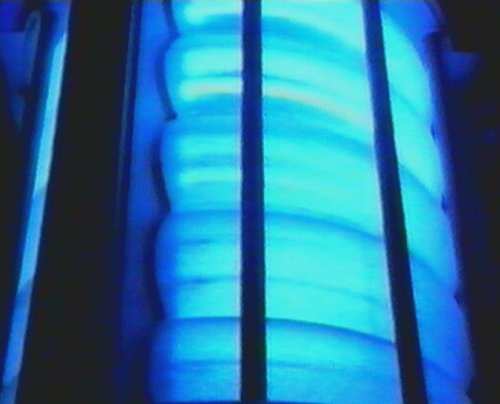 |
The magnetic constrictors
make up the bulk of the warp core. They provide physical support to the
reaction chamber, pressure containment for the whole core and, most importantly,
guide and align the fuel flow onto the desired location within the reaction
chamber.
The matter constrictor is typically longer than the antimatter constrictor, as antimatter is easier to focus and so requires a shorter distance for the same accuracy. Typically, the magnetic constrictors are divided into segments; each segment will contain several sets of tension frame members, a toroidal pressure vessel wall, several sets of magnetic constrictor coils and related power and control hardware. Constrictor coils will have dozens of active elements, and on more advanced designs these will be configures to contain the magnetic field almost wholly within the constrictor, with minimum spillage into the exterior environment. Starfleet warp cores usually have the outermost layers of the constrictors constructed of a semi-transparent layer which allows harmless secondary photons to escape from the inner layers, creating a glow effect. This gives an immediate visual cue to the current activity rates within the warp core. As the fuel is released from the injector nozzles, the constrictors compress it and increase the velocity considerably. This ensures the proper collision energy and alignment within the reaction chamber. |
Reaction Chambers
 |
This is in many ways the "heart" of the ship. The principle function of any reaction chamber is to allow the matter and antimatter streams to come together and direct the resultant energy flow into the power transfer conduits. This apparently simple task is rendered highly complex by the need to allow the various sensor and other monitoring and control equipment to function within the chamber. The addition of dilithium to regulate and control the reaction, while allowing far higher efficiency and so increasing the power output, has also lead to ever more complex designs - most especially in more recent starships which are designed to allow continual recompositing of the dilithium whilst in use. Nevertheless, reaction chambers of today perform fundamentally the same task as those of a century ago or more. |
Dilithium Crystals
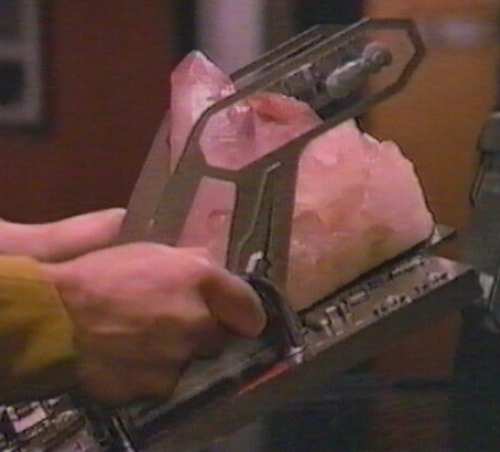 |
Dilithium is a key factor
in the design of any efficient matter / antimatter reactor, and has been
incorporated into Federation Starship designs since it replaced lithium
crystals in 2265.
The key to the success of dilithium lies in the remarkable properties of this material. When subjected to a high frequency electromagnetic field in the megawatt range, dilithium - or 2<5>6 dilithium 2<:> diallosilicate 1:9:1 heptoferranide to give it the full scientific name - becomes completely porous to antimatter. The field dynamo effect created by the iron atoms within the crystalline structure allows antimatter atoms to pass through without actually touching it; it is thus the only known substance which does not react to the antimatter fuel commonly used in Starships. Dilithium can thus be used to mediate the reaction, boosting efficiency. Early reactor designs used naturally occurring dilithium, and considerable time and effort was spent in locating sources of dilithium ore. This led to confrontations between major powers seeking to secure new sources, most especially between the Klingon Empire and the Federation. The Federation was largely successful in these efforts, and the Klingon Empire was forced to expand its mining operations on the few sources it did have access to. Such over mining was a major contributory factor in the catastrophic explosion on Praxis in 2293, which ultimately led to peace between the two powers. Eventually reliance on natural dilithium was reduced after breakthroughs in nuclear epitaxy and antieutectics made it possible to synthesize dilithium for Starship use through theta-matrix compositing techniques utilizing gamma radiation bombardment. However, refining dilithium ore is a procedure which is still viable for Starships which are unable to obtain synthetic dilithium from a Starbase or other manufacturing facility. This is not generally a problem within known space, but USS Voyager has resorted to collecting dilithium ore to aid her in the long journey back to the Federation. |
Power Transfer Conduits
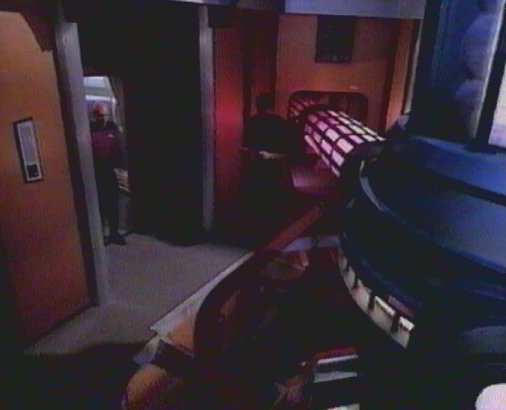 |
The power transfer conduits
are similar in nature to the magnetic constrictors of the warp core, in
that they are ducts designed to use high energy magnetic fields to carry
energetic plasma from one point to another. But where the magnetic constrictors
operate only across relatively short distances and require a very high
degree of precision with a comparatively low energy plasma, the PTC's must
carry very energetic plasma across large distances with - relatively speaking
- far less finesse.
Federation starships are equipped with a separate PTC line for each nacelle, a measure which increases resistance to battle damage or other failures. Since most Starships have twin nacelles, two PTC's will typically be arranged to be symmetrical about the ships centreline. These will proceed through the bulk of the engineering hull and along the connecting struts, if any, to the nacelles themselves. Smaller versions of these heavy duty systems are also used to carry power to components such as the phasers, shields, and high energy scientific laboratories. |
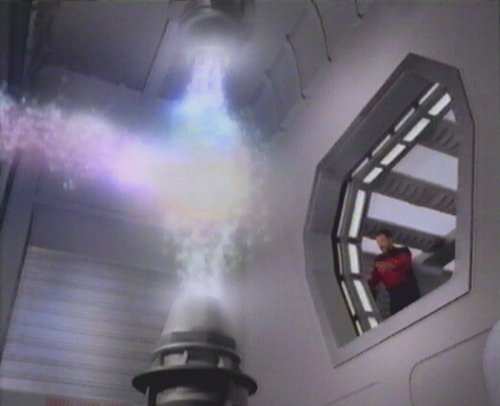 |
At the terminus
of the Power Transfer Conduits are the plasma injectors. One of these devices
is fitted in each nacelle, and has the task of sending a precisely aimed
plasma flow through the centre of the warp coils.
Because of the relatively low accuracy with which the plasma flow is usually controlled by a PTC, the plasma injector system must often be designed to re-condition the fuel flow in order to dampen down turbulence and so ensure a smooth flow through the warp coils. In many Starfleet designs, most especially those systems with the highest raw power output, the plasma flow from the PTC is split into two parts and sent through swirl dampers before being recombined during the injection process. Long experience has found that this method reduces the size of the required hardware to a reasonable minimum. |
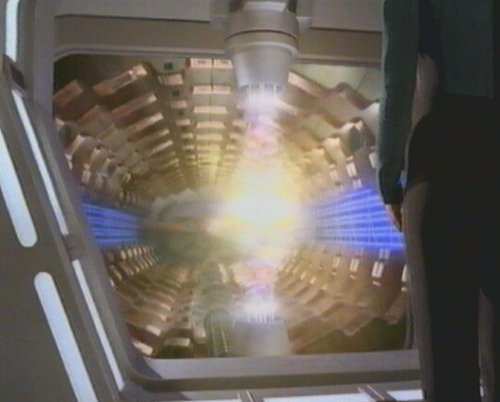 |
After its long
journey from the fuel systems, the flow is finally directed down the warp
coils. These devices are large split toroids which take up the bulk of
the nacelle. In order to increase efficiency they are usually made from
multiple layers of various materials; this complicates the manufacturing
processes greatly and has - so far - kept the replication of warp coils
beyond Federation science.
The warp coils generate a multi-layered set of fields around the craft, creating the propulsive forces that enable a Starship to travel beyond light speed. Manipulation of the shape and size of the field determines the velocity, acceleration and direction of the vessel. |
WARP
SPEED CHART
The original
"Cochrane Scale" was devised by the great man himself for his first test
flight aboard the USS Phoenix. It was a relatively straightforward scale
which followed the formula:
The Terrance-Neltorr Graduated Scale was first suggested in 2298 by two civilian warp field specialists of those names. On the current scale the warp factor is indicative of the subspace stress levels which the vessel must both create and endure, rather than the actual velocity of the vessel itself. The actual speed denoted by any given warp factor would depend upon the precise conditions prevalent at the time. So a Captain using the current scale would be able to order Warp 7 while in space, a solar system, or an Ion storm and be assured that he would not be over stressing his engines. The new scale was also tweaked to accommodate a number of technical advances made over the last century and in development at the time. Starfleet conducted a quick assessment of several possible new warp scales between 2310 and 2311 before formally adopting the current scale, with the changeover made in 2312.
For ideal conditions, such as are found in interstellar space, the speeds of warp factors are calculated using either of two formulae :
Up to Warp 9 :
V/c = WF(10/3)
Which is very similar to the Cochrane Scale. Beyond Warp 9 the formula becomes somewhat more complex. It is best approximated by :
V/c = WF[{(10/3)+a*(-Ln(10-WF))^n}+f1*((WF-9)^5)+f2*((WF-9)^11)]
Where
a is the subspace field density, n is the electromagnetic flux, and f1
and f2 are the Cochrane refraction and reflection indexes respectively.
Under ideal conditions values of a = 0.00264320, n = 2.87926700, f1 = 0.06274120
and f2 = 0.32574600 can be expected within a "normal" area of deep interstellar
space. The values for TNG warp speeds under these conditions are shown
below, along with travel times across typical distances
|
|
|
|
|
|
|
||||
| Speed | km/h | X's speed of light | 400,000 km | 12 million km | 5 light years | 20 light years | 10,000 light years | 2,000,000 light years | Notes: |
| Standard Orbit | 9600 | less than 0.00001 | 42 hours | 142 years | 558,335 years | 2 million years | 1.12 billion years | 223.33 billion years | Synchronus orbit around Class M planet |
| Full Impulse | 270 million | 0.25 sublight | 5.38 sec. | 44 hrs. | 20 years | 80 years | 40,000 years | 8,000,000 years | Normal maximum impulse speed |
| Warp 1 | 1078 million | 1 | 1.34 sec. | 11 hrs. | 5 years | 20 years | 10,000 years | 2,000,000 years | Warp 1 = Speed of Light |
| Warp 2 | 11 billion | 10 | 0.13 sec. | 1 hr. | 6 months | 3 years | 992 years | 198,425 years | N/A |
| Warp 3 | 42 billion | 39 | 0.03 sec. | 17 mins. | 2 months | 1 year | 257 years | 51,360 years | N/A |
| Warp 4 | 109 billion | 102 | 0.013237 sec. | 7 mins. | 18 days | 2 months | 98 years | 19,686 years | N/A |
| Warp 5 | 230 billion | 214 | 0.006291 sec. | 3 mins. | 9 days | 1 month | 47 years | 9,357 years | New cruising speed |
| Warp 6 | 423 billion | 392 | 0.003426 sec. | 2 mins. | 5 days | 19 days | 25 years | 5,096 years | Old normal cruising speed |
| Warp 7 | 707 billion | 656 | 0.002049 sec. | 1 min. | 3 days | 11 days | 15 years | 3,048 years | N/A |
| Warp 8 | 1103 trillion | 1,024 | 0.001313 sec. | 39 sec. | 2 days | 7 days | 10 years | 1,953 years | N/A |
| Warp 9 | 1.63 trillion | 1,516 | 0.000886 sec. | 26 sec. | 1 day | 5 days | 7 years | 1,319 years | N/A |
| Warp 9.2 | 1.78 trillion | 1,649 | 0.000815 sec. | 24 sec. | 1 day | 4 days | 6 years | 1,213 years | Old normal maximum speed |
| Warp 9.6 | 2.06 trillion | 1,909 | 0.000704 sec. | 21 sec. | 23 hours | 4 days | 5 years | 1,048 years | Max. rated speed. Can be maintained for 12 hrs. |
| Warp 9.9 | 3.29 trillion | 3,053 | 0.000440 sec. | 13 sec. | 14 hours | 2 days | 3 years | 655 years | Auto-shutdown of engines after 10 min. |
| Warp 9.99 | 8.53 trillion | 7,912 | 0.000169 sec. | 5 sec. | 6 hours | 22 hours | 1 year | 253 years | Nearly Infinite power required |
| Warp 9.9999 | 215 trillion | 199,516 | 0.000006 sec. | 0.2 sec. | 13 min. | 53 min. | 18 days | 10 years | Maximum subspace radio speed (with booster relays) |
| Warp 10 | <infinite> | <infinite> | 0 | 0 | 0 | 0 | 0 | 0 | Warp 10 cannot be reached. Theoretically, at Warp 10 (Infinate Velocity) a vessle and it's occupants would be at all points in the universe simultaneously. |
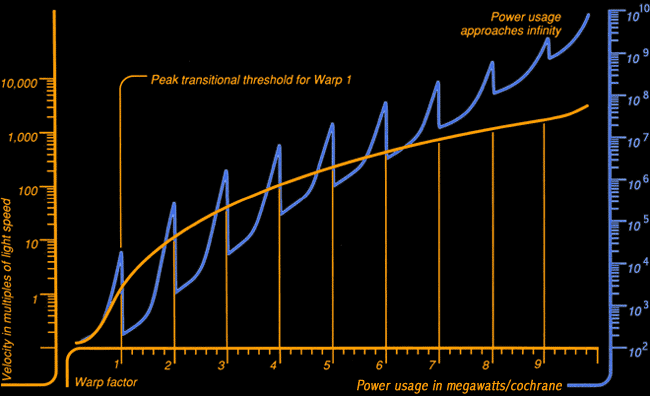
WARP POWER USEAGE
WARP
ANOMOLIES
The effect of a warp highway is to change the speed associated with any given warp factor according a multiplier known as Cochranes Value, which is highly variable from region to region. Shortly after Zephram Cochrane made his first warp flight the SS Valiant was able to use a warp highway, reaching the edge of the galaxy, a distance of some several thousand light years which otherwise would have taken the vessel many years to accomplish at modest warp factors. The most dramatic example of a warp highway is the one which existed between Nimbus III and the galactic core. In 2287 the Enterprise-A travelled this highway at Warp 7, covering the 22,000 light year distance to the core in just 6.8 hours - an average of 3,235 light years per hour. These phenomena are known to exist for a finite period of time; the one between Nimbus III and the Galactic core no longer exists, which is why the USS Voyager is unable to make use of it in her attempts to return from the other side of the galaxy.
Amongst their other properties, highways are notoriously difficult to detect and map - Starfleet has always put considerable effort into locating these regions, carrying out many mapping missions. Voyager has been partially able to overcome this difficulty with the use of advanced Astrometric sensors, which allowed the vessel to detect regions where the Cochrane Value would be slightly higher from many thousands of light years away, enabling the crew to cut five years off their journey time.
Since their discovery, the
warp highways have been a crucial factor in the expansion of the Federation
and other powers. They allow the journey time across known space to be
cut from years or even decades down to a matter of days.
Warp
Shallows
Whilst some regions of space
have a speed multiplier in the tens of thousands, there are also regions
where the value is less than unity. For example, in the region around the
Xendi Sabu system warp speeds are reduced by almost one half - a Cochrane
Value of 0.55. These regions, which are commonly nicknamed 'Warp Shallows',
are generally more common than warp highways and tend to cover a larger
area. Warp shallows can be caused by a variety of phenomena - the Hekaras
corridor is a region of relatively normal space which passes through a
large warp shallow caused by unusually intense tetryon fields. The Briar
Patch is a warp shallow caused by the unusual metaphasic radiation common
to the region.
Warp
Sandbars
Subspace Sandbars are a
phenomenon which prevents a vessel using warp drive at all within a given
region - essentially, a region with a Cochrane factor of zero. These regions
are, fortunately, very rare.
