| U.S.S.
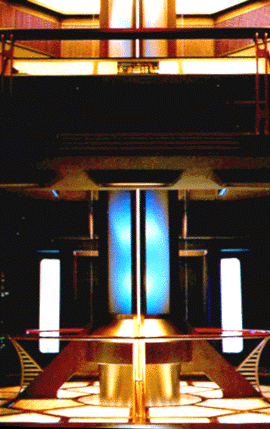
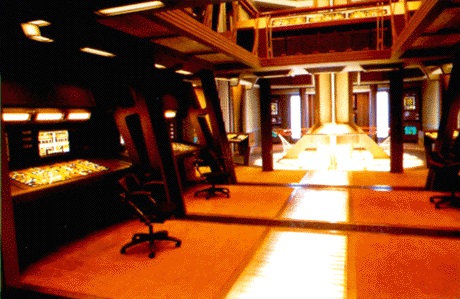
BISMARCK NCC-1108B
ENGINEERING - DECKS 10 & 11 |
 |
| U.S.S.
BISMARCK NCC-1108B
ENGINEERING - DECKS 10 & 11 |
|
 |
 |
|
|
|
SHIP'S
SPECIFICATIONS
| Designated Name | United Star Ship Bismarck (B). [U.S.S. Bismarck B] |
| Naval Construction Code / Registry | NCC - 1108 B. |
| Design Class | Intrepid Class. |
| Classification | Scout / Explorer. |
| Constructed | Antares Fleet Yards. Antares IV. |
| Number of Decks | 24 and 4 habitat |
| Accomodation | 500 Officers and Crew |
| Evacuation Limit | 4,500 Persons |
| Length | 464.43 meters. |
| Beam | 316.67 meters. |
| Height | 87.43 meters. |
| Mass | 3,055,00 metric tonnes. |
| Powerplant / Performance | M/AM RA Mk III. Warp 9.8 for 12 hours. |
| Armament | 6 Type X Phaser Emitters. 4 Torpeedo Launcers (Photon & Quantum). |
GENERAL
LAYOUT
DECK
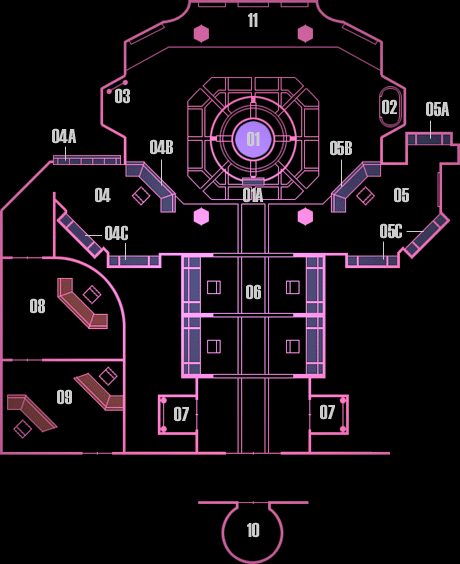
11 - LOWER ENGINEERING
 |
|
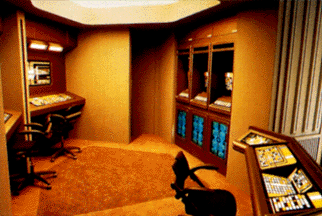 |
 |
|
|
|
DECK
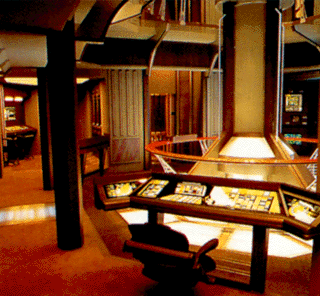
10 - UPPER ENGINEERING
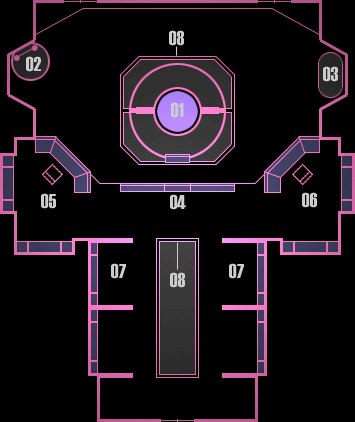 |
|
U.S.S.
BISMARCK - GENERAL EXTERIOR VIEW
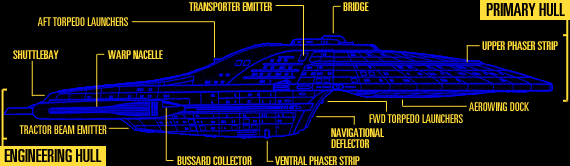 |
ENHANCED WARP NACELLE SYSTEM
VARIABLE
GEOMETRY WARP NACELLES
Intrepid class starships employ
a folding wind-and-nacelle configuration that no longer have a negative
impact on subspace. Incorporating a device called a quantum charge reversal
device, or anti-matter generator, provides the power necessary to run the
warp eninges. The anti-matter reaction is "tuned" through the dilithium
chamber containing a theta-matrix compositing system which is used to recrystallize
"used" dilithium.
IMPULSE
ENGINES
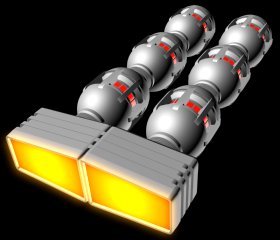 |
The impulse drive
is powered by a series of fusion reactors located in both aft wings on
Deck 11. Another set of fusion reactors provides auxiallary power to keep
systems operational when both the warp drive and impulse reactors are off-line.
The impulse fusion reactors are fueled by frozen hydrogen, also called
deuterium. The main driver assembly consists of two YPS 8020fusion drive
motors equipped with subspace driver accelerators. Acceleratorfield output
is rated at 190 millicochranes at 10,200,000 K. Maximum rated velocity
is 0.90c, Normal impulse operations are restricted to 0.25c due to relativistic
considerations.
FOR FURTHUR INFORMATION - SEE:
|
WARP CORE
 |
The primary warpcore
is located on decks six through twelve in Main Engineering. As powerful
as the main engines on board the Intrepid class starship, the Bismarck
can produce warp fields of equal magnitude, without the need for a variable
nacelle configuration. This is possible because of the relatively thin
profile of the Bismarck allowing for greater Z-axis warp field compression.
This has the benefit of creating a very stable warp field at a lower power
level than other current starship designs.
The Intrepid Class has a 6th phase dilithium controlled matter/antimatter reactor providing primary systems power. Sustainable field output is rated to exceed 1,256 cochranes with a peak transitional surge reserve exceeding 4,634% of nominal output. (165 ns phase) Sustainable cruise velocity of warp factor 8.5 Emergency warp factor 9.75 for significant sustainable periods. FOR FURTHUR INFORMATION - SEE:
|
REACTION CONTROLL THRUSTERS
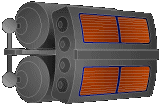 |
There are 24 Reaction Control
Thrusters (18 for normal flight operations, 6 specifically used in atmospheric
flight mode) that are strategically located along the hull to provide low
velocity attitude and transitional control. Primary RCS operations entail
station keeping, three-axis stabilization, and spacedock maneuvering.
Each thruster is equipped
with a supply of deuterium, as well as a refill connection tothe main deuterium
storage tank located on decks five and six. The reaction control thrusters
are rated at a maximum 5.5 million newtons thrust, with an expected operational
life of 400,000 firings.
|
BIO-NEURAL
CIRCUITRY
| The Bio-Neural Circuitry is an integral part of the Voyager's computer core. It consists of bio-neural gelpacks, replacing some of the traditional circuitry. The gelpacks are packets of bioneural cells. These help to organize information more efficiently, as well as speed up response time. The Intrepid-class typically carries 96 replacement gelpacks. |
LANDING
TECHNOLOGY
| The Bismarck has the capability to land on a planet, something that no starships, not even USS Enterprise, have been able to do before. There is landing gear at the bottom of the ship, and the Primary Hull is held up by a low-intensity tractor beam. |
AEROWING
SHUTTLE
| The bottom of the Primary Hull, or saucer, holds a single aerodynamic shuttle capable of atmospheric travel as well as interplanetary flight at speeds up to Warp 3. The AeroWing can carry various combinations of crew and cargo; the usual flight complement numbers four crewmembers. |
DECK
BREAKDOWN
| Deck | Primary Hull | Deck | Engineering Hull |
| 01 | Bridge, Ready Room, Conference Room, Escape Pod Access, Aft Bridge Airlock, Upper Sensor Platform | 01 |
|
| 02 | Officer's Mess, Officers' and VIP Quarters, Labs and Storage, Sensor Gear, Escape Pod Access | 02 |
|
| 03 | Captain's Quarters, Officers' and VIP Quarters, Photon Torpedo Trackers | 03 |
|
| 04 | Aft Photon Torpedo Launchers, Tranporters 1 & 2, Phaser Maintenance, Sensor Gear, Escape Pod Access | 04 |
|
| 05 | Sickbay, Doctor's Office, Sensor Gear, Escape Pod Access | 05 |
|
| 06 | Aux Deflector, Aux Computer Core, Escape Pod Access | 06 | Deuterium (Matter) Processing, Comsumables Resupply Connectors |
| 07 | Aux. Computer Core, Upper Cargo Bays 1 & 2, Labs, Escape Pod Access, RCS Thruster Access, '7 Forward' Lounge, Security Office and Brig | 07 | 7 Deuterium Tankage, Warp Engine Core Injector Access |
| 08 | Deuterium Processing, Port/Starboard/Forward Docking Ports, ODN/EPS Main Trunks, Lower Cargo Bays 1& 2 | 08 | Deuterium Tankage, Warp Engine Core, Aft Work Pod Storage |
| 09 | Cargo Loading Doors, AeroWing Shuttle Dock, Labs | 09 | Upper Main Shuttlebay, Warp Engine Core |
| 10
|
|
10
|
Main Shuttlebay, Main Computer Core, warp Engine Core, Forward Phton Torpedo Launchers, Reserve Warp Engine Core, Main Navigational Deflector, Upper Main Engineering |
| 11
|
|
11
|
"Wing" Level: Main Engineering, Engineer's Office, Warp Engine Core, Reserve Warp Engine Core, Main Computer Core, Main Navigational Deflector |
| 12 |
|
12 | Antimatter Tankage, Warp Engine Core, Main Deflector, Reserve Warp Engine Core, Escape Pod Access |
| 13
|
|
13
|
Aft Tractor Beam Emitter, Warp Engine Core, Reserve Warp Engine Core, Quarters, Labs, Escape Pod Access, Secondary ODN/EPS Trunks |
| 14 |
|
14 | Antimatter Processing, Reserve Warp Engine Core, Escape Pod Access, Ground Hover Footpad Systems |
| 15 |
|
15 | Antimatter Loading Port, Forward Tractor Beam Emitter, Ground Hover Footpads |

