
Aviation.
This is an aviation tutorial that was compiled by two people: Birya and d3nA. It is meant to give people the actuality occurring in a craft that sustains flight in air. Click here to download printer friendly version.
Principles of flight.
LIFT.
An aircraft is a human created machine that sustains flight. An aircraft generates its lift from pressure differential over and below the wing. In a moving aircraft, the top part of the wing has less pressure than the bottom part of the wing; this is the principle that is used to generate lift. All this was brought about by the great Bernoulli’s principle.
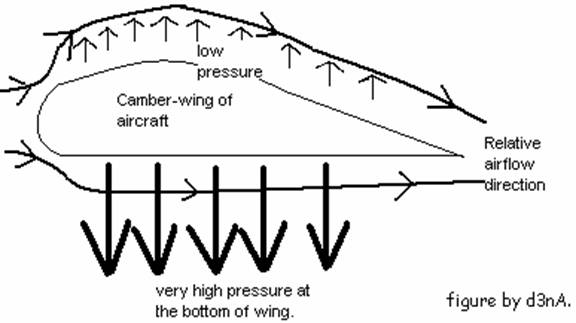
(click here if figure does not open...to open it manually)
As the moving air breaks through the wing, the top air ends up having a longer distance to travel than the bottom wing; this causes the top wind to travel faster so that it may meet at the end of the wing (Trailing edge) with the bottom wind. The high velocity at the top of the wing, brings about a low pressure while the low velocity below the wing brings about high pressure, hence having the lift occurring. Bernoulli’s principle states that velocity is inversely proportional to pressure.
THRUST.
Thrust is a force that causes an aircraft to move forward at different speeds. The force is normally got from an engine; the engine could a Piston Engine (4-stroke) or a Gas Turbine engine, which is also known as Jet engine. Thrust cases the motion of airflow over and below the wing. In one of my tutorials I will explain how a piston engine and Gas Turbine engine works.
DRAG.
This is a force that acts parallel and opposite to thrust, the causes of drag may be protrusions through the surface of the aircraft e.g. the landing gear causes drug. When flying pilots have to make sure that they have more thrust than Drag at all times with the exception of landing, where more drag is needed.
WEIGHT.
Every object on the earth gets a downward force towards the earth which is known as gravitational force. It surprises me when people say that they weigh 70kg, and in reality weight is never measured in Kilograms; the units of weight are Newton’s, so you actually weight 70 Newton’s and have a mass of 70kg. ([weight] 1kg= 10n [Newton’s]). An aircraft in flight always has an effect of gravity on it; the weight always acts parallel and opposite to the lift in a straight and level flight.
I think that’s enough for now until next time when I will get into more details, if and only if you ask for it (Email me)…I will be happy to help you as much as I could. I hope you enjoyed and understood my first aviation tutorial and if you didn’t understand anything…just hola at me. My email is [email protected] . i’M OuT!! PeAcE!!
=========================================================================
Have fun as much and whenever as you can. Never let an opportunity pass by for opportunity only knocks once, and you will only notice it’s worthiness at the bream of loosing it. Have Fun and Yet be very very careful…look and (fore) see!!
=========================================================================
Click here to download printer friendly version.
| HomePage | Downloads | Chat | Aviation | Computers @ Jokes |
 Back to
