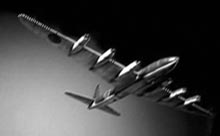
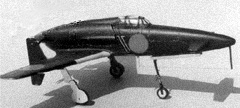
The Akajima Fokoku heavy bomber and the Kyushu Shindin fighter
July 15th 1946
The U.S. declares war on Japan. President Dewey, addressing a joint session of congress, blasts the Japanese as 'savage barbarians of the worst kind' and promises justice, courage,and ultimate victory.
In Germany, Hitler has a decision to make. Join Japan by declaring war on the U.S. or maintainthe status quo of an undeclared war in the Atlantic? Privately, the Führer is enraged that the Japanese have provoked the Americans before he could finish off the Soviets once and for all.
The Alliance, for its part, has been delivered a massive, sharp, shock. They are teetering on the brink in Europe and now the Pacific is aflame. Churchill is on the phone with U.S. President Dewey several minutes after hearing news of the attack on Pearl and De Gaulle follows up not long after.
The governor of Italian East Africa, Commander in Chief of the Italian Armies in Eritrea and Ethiopia, surrenders forces under his command to the British Army in Ethiopia. Mussolini, though disappointed by the loss of his east African possessions,believes that they will be regained after the Alliance is forced to accept Axis terms for an Armistice.
July 17th 1946
Guam falls to Japanese marines. U.S. marines on Wake Island manage to repel the initial under strength Japanese attack there.
Japanese forces land near Singapore and encounter immediate and fierce resistance from British forces in the area.
The USS Hornet(Essex Class), which survived the attack on Pearl because she was in San Francisco, begins steaming west towards Hawaii. Two older carriers and a taskforce of escorts accompany her.
July 18th 1946
Hitler issues a formal statement supporting Japan 'in all her endeavors'; but the statement falls short of joining Japan's new war against the U.S. Hitler has calculated that declaring war on the U.S. isn't in his best interests. After all, the Japanese took their time in joining his wars on the Soviets and later the Alliance. Let the Americans distract themselves in the Pacific while he went about mopping up Europe.
In OTL Hitler declared war on the U.S. at least partly because he thought that Japan would then help him by attacking the Soviets. In the Shattered World timeline Japan has already attacked the Soviets so this motivation isn't there. The general staff and many of his inner circle are also strongly opposed to open war with the U.S. and Hitler has less prestige in the Shattered World timeline and must pay more attention to these opinions. Not to mention that Hitler is angry with Japan for what he views as a premature attack.
July 19th 1946
The same huge taskforce that recently attacked Pearl Harbor has turned north and west in its path back towards Japan. The second phase of Yamamoto's central Pacific campaign is underway.
July 20th 1946
After a week of slow progress 1st panzer army has finally torn a gap in Alliance lines to the east of Kria Vrisi in central Greece. Encouraged by developments Guderian orders his best armored forces to flood this gap in a drive straight for his objective, Ptolemaida. If he can rapidly capture Ptolemaida he could trap a good portion of British forces in Greece as well as nearly a hundred thousand Greek soldiers.
July 21st 1946
British commandoes, supported by the Royal Navy, raid the northwestern Spanish port of La Coruna, setting the harbor ablaze. The raid is a distraction for the real mission - supplying anti-fascist rebels with British and U.S. weapons.
July 22nd 1946
The Japanese invasion of French Indochina is meeting with mixed levels of resistance. The RAF and Free French air force are locked in a death struggle with Japanese aircraft over the region while Japanese infantry and mechanized units penetrate deep into the Free French lines. The Japanese forces are proving to be much superior in the arts of jungle warfare.
To complicate matters, Vietnamese nationalists led by Ho Chi Minh have launched a widespread uprising against the French colonial government.
In North Africa, Italy renews its offensive into the Mareth line. Copying German-style tactics, Italian armor(mostly late model MkIII's) drives into the line at three points supported by massive artillery bombardments. Troops using infiltration tactics move forward across the breadth of the front. The French are equipped with plenty of U.S. and British anti-tank weapons and begin brewing up Italian tanks by the dozens.
July 23rd 1946
Dewey orders one of the Atlantic Fleet's two Essex class carriers, the Lexington, to move to the Pacific theatre along with two older model carriers and numerous support ships. Churchill and Dewey have a heated argument via phone about the reduction in strength of the U.S. Atlantic fleet. The carriers are scheduled to move through the Panama Canal sometime in September, much to the interest of Japanese Intelligence who get word of the scheduled movement.
July 25th 1946
In Greece, Guderian's panzers have reached Ptolemaida. Greek and British forces north of the city begin to withdraw south and west down the Adriatic coast, allowing the stalled Italian offensive in northwestern Greece to resume. In isolated eastern Greece Alliance forces are running desperately short of ammunition and supplies.
July 26th 1946
After several days of heavy bombardment from Japanese carrier aircraft and warships - Japanese marines land on Midway, at both Sand Island and East Island, and become heavily engaged with U.S. marines on both islands. Japanese air attacks have destroyed Midway's entire contingent of aircraft.
July 27th 1946
Wake Island falls to Japan after a second, much stronger, landing force overwhelms the U.S. defenders. Reports of atrocities against U.S. prisoners on Guam and Wake further outrage the American people.
Japanese forces invade Hong Kong.
August 1st 1946
Guderian has driven his panzers further south and west and has now linked with Italian forces south of Ptolemaida, thus cutting off some 150,000 Greek and British troops. The 'Kozani Pocket' contains over half of the British forces in Greece.
The new Italian offensive in Tunisia has been a disaster for the Italian army. Well prepared French anti-tank defenses have destroyed roughly 190 Italian tanks and largely blunted the Italian attack. Italy advances no more than 8 kilometers at any point along the front of the attack, but it has succeeded in penetrating the Mareth line at several points.
August 2nd 1946
Japanese forces begin the invasion of the Philippines with a large amphibious landing on Luzon. Philippine and U.S. forces have been preparing for the attack and are well entrenched at all the likely landing spots. By the end of the day Japanese marines are clinging to several narrow beach heads while Japanese warships and aircraft hammer Philippine and U.S. forces further inland. Many Philippine and U.S. aircraft have been destroyed on the ground in earlier raids but those that remain are fighting hard against all odds.
The Philippines are still a U.S. protectorate but have a native defense force of over a hundred thousand soldiers equipped and trained by the U.S. The protectorate status of the Philippines was extended due to the Japanese threat. Also, the Japanese landings on Luzon are supported by amphibious tanks, something the Japanese never had available in OTL.
August 3rd 1946
In the fighting at Midway, the East Island has fallen to Japanese marines. On Sand Island,however, the U.S. marines have dug into the center of the tiny island and are fighting with a tenacious determination. Sand Island will not fall easily. On both islands the U.S. marines managed to heavily damage the airfields in order to deny them to the Japanese for as long as possible.
August 4th 1946
An attempt by Alliance forces in the 'Kozani pocket' to break out to the south are repulsed by German forces. To the south, along a line extending from Arta in the southwest to Elassona in the east, Alliance forces have dug themselves into another well-prepared line of defense. Italian forces have now driven south down the Adriatic coast as far as Preveza where the far western end of the new Alliance defensive line is anchored.
In eastern Greece - Turkish, Bulgarian, and Romanian forces have begun to force breakthroughs into the teetering Greek lines as the Greek supply situation there worsens.
August 6th 1946
In several simultaneous and coordinated attacks - British B-31 bombers (purchased from the U.S.), escorted by long-range fighters, bomb ballistic missile launch facilities in Calais and northern France - damaging or destroying as many as 25% of the launch facilities in the region. This large-scale attack, the latest and most successful in the RAF's campaign against northern France and the Low Countries, will force the Germans to begin seriously beefing up air defenses in this region. It also will temporarily slow the rain of ballistic missiles hitting England.
The B-31 can fly high enough and fast enough to avoid German flak but many are downed by German interceptors despite the ten .50 caliber machineguns mounted by the 'Flying Super Fortress'. Goering quietly begins increasing Luftwaffe funds for the various anti-aircraft missiles under development.
The B-31 mentioned here is very similar to the B-29 of our timeline. It is a larger, more modern, replacement for the B-17. As in OTL it has a pressurized cabin, many .50 caliber machineguns for defense, a very large bomb load, ~5500 mile range, etc. The U.S. is working on an even larger 6 engine propeller bomber named the B-34; it will have almost twice the bomb load of the B-31, over twice the range, mount even more and heavier caliber machineguns, etc - it is envisioned as a intercontinental bomber capable of hitting Europe should Britain fall or capable of hitting Japan from airbases in the western Pacific. The B-34 is similar in overall design to the B-36 of OTL.
August 8th 1946
The Japanese landings on Luzon in the Philippines remain bogged down. Japanese marines have extended their beach heads by as much as half a kilometer at a very heavy price in casualties and Japanese naval air forces are maintaining air superiority over the region. Japanese warships continue to hammer the entrenched U.S. and Philippine defenders.
U.S. submarines have already begun to prowl the waters off Luzon in an effort to choke off the Japanese lines of supply into the landings.
August 12th 1946
Free French resistance in French Indochina collapses under pressure from Japan and Ho Chi Minh's rebels. Much of the remaining French colonial army begins fleeing west into Thailand.
Continued Italian pressure along the Tunisian front has finally caused the Mareth line to crumble. Rather than try to defend every inch of ground, De Gaulle orders his forces to pull back to the next line of defense to the north of Gabes. The Akarit Line is, if anything, a more formidable line of defense than the Mareth line had been.
Also, French troop strength has risen to some 130,000 in the Tunisian theatre as the Free French government has been able to begin to improve road and communication lines from Algiers to the front. Italian forces begin digging themselves into the Mareth line, making it their own defensive line while the Italian leadership decides what to do next.
Meanwhile, an uneasy calm continues to hang across the middle east from the Libyan-Egyptian frontier to divided Persia.
August 13th 1946
First test flight of Japan's new long range heavy bomber, the Akajima G9 Fokoku. This six engine bomber has a range in excess of 7,000 miles and a bomb load of 18,000 pounds. The first series production is set to begin in six months, with the first operational squadron available to the Japanese Air Force by early 1947.
Japan has also begun production of several new aircraft models, including the Kyushu Shindin. This agile little turbo-jet powered fighter uses canards and a sleek swept wing configuration to attain excellent maneuverability and is intended for an interceptor role in defending key installations from bomber attacks. Other new aircraft include an upgraded and enhanced version of the 'zero' fighter used by Japanese Naval aviation and a Japanese version of the latest Stuka bomber model built on license in Japan.
The Shindin fighter actually flew in OTL in August of 1945 but the war ended before they could be produced in numbers. The Akajima G9 Fokoku mentioned here is similar to the planned Akajima G10 Fokoku of OTL but its six engines are only running at around 2,200 HP, not the 3,000+ HP engines that the G10 would have had, thus the G9 of the Shattered World timeline has a smaller range and bombload. Once the Japanese can begin producing 3,000+ HP engines in numbers they can begin to upgrade the Fokoku.
August 16th 1946
The U.S. Army Air Corps establishes the world's first 'Helicopter Squadron'. The helicopters will be used to transport troops, supplies, wounded personnel, etc. Some will be equipped with machine guns and rockets for close air support and recon. Germany is using some helicopters for scouting purposes but hasn't yet produced them in significant numbers.
These helicopters are about as advanced as those in use during the Korean War of OTL.
August 18th 1946
Japanese forces invade the Dutch East Indies and Dutch Borneo. Dutch forces in this region have been bolstered by British troops, including Australian forces.
Japanese forces enter Saigon, completing the occupation of French Indochina.
August 21st 1946
Thailand signs an Alliance with the Japanese Empire making it a member(puppet) of the 'Greater East Asia Co-Prosperity Sphere' and declares war against the Alliance for Democracy. Japanese forces can now move unhindered through Thailand. Free French forces which had been fleeing from French Indochina are now surrounded by Thai military forces to the west and Japanese forces to the east.
August 23rd 1946
The British surrender Hong Kong after the destruction of much of the city by Japanese air and artillery bombardment. Hundreds of thousands of civilians are killed or wounded in the month-long siege.
August 27th 1946
British forces around Singapore withdraw into the city itself, beginning the siege of Singapore. The RAF has been able to maintain air superiority over Singapore and the surrounding area thanks in large part to the squadron of Meteor jet aircraft based there. This has prevented any large scale air attack on the British fleet there.
The Japanese take Rabaul on New Britain in the Solomon Islands and also invade Bougainville, the largest island.
August 28th 1946
The Japanese invade Java in the Dutch East Indies.
August 29th 1946
The remnants of the Free French army in Indochina and Thailand formally surrender to Thai and Japanese forces.
September 5th 1946
Greek forces in isolated eastern Greece, after a long and gallant defense there, surrender to the invading Turkish, Bulgarian and Romanian forces. Eastern Greece is now in Axis hands.
In peninsular western Greece the lines have stabilized as both sides gather their strength for the fighting to come.
September 9th 1946
After a long and bloody defense, the last U.S. marines on Midway are forced to surrender after running out of water. More cases of Japanese atrocities against U.S. prisoners will filter out to add to the growing outrage of the American people.
In Norway another campaign season has come and gone with the Norwegians remaining in the fight. Winter is shutting down operations there and Churchill is already itching for a spring campaign of some sort in that theatre.
September 12th 1946
Japanese forces invade Sumatra in the Dutch East Indies.
The head of the Luftwaffe and the head of the Kriegsmarine were no
friends, far from it. Both believed they led the most prestigious branch
of the Reich's armed forces and they competed as fiercely with each other
as did any two nations at war. But sometimes two enemies can put aside
their differences when they see the means of achieving a greater good.
The Kriegsmarine has submarines. Lots of them. The Luftwaffe has heavy
bombers and successful new anti-ship glide bombs. A group of junior
officers in the Luftwaffe has hatched a scheme which has caught Goering's
imagination. Here was a plan that would gain the Luftwaffe a much needed
boost following the failed bombing efforts over the British Isles. That it
would require cooperation with Dönitz and his Kriegsmarine was a minor
price to pay.
Together, Dönitz and Goering had pitched the plan to Hitler and some of the general staff : The ambush and murder of an allied convoy in the North Atlantic. If the plan worked as designed it could mark the beginning of the end of the war on the Atlantic high seas - a favorable ending for the Reich.
It would require close coordination between submarines, martime recon aircraft and heavy bomber crews. It would push the capabilities of new weapons and sensors to the limits and test the metal of sea and air crews alike. It would require much new training and the development of a whole new style of warfare. Lightning fast and technical, a warfare of radar and guided bombs, of on-the-spot decision making and deadly firepower.
On the eastern shores of the Atlantic Ocean a storm looms on the horizon, a Grey Storm Rising.
Meanwhile, in the Pacific Ocean some five hundred kilometers west of
Panama, the captain of a rather unique submarine stares eastward towards
the rising sun. The Rising Sun - Symbol of Japanese power and stature. The
submarine he was commanding was one of eight such aircraft-carrying I-400
submarines allocated for this mission, each carrying three specialized
torpedo bombers. The crews of those bombers, ready to sacrifice all for
the Emperor, had been training for this mission for well over a year.
Traveling submerged for most of the distance and maintaining strict radio
silence the submarines were now close to their objective. Soon, soon they
could carry out there mission. A mission that could influence the outcome
of the war.
To Be Continued...
Back to Part 35