 |
| rfffffff |
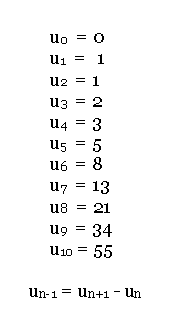
| The Fibonacci numbers form what we call a recurrent sequence. Beginning with 1, each term of the Fibonacci sequence is the sum of the two preceding numbers. 0+1=1 1+1=2 1+2=3 2+3=5 3+5=8 5+8=13 Here is a recurrence relation for the Fibonacci numbers: |
| Fibonacci is perhaps best known for discovering a series of numbers that we now refer to as the Fibonacci numbers. 1, 1, 2, 3, 5, 8, 13, 21, 34, 55, 89, 144, 233,... This sequence was introduced in Fibonacci's first book, Liber abbaci, where it arose in the solution to a mathematical problem: "A certain man put a pair of rabbits in a place surrounded by a wall. How many pairs of rabbits can be produced from that pair in a year if it is supposed that every month each pair begets a new pair from which the second month on becomes productive?" (Liber abbaci, chapter 12, p. 283-4) Solution: At month zero, there is one pair of rabbits. At the beginning of the first month (January 1st), there is one pair of rabbits that has mated, but not yet given birth. At the beginning of the second month, the original pair gives birth, giving rise to another pair of rabbits...and so on. After one full year, there are 377 pairs of rabbits. |
|
| Fibonacci Numbers |
| References: Garland, Trudi Hammel. 1987. Fascinating Fibonaccis: Mystery and Magic in Numbers. Dale Seymour Publications, Palo Alto. 103 pp. Newton, Lynn D. 1987. Fibonacci and Nature: Mathematics investigations for schools. Mathematics in School. 16:5:2-8. http://library.thinkquest.org/27890/splash.html http://pass.maths.org/issue3/fibonacci/#rabbit-answer |
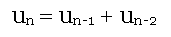 |
| This equation identifies a situation, when n is greater than 2, where each term of a sequence is the sum of the two preceeding terms, as is the case with the Fibonacci series. |
 |
|
 |
 |
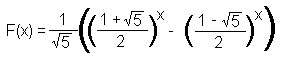
| To find a given Fibonacci number, one must find all of the preceding Fibonacci numbers. As n gets larger, finding the Fibonacci number becomes more difficult. It is possible to express the nth Fibonacci number using an equation. The formula for finding the nth term of the Fibonacci series was discovered by Jacques Philippe Marie Binet, in 1843. Binet Formula: |
 |
| Figure credit: http://library.thinkquest.org/27890/theSeries3.html |
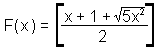
| If the number that directly precedes a Fibonacci number, x, is known, it is possible to determine x without using the Binet formula. By using the Successor formula, we can calculate the "successor" to the term that we know. Successor Formula: |
 |
| Figure credit: http://library.thinkquest.org/27890/theSeries4.html |
| Where F(x) is the Fibonacci number, and x denotes the numerical order of the Fibonacci number. |
| Where x is the value of the Fibonacci number, not the numerical order which it represents in the Binet equation. |
| Try the Successor formula using x=3. Did you get F(3) = 5? I'm confused... |
| It is possible to find the sum of the first 5 Fibonacci numbers for example, by adding each term individually. 1 + 1 + 2 + 3 + 5 = 12 Alternatively, this relationship can be expressed as an equation. This makes it easier to find the aggregate of the first n Fibonacci numbers, especially for large values of n. sum of first n Fibonacci numbers = S(n) = F(n+2) - F(2) for n=5: S(5) = F(5+2) - F(2) = F(7) - F(2) = 13 - 1 = 12 |
|
|
|
 |
| Biography |
| contents |
| contents |
| Jan 1 Feb 1 Mar 1 Apr 1 May 1 Jun 1 Jul 1 Aug 1 Sep 1 Oct 1 Nov 1 Dec 1 Jan 1 |
| 1 pair 2 pairs 3 pairs 5 pairs 8 pairs 13 pairs 21 pairs 34 pairs 55 pairs 89 pairs 144 pairs 233 pairs 377 pairs |
   |
 |