 |
|
| Fibonacci in Art |
 |
| The Golden Ratio may be applied to the sides of a rectangle to form what is known as a Golden Rectangle. It is believed that the most visually pleasing dimensions are found in a rectangle whose length:width ratio is equal to Phi. |
| Picture Credits: Fig. 1 - http://www.tulane.edu/~hughl/Period.Styles/Greece/Parthenon.html Fig. 2,4,5 - http://www.q-net.net.au/~lolita/symmetry.htm Fig. 3 - http://www.goshen.edu/~poakley/Math150/Notes/monalisa.jpg References: Vitruvius. The Ten Books on Architecture. Trans. Morris Hickey Morgan. New York: Dover Publications, Inc., 1960. |
 |
 |
 |
 |
| l |
| w |
| Where l / w = Phi = 1.618... |
| "Symmetry is a proper agreement between the members of the work itself, and relation between the different parts and the whole general scheme..." |
| Vitruvius (De architectura - I, ch. II) |
| Golden Rectangle |
| First constructed by Pythagoras in the 6th Century BCE, Golden Rectangles can be formed easily by using adjacent terms of the Fibonacci series. I don't understand... |
|
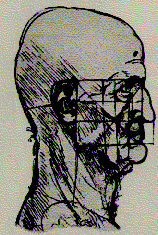
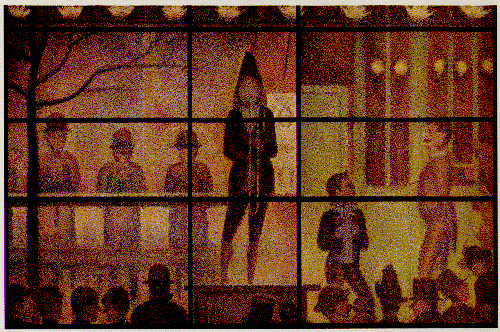
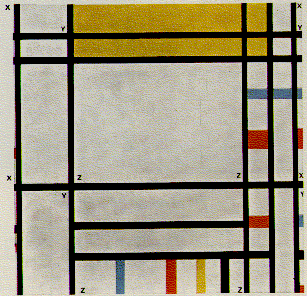
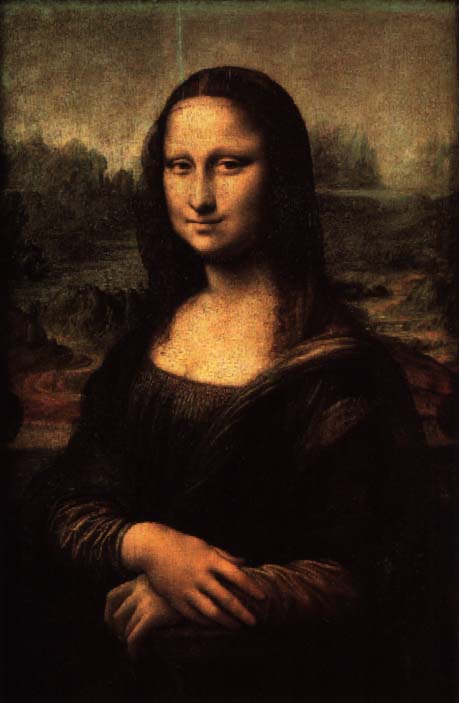
| It is not surprising that the Golden Rectangle, given its aesthetically pleasing proportions, has a ubiquitous presence in art. It can be found in art and architecture of ancient Greece and Rome, in works of the Renaissance period, through to modern art of the 20th Century. The Golden Rectangles present in Figures 1, 2, 4 & 5 are quite obvious. However, various features of the Mona Lisa have Golden proportions, too. Rest your mouse on the Parthenon and the Mona Lisa to see the Golden Rectangles! |
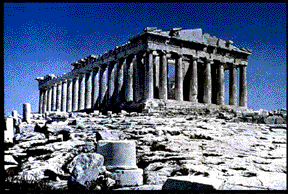 |
| Fig. 1 - The Parthenon, Greece |
| Fig. 2 - Leonardo DaVinci, Sketch of an Old Man |
| Fig. 3 - Leonardo DaVinci, Mona Lisa |
| Fig. 4 - Piet Mondrian, Place de la Concorde |
| Fig. 5 - Georges Seurat, La Parade |
 |
| Fibonacci in Art: The Golden Rectangle |
| The Golden Rectangle |
|
| contents |
 |
| contents |
   |
 |
