|
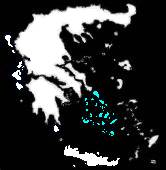
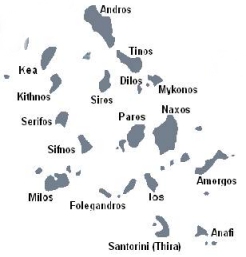
Cyclades are a group of islands east of the Peloponnese and south-east of the coast of Attica. Their name comes from the greek word cyclos because, even though they do not form a perfect circle, they are supposed to form an imaginary circle around the sacret island of Dilos (Delos). The climate is Mediterranean with mild winters and rather cool summers -by the greek standards- thanks to the meltemia, the seasonal winds that blow during late summer.
In these islands, washed by sunshine and breathing the sea breeze, was born one of the most important Mediterranean civilizations, the Cycladic (3000 - 1000 BC). Geologists attribute the peculiar form which the Cyclades take today to a succession of geological upheavals -earthquakes, volcanic eruptions, movements of the earth's crust- which resulted in the submergence of large chunks of land. Many believe that one such strech of land was the lost continent of Atlantis.
The diverse outlines of the islands as they protrude from the blue waters of the Aegean, bathed in the dazzling sunlight and embellished with little white houses, resemble, in the words of the Nobel Prize-winning poet Odysseas Elytis, "stone horses rampant manes". Above all, the people who live there, with their own individual approach to the world, bring to life the narrow alleyways of the villages and the pathways of the countryside, the countless tiny chapels, the windmills, the dovecotes or the wind-beaten hillsides and are themselves a basic feature of the charm which these possess. |
|
Yet, in spite of the characteristics which the islands share -sparkling sea, sun, the landscape and the austere line of the architecture- each retains its own individual features, which visitors can discover as they explore them one by one.
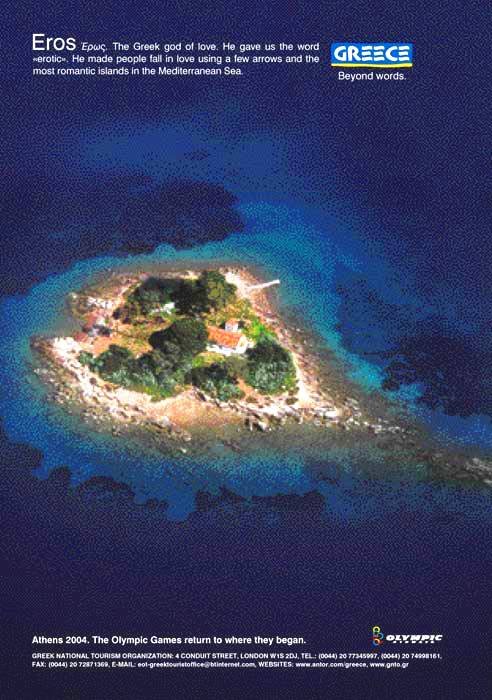
Calm, crystal clear water, bright sky, sun and an austere architecture on nacked rock, the Cyclades are filled with light and sunshine. |