Even though roses are not the easiest plants to propagate, even an inexperienced gardener will be successful if the correct method is used. The easiest roses to propagate from stem cuttings are wild roses, hybrid musks, rugosas, Scotch roses, gallicas, wild ramblers, and floribundas. Don't let this discourage you from trying a hybrid tea or shrub rose, though. I have even successfully started cuttings from the English roses of David Austin. While this article is geared specifically to rose stem cuttings, the method described here can also be applied to perennials.
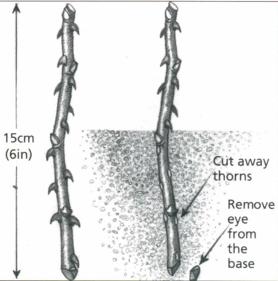
Spring and fall when the plants are the best times to take stem cuttings. Take a stem cutting from new growth that is not yet blooming. Don't take cuttings from wilted plants or from plants that are undernourished or stunted. The ideal stem is soft but vigorous (soft enough to bend, but strong enough to stand upright unsupported). Use sharp secateurs to cut a pencil-thick section of stem about 6 inches long. Cut just above the upper bud and below the lower one. Cut at an angle (the same as you would do when pruning) and remove the thorns from the lower portion that will be underground (about 1 inch). Remove all the foliage except for a few leaves at the top. Also remove the lower bud. See image below.
Dip the "root" end of the cutting in rooting hormone powder. This step is not necessary, but greatly improves the chances that the cutting will successfully root. Rooting hormone powder is available at most garden centers. Place the cutting in a premoistened mixture of sterile potting soil. (A 50/50 mix of peat and perlite is best.) Water the cutting thoroughly, but do not make the soil soggy. Place in propagating tent made by placing clear plastic over wire hoops on top of the flat or pot containing your cutting. Make sure the plastic does not touch the cuttings. See image below.
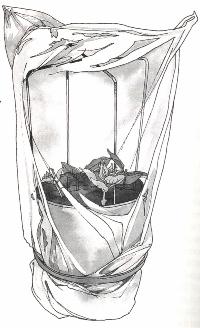
*Quick and easy propagating tent: use a plastic soda bottle that has the bottom cut out. Place over potted cutting and leave the cap off the top to provide ventilation.
Place in a warm (60o - 75oF) environment (not in direct sunlight!) Open the tent once a day to ventilate and help prevent fungal problems. Remove mildewed or dropped leaves. Keep moist, but do not fertilize until rooting has occured. Begin checking for rooting after 10 days by gently tugging on the plants. If you feel resistance, start to give the cutting more ventilation. Begin foliar feeding once growth begins.

� 1998-2002 Rosebriar Gardens
Send comments or suggestions to: [email protected]